
Trousses et réactifs d'immunohistochimie


Invitrogen™ Alexa Fluor™ 488 Kit de tyramide SuperBoost™ , streptavidine

SuperBoost™ L’amplification du signal tyramide est la méthode la plus sensible pour la détection de cibles à faible abondance en immunocytochimie fluorescente multiplexable (ICC), immunohistochimie (IHC) et hybridation in situ (ISH).

Invitrogen™ Predictor™ Kit de test de polarisation de fluorescence hERG
Predictor™ Kit de test de polarisation de fluorescence hERG

Thermo Fisher Scientific™ ReadyProbes™ Stylo Pap barrière hydrophobe
Le ReadyProbes Stylo Pap à barrière hydrophobe crée une barrière hydrofuge lorsqu’il est utilisé sur une lame ou une housse de microscope.

Invitrogen™ ReadyProbes™ Trousse de trempe d’autofluorescence tissulaire
Minimise l’autofluorescence indésirable dans le FFPE et les tissus gelés à cause de la fixation de l’aldéhyde, des globules rouges et des éléments structurels comme le collagène et l’élastine

Invitrogen™ eBioscience™ Solution de récupération d’antigènes IHC - pH élevé (10X)
Conçu pour être utilisé lors de l’étape de récupération de l’épitope induit par la chaleur (HIER) avant l’immunohistochimie sur des sections tissulaires incrustées en paraffine fixées au formol. Il a été démontré que l’utilisation combinée à la chaleur restaure l’antigénicité des protéines modifiées lors de la fixation du formol dans les tissus.
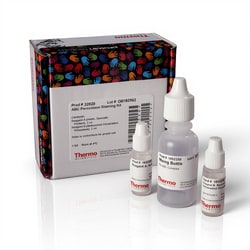
Thermo Scientific™ Trousse de coloration standard ABC Peroxidase
Détecter les anticorps secondaires biotinylés par l’IHC à l’aide de la technique très sensible du complexe avidin-biotine (ABC).

Thermo Scientific™ Kit de substrat amélioré DAB en métal
Formulation spéciale de substrat de peroxydase de diaminobenzidine utilisant du cobalt et du chlorure de nickel pour obtenir une couleur intense lors de la coloration IHC.

Invitrogen™ eBioscience™ Solution de prélèvement d’antigènes IHC - pH bas (10X)
Conçu pour être utilisé lors de l’étape de récupération de l’épitope induit par la chaleur (HIER) avant l’immunohistochimie sur des sections tissulaires fixées dans la paraffine fixées au formol. L’utilisation combinée à la chaleur a démontré qu’elle restaure l’antigénicité des protéines modifiées lors de la fixation du formol dans les tissus.

Thermo Scientific™ Pierce™ Trousse de détection IHC à la peroxydase
Anticorps monoclonal de souris
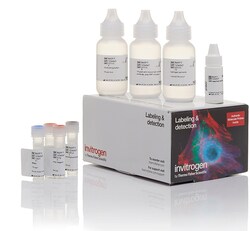
Invitrogen™ Kit de tyramide SuperBoost™ Biotine XX, IgG anti-souris pour chèvres
SuperBoost™ L’amplification du signal tyramide est la méthode la plus sensible pour la détection de cibles à faible abondance en immunocytochimie fluorescente multiplexable (ICC), immunohistochimie (IHC) et hybridation in situ (ISH).

Invitrogen™ Alexa Fluor™ 647 Tyramide SuperBoost™ Kit, chèvre anti-lapins IgG
Présente un anticorps secondaire anti-lapin, anti-lapin, conjugué poly-HRP. Alexa Fluor™ Le kit de tyramide SuperBoost™ 647 combine la luminosité des AlexaFluor colorants avec une amplification de signal élevée d’une réaction de marquage tyramide médiée par poly-HRP pour produire s

Invitrogen™ eBioscience™ DAB Kit chromogénique avancé
Contient les réactifs nécessaires pour préparer une DAB solution de travail sur le substrat.
MilliporeSigma™ Calbiochem™ IgG provenant du plasma de lapin
Utilisé comme témoin négatif avec des anticorps primaires spécifiques de type IgG de lapin.

Invitrogen™ Alexa Fluor™ 647 Kit Tyramide SuperBoost™ , IgG anti-souris pour la chèvre
Présente un anticorps secondaire anti-souris anti-souris conjugué poly-HRP. Alexa Fluor™ 647 Tyramide SuperBoost™ Kit combine la luminosité des AlexaFluor colorants avec une amplification du signal élevée d’une réaction de marquage tyramide médiée par Poly-HRP pour produire se

Invitrogen™ PolarScreen™ Trousse de test pour compétiteurs des récepteurs androgènes, vert
PolarScreen™ Trousse de test pour compétiteurs des récepteurs androgènes, vert