
Cell Based Assays


Invitrogen™ Phalloidin Labeling Probes

Achieve precise and reliable F-actin staining with fluorescent and biotinylated phalloidins. Phalloidin conjugates are widely used in imaging applications to selectively label F-actin in a variety of sample types including fixed and permeabilized cells, tissue sections, and cell-free experiments.

Molecular Probes™ SYTOX™ Dead Cell Stain Sampler Kit, for flow cytometry
SYTOX™ Dead Cell Stain Sampler Kit contains five nucleic acid stains that can be used to determine the viability of cells in flow cytometry assays.

Molecular Probes™ CellROX™ Green Flow Cytometry Assay Kit
CellROX™ Green Flow Cytometry Assay Kit
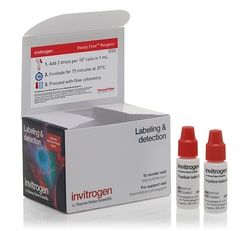
Invitrogen™ Propidium Iodide Ready Flow™ Reagent
Propidium Iodide Ready Flow™ Reagent is a bright, easy-to-use nucleic acid stain for distinguishing dead cells from live cells in flow cytometry assays.
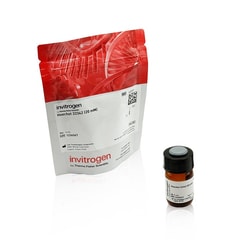
Thermo Scientific™ Hoechst 33342 solution (20 mM), 5 mL
DAPI and Hoechst are classic popular nuclear counterstains for use in all fluorescent cell and tissue techniques. The blue fluorescence is vivid contrast to green, yellow, orange, red, far red and NIR fluorescent probes and labels.

Invitrogen™ Image-iT™ TMRM Reagent (mitochondrial membrane potential indicator)
Healthy mitochondrial membranes maintain a difference in electrical potential between the interior and exterior of the organelle, referred to as a membrane potential.
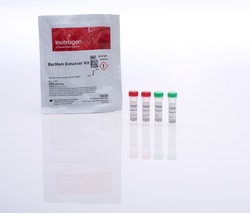
Invitrogen™ BacMam Enhancer Kit
Helps to increase expression of BacMam reagents in mammalian cells

Invitrogen™ Amplex™ Red and Amplex™ UltraRed Reagents
The Amplex Red and UltraRed reagents are fluorogenic substrates for peroxidase. These highly sensitive and stable probes react with H2O2 in the presence of HRP for solution-based assays and ELISAs. Amplex UltraRed is a brighter version of Amplex Red with an improved pH range and sensitivity.
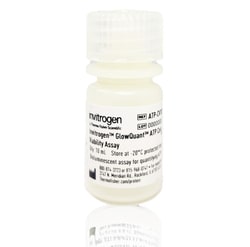
Invitrogen™ GlowQuant™ ATP Cell Viability Assay Kit
The GlowQuant™ ATP Cell Viability Assay Kit is a ready-to-use, bioluminescence-based solution for rapid and sensitive measurement of viable cells through ATP detection and quantification.

Invitrogen™ CellROX™ Green Reagent, for oxidative stress detection
Novel fluorogenic probe for measuring oxidative stress in live cells

Thermo Scientific Chemicals Tacrolimus, 99+%
CAS: 104987-11-3 Molecular Formula: C44H69NO12 Synonym: FK-506; Fugimycin

Thermo Scientific Chemicals Vinblastine Sulfate, 98%
CAS: 143-67-9 Molecular Formula: C46H60N4O13S Synonym: Vincaleukblastine sulfate

Invitrogen™ PiPer™ Pyrophosphate or Phosphate Assay Kit
The PiPer Pyrophosphate Assay Kit provides reagents for fluorogenic or colorimetric detection as low as 0.4 μM (fluorescence) or 2 μM (absorbance) inorganic pyrophosphate (PPi). The Phosphate Assay Kit can detect down to 0.2 μM Pi in purified enzyme systems. Each kit is sufficient for 1000 labelings.

Molecular Probes™ pHrodo™ Red Zymosan BioParticles™ Conjugate for Phagocytosis
Study endocytosis and phagocytosis regulation by drugs and/or environmental factors with the pHrodo Red Zymosan Bioparticles Conjugate for Phagocytosis, which contains pHrodo Red indicator dye and is compatible with HCS, HTS, fluorescence microplate readers, and flow cytometry.

Molecular Probes™ pHrodo™ Red and Green AM Intracellular pH Indicator Dyes
Quantify intracellular pH with pHrodo Red and Green AM intracellular pH indicator dyes, which permeate cell membranes and fluoresce in acidic cytosolic environments. Both the pHrodo Red and Green AM indicator dyes are compatible with HCS, fluorescence microplate, flow cytometry, and HTS platforms.