missing translation for 'onlineSavingsMsg'
Learn More
Learn More
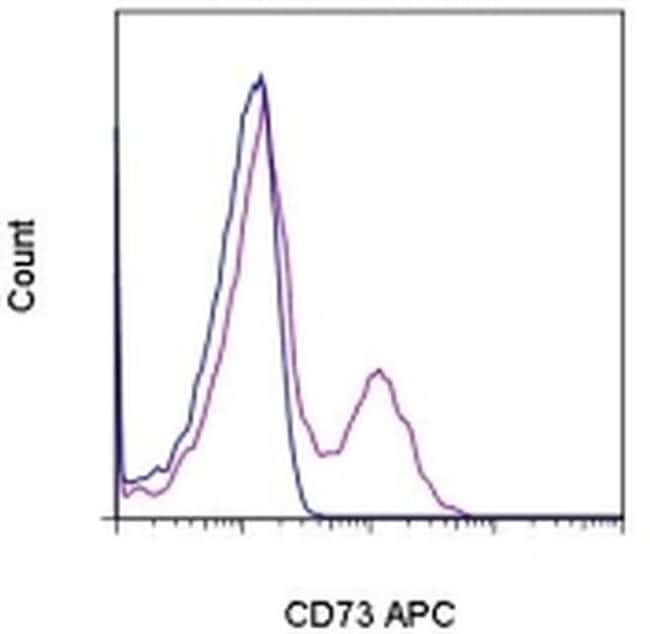
Invitrogen™ CD73 Monoclonal Antibody (AD2), APC, eBioscience™, Invitrogen™
Mouse Monoclonal Antibody
Supplier: Invitrogen™ 17073942
Description
Description: This AD2 monoclonal antibody reacts with human CD73, a 5'-ectonucleotidase that converts 5'-adenosine monophosphate to adenosine. CD73 is expressed on the surface of endothelial cells, as well as B and T cells, including some CD4+Foxp3+ regulatory T cells. Adenosine production by these cells has been linked to the inhibition of CD4 T cell effector functions such as proliferation and cytokine secretion. Applications Reported: This AD2 antibody has been reported for use in flow cytometric analysis. Applications Tested: This AD2 antibody has been pre-titrated and tested by flow cytometric analysis on normal human peripheral blood cells. This can be used at 5 μL (0.125 μg) per test. A test is defined as the amount (μg) of antibody that will stain a cell sample in a final volume of 100 μL. Cell number should be determined empirically but can range from 10^5 to 10^8 cells/test. Excitation: 633-647 nm; Emission: 660 nm; Laser: Red Laser. Filtration: 0.2 μm post-manufacturing filtered.
CD73, also known as Ecto-5-prime-nucleotidase or 5-prime-ribonucleotide phosphohydrolase, is an enzyme that catalyzes the conversion of purine 5-prime mononucleotides to nucleosides at neutral pH, with AMP as its preferred substrate. It is composed of a dimer of two identical 70 kDa subunits, externally bound to the plasma membrane via a glycosyl phosphatidyl inositol linkage. CD73 serves as a marker of lymphocyte differentiation and is expressed on a subset of lymphocytes, increasing during lymphocyte maturation. It is found on memory CD4 T cells, which resemble uncommitted primed precursor helper cells (Thpp) capable of differentiating into Th1 or Th2 cells, and is also present on regulatory T cells. CD73 deficiency is associated with various immunodeficiency diseases. Other forms of 5-prime nucleotidase exist in the cytoplasm and lysosomes, distinguishable from CD73 by their substrate affinities, requirement for divalent magnesium ions, activation by ATP, and inhibition by inorganic phosphate. The CD73 gene is localized to chromosome 6q14-q21, and defects in this gene can lead to conditions such as calcification of joints and arteries, and intestinal tuberculosis. Additionally, two transcript variants encoding different isoforms of CD73 have been identified.Spécifications
| CD73 | |
| Monoclonal | |
| 5 μL/Test | |
| PBS with BSA and 0.09% sodium azide; pH 7.2 | |
| P21589 | |
| NT5E | |
| Affinity chromatography | |
| RUO | |
| 4907 | |
| 4°C, store in dark, DO NOT FREEZE! | |
| Liquid | |
| Responsibly packaged |
| Flow Cytometry | |
| AD2 | |
| APC | |
| NT5E | |
| 2210401F01Rik; 5 nucleotidase, ecto; 5' nucleotidase, ecto; 5'-NT; 5'-nucleotidase; 5'-nucleotidase ecto; 5'-nucleotidase, ecto (CD73); AI447961; CALJA; CD73; E5NT; ecto-5'-nucleotidase; eN; eNT; NT; Nt5; Nt5e; NTE; Purine 5-Prime-Nucleotidase | |
| Mouse | |
| 100 Tests | |
| Primary | |
| Human | |
| Antibody | |
| IgG1 κ |
For Research Use Only.