Learn More
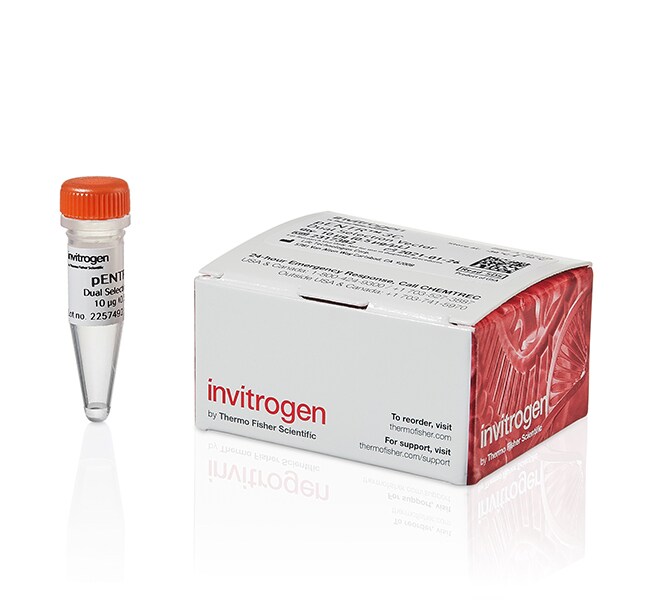
Invitrogen™ Gateway™ pENTR™ 3C Dual Selection Vector

Description
Gateway™ entry vectors are designed to clone DNA sequences using restriction endonucleases and ligase to create a Gateway™ entry clone. The resulting entry clone is ready for recombination with a destination vector to create an expression clone. New: pENTR™ Dual Selection vectors!
The Gateway™ entry vectors (Table 1) offer the following:
- attL1 and attL2 sites for site-specific recombination of the entry clone with a Gateway™ destination vector to ensure cloning of the gene of interest in the correct orientation for expression
- Kozak consensus sequence for efficient translation initiation in eukaryotic systems
- Ribosome binding site for efficient translation initiation in prokaryotic systems (pENTR™ 1A Dual Selection, pENTR™3C Dual Selection, and pENTR™11 Dual Selection vectors only)
- rrnB transcription termination sequences to prevent basal expression of the PCR product of interest in E. coli
- pUC origin for high-copy replication and maintenance of the plasmid in E. coli
- Kanamycin resistance gene for selection in E. coli
- The ccdB⁄chloramphenicol fusion gene located between the two attL sites for
- o negative selection and
- o Chloramphenicol selection in E. coli
- Kanamycin resistance gene for selection in E. coli
Specifications
Specifications
| Product Type | Dual SelectionExpression Vector |
| Content And Storage | 10 μg pENTR™ Dual Selection vector, in 20 ul in TE buffer, pH 8.0. Store at -20°C |
| Antibiotic Resistance Bacterial | Chloramphenicol (CmR), Kanamycin (KanR) |
| Cleavage | No Cleavage Site |
| Protein Tag | Untagged |
| Cloning Method | Gateway |
| Quantity | 10 μg |
| Vector | pENTR |
| Product Line | pENTR |
Frequently Asked Questions (FAQs)
There is no theoretical limit to insert size for a BP reaction with a pDONR vector. Maximum size tested in-house is 12 kb. TOPO vectors are more sensitive to insert size and 3-5 kb is the upper limit for decent cloning efficiency.
After generating your attB-PCR product, we recommend purifying it to remove PCR buffer, unincorporated dNTPs, attB primers, and any attB primer-dimers. Primers and primer-dimers can recombine efficiently with the Donor vector in the BP reaction and may increase background after transformation into E. coli, whereas leftover PCR buffer may inhibit the BP reaction. Standard PCR product purification protocols using phenol/chloroform extraction followed by ammonium acetate and ethanol or isopropanol precipitation are not recommended for purification of the attB-PCR product as these protocols generally have exclusion limits of less than 100 bp and do not efficiently remove large primer-dimer products. We recommend a PEG purification protocol (see page 17 of the Gateway Technology with Clonase II manual). If you use the above protocol and your attB-PCR product is still not suitably purified, you may further gel-purify the product. We recommend using the PureLink Quick Gel Extraction kit.
Check the genotype of the cell strain you are using. Our Gateway destination vectors typically contain a ccdB cassette, which, if uninterrupted, will inhibit E. coli growth. Therefore, un-cloned vectors should be propagated in a ccdB survival cell strain, such as our ccdB Survival 2 T1R competent cells.
LR Clonase II Plus contains an optimized formulation of recombination enzymes for use in MultiSite Gateway LR reactions. LR Clonase and LR Clonase II enzyme mixes are not recommended for MultiSite Gateway LR recombination reactions, but LR Clonase II Plus is compatible with both multi-site and single-site LR recombination reactions.
When the LR reaction is complete, the reaction is stopped with Proteinase K and transformed into E. coli resulting in an expression clone containing a gene of interest. A typical LR reaction followed by Proteinase K treatment yields about 35,000 to 150,000 colonies per 20ul reaction. Without the Proteinase K treatment, up to a 10 fold reduction in the number of colonies can be observed. Despite this reduction, there are often still enough colonies containing the gene of interest to proceed with your experiment, so the Proteinase K step can be left out after the LR reaction is complete if necessary.
For Research Use Only. Not for use in diagnostic procedures.