Recombinant Proteins
Modified or manipulated proteins encoded by recombinant DNA and suitable for a variety of purposes including the modification of gene sequences, mass protein production, and the manufacture of commercial products.
Keyword Search:
animal-free
Effacer toutes les sélections
Résultats de la recherche filtrée
Les produits de certains de nos fournisseurs ne s'affichent pas dans les résultats de la recherche filtrée. Veuillez
supprimer tous les filtres
pour voir ces produits.
1
–
15
de
282
résultats
| Numéro d’adhésion | P09056 |
|---|---|
| Séquence | SPLPITPVNA TCAIRHPCHG NLMNQIKNQL AQLNGSANAL FISYYTAQGE PFPNNVEKLC APNMTDFPSF HGNGTEKTKL VELYRMVAYL SASLTNITRD QKVLNPTAVS LQVKLNATID VMRGLLSNVL CRLCNKYRVG HVDVPPVPDH SDKEAFQRKK LGCQLLGTYK QVISVVVQAF |
| Concentration en endotoxines | <0.1 EU/ μg |
| Pureté ou qualité | ≥ 98% by SDS-PAGE gel and HPLC analyses. |
| Activité biologique | PeproTech's Murine LIF is fully biologically active when compared to standards. The ED50 as determined by the M1 cell differentiation assay is ≤ 0.05 ng/ml, corresponding to a specific activity of ≥ 2 x 10^7 units/mg |
| Conjugué | Unconjugated |
| Nom | Mouse LIF, Animal-Free |
| Source | E. coli |
| Forme | Lyophilized |
| Contenu et stockage | -20°C |
| Nom usuel | LIF |
| À utiliser avec (application) | Functional Assay |
| État réglementaire | RUO |
| Poids moléculaire | 19.6 kDa |
| Système d’expression | E. coli |
| Identification génétique (Entrez) | 16878 |
| Symbole de gène(s) | Lif |
| Formule | protein with no preservative |
| Recombinant | Recombinant |
| Alias de gène | CDF; cholinergic differentiation factor; cholinergic neuronal differentiation factor; d factor; DIA; differentiation inhibitory activity; differentiation-inducing factor; differentiation-stimulating factor; Emfilermin; hepatocyte-stimulating factor III; HILDA; human interleukin in DA cells; leukemia inhibitory factor; leukemia inhibitory factor (cholinergic differentiation factor); LIF; Melanoma-derived LPL inhibitor; MLPLI; myeloid leukaemia inhibitory factor |
| Numéro d’adhésion | P97466 |
|---|---|
| Séquence | MQHYLHIRPA PSDNLPLVDL IEHPDPIFDP KEKDLNETLL RSLLGGHYDP GFMATSPPED RPGGGGGPAG GAEDLAELDQ LLRQRPSGAM PSEIKGLEFS EGLAQGKKQR LSKKLRRKLQ MWLWSQTFCP VLYAWNDLGS RFWPRYVKVG SCFSKRSCSV PEGMVCKPSK SVHLTVLRWR CQRRGGQRCG WIPIQYPIIS ECKCSC |
| Pureté ou qualité | ≥ 98% by SDS-PAGE gel and HPLC analyses. |
| Conjugué | Unconjugated |
| Nom | Mouse Noggin, Animal-Free |
| Source | E. coli |
| Forme | Lyophilized |
| À utiliser avec (application) | Functional Assay |
| État réglementaire | RUO |
| Identification génétique (Entrez) | 18121 |
| Symbole de gène(s) | NOG |
| Formule | protein with no preservative |
| Recombinant | Recombinant |
| Alias de gène | NOG; Noggin; Noggin precursor; noggin; LOW QUALITY PROTEIN: noggin; SYM1; symphalangism 1 (proximal); SYNS1; SYNS1A |
| Numéro d’adhésion | P41159 |
|---|---|
| Séquence | MVPIQKVQDD TKTLIKTIVT RINDISHTQS VSSKQKVTGL DFIPGLHPIL TLSKMDQTLA VYQQILTSMP SRNVIQISND LENLRDLLHV LAFSKSCHLP WASGLETLDS LGGVLEASGY STEVVALSRL QGSLQDMLWQ LDLSPGC |
| Concentration en endotoxines | <0.1 EU/ μg |
| Pureté ou qualité | ≥ 98% by SDS-PAGE gel and HPLC analyses. |
| Conjugué | Unconjugated |
| Nom | Human Leptin, Animal-Free |
| Source | E. coli |
| Forme | Lyophilized |
| Contenu et stockage | -20°C |
| Nom usuel | Leptin |
| À utiliser avec (application) | Functional Assay |
| État réglementaire | RUO |
| Poids moléculaire | 16 kDa |
| Système d’expression | E. coli |
| Identification génétique (Entrez) | 3952 |
| Symbole de gène(s) | Lep |
| Formule | protein with no preservative |
| Recombinant | Recombinant |
| Alias de gène | CD295 antigen; H-Leptin; HuB219; Lep; LEPD; LEP-R; Leptin; leptin (murine obesity homolog); leptin (obesity homolog, mouse); leptin precursor; Method: conceptual translation supplied by author.; OB; obese; obese protein; obese, mouse, homolog of; obesity; obesity factor; obesity protein; OB-R; OBS; truncated leptin |
| Numéro d’adhésion | P01031 |
|---|---|
| Séquence | TLQKKIEEIA AKYKHSVVKK CCYDGACVNN DETCEQRAAR ISLGPRCIKA FTECCVVASQ LRANISHKDM QLGR |
| Concentration en endotoxines | <0.1 EU/ μg |
| Pureté ou qualité | ≥ 98% by SDS-PAGE gel and HPLC analyses. |
| Activité biologique | Measured by its ability to support adhesion of Human Umbilical Vein Endothelial Cells (HUVEC) to the Recombinant Human C5a-coated surface. |
| Conjugué | Unconjugated |
| Nom | Human C5a, Animal-Free |
| Source | E. coli |
| Forme | Lyophilized |
| Contenu et stockage | -20°C |
| Nom usuel | Complement C5a |
| À utiliser avec (application) | Functional Assay |
| État réglementaire | RUO |
| Poids moléculaire | 8.3 kDa |
| Système d’expression | E. coli |
| Identification génétique (Entrez) | 727 |
| Symbole de gène(s) | C5 |
| Formule | protein with no preservative |
| Recombinant | Recombinant |
| Alias de gène | anaphylatoxin; anaphylatoxin C5a analog; C3 and PZP-like alpha-2-macroglobulin domain-containing protein 4; C4B1; C4B12; C4B2; C4B3; C4B5; C4F; C5; C5a; C5a anaphylatoxin; C5b; C5D; CH; CO4; complement C5; Complement C5 alpha chain; Complement C5 alpha' chain; Complement C5 beta chain; complement component 5; CPAMD3; CPAMD4; DADB-112B14.11; ECLZB; FLJ17816; FLJ17822; FLJ60561; Hc; He; Hemolytic complement; MGC142298; MGC164979; prepro-C5; RGD1561905 |
| Numéro d’adhésion | P01132 |
|---|---|
| Séquence | NSYPGCPSSY DGYCLNGGVC MHIESLDSYT CNCVIGYSGD RCQTRDLRWW ELR |
| Concentration en endotoxines | <0.1 EU/ μg |
| Pureté ou qualité | ≥ 98% by SDS-PAGE gel and HPLC analyses. |
| Activité biologique | The ED50 was determined by a cell proliferation assay using BALB/c 3T3 cells is ≤ 0.1 ng/ml, corresponding to a specific activity of ≥ 1 x 10^7 units/mg |
| Conjugué | Unconjugated |
| Nom | Mouse EGF, Animal-Free |
| Source | E. coli |
| Forme | Lyophilized |
| Contenu et stockage | -20°C |
| Nom usuel | EGF |
| À utiliser avec (application) | Functional Assay |
| État réglementaire | RUO |
| Poids moléculaire | 6 kDa |
| Système d’expression | E. coli |
| Identification génétique (Entrez) | 13645 |
| Symbole de gène(s) | EGF |
| Formule | protein with no preservative |
| Recombinant | Recombinant |
| Alias de gène | AI790464; beta-urogastrone; EGF; Epidermal growth factor; epidermal growth factor (beta-urogastrone); epidermal growth factor precursor; H-EGF; HOMG4; Pro-epidermal growth factor; Pro-epidermal growth factor precursor (EGF); sb:eu639; URG; Urogastrone |
| Numéro d’adhésion | P39905 |
|---|---|
| Séquence | MSPDKQMAVL PRRERNRQAA AANPENSRGK GRRGQRGKNR GCVLTAIHLN VTDLGLGYET KEELIFRYCS GSCDAAETTY DKILKNLSRN RRLVSDKVGQ ACCRPIAFDD DLSFLDDNLV YHILRKHSAK RCGCI |
| Concentration en endotoxines | <0.1 EU/ μg |
| Pureté ou qualité | ≥ 98% by SDS-PAGE gel and HPLC analyses. |
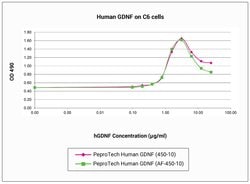
| Activité biologique | Determined by a cell proliferation assay using SH-SY5Y cells. The expected ED50 for this effect is 1.0-10.0 ng/ml |
| Conjugué | Unconjugated |
| Nom | Human GDNF, Animal-Free |
| Source | E. coli |
| Forme | Lyophilized |
| Contenu et stockage | -20°C |
| Nom usuel | GDNF |
| À utiliser avec (application) | Functional Assay |
| État réglementaire | RUO |
| Poids moléculaire | 30.4 kDa |
| Système d’expression | E. coli |
| Identification génétique (Entrez) | 2668 |
| Symbole de gène(s) | GDNF |
| Formule | protein with no preservative |
| Recombinant | Recombinant |
| Alias de gène | AI385739; Astrocyte-derived trophic factor; ATF; ATF1; ATF2; Gdnf; glial cell derived neurotrophic factor; glial cell line derived neurotrophic factor; Glial cell line derived neutrophic factor; glial cell line-derived neurotrophic factor; gndf; HFB1-GDNF; hGDNF; H-GDNF; HSCR3; mGDNF; neurotrophic factor |
| Numéro d’adhésion | P26441 |
|---|---|
| Séquence | AFTEHSPLTP HRRDLCSRSI WLARKIRSDL TALTQSYVKH QGLNKNINLD SADGMPVAST DQWSQLTQAQ RLQQNLQAYR TFHVLLARLL QDQQVHFTPT QGDFHQAIHT LLLQVAAFAY QIQQLMILLQ YKIPRNQADG MPINVGDGGL FQKKLWGLKV LQQLSQWTVR SIHDLRFISS HQTGIPARGS HYIANNKKM |
| Concentration en endotoxines | <0.1 EU/ μg |
| Pureté ou qualité | ≥ 98% by SDS-PAGE gel and HPLC analyses. |
| Activité biologique | Determined by its ability to stimulate proliferation of human TF-1 cells using an ED50 concentration range of 50-150 ng/ml |
| Conjugué | Unconjugated |
| Nom | Human CNTF, Animal-Free |
| Source | E. coli |
| Forme | Lyophilized |
| Contenu et stockage | -20°C |
| Nom usuel | CNTF |
| À utiliser avec (application) | Functional Assay |
| État réglementaire | RUO |
| Poids moléculaire | 22.8 kDa |
| Système d’expression | E. coli |
| Identification génétique (Entrez) | 1270 |
| Symbole de gène(s) | CNTF |
| Formule | protein with no preservative |
| Recombinant | Recombinant |
| Alias de gène | AI429687; Ciliary neurotrophic factor; ciliary neurotropic factor; Cntf; HCNTF; H-CNTF |
| Numéro d’adhésion | Q5T4W7 |
|---|---|
| Séquence | AGGPGSRARA AGARGCRLRS QLVPVRALGL GHRSDELVRF RFCSGSCRRA RSPHDLSLAS LLGAGALRPP PGSRPVSQPC CRPTRYEAVS FMDVNSTWRT VDRLSATACG CLG |
| Concentration en endotoxines | <0.1 EU/ μg |
| Pureté ou qualité | ≥ 98% by SDS-PAGE gel and HPLC analyses. |
| Conjugué | Unconjugated |
| Nom | Human Artemin, Animal-Free |
| Source | E. coli |
| Forme | Lyophilized |
| Contenu et stockage | -20°C |
| Nom usuel | Artemin |
| À utiliser avec (application) | Functional Assay |
| État réglementaire | RUO |
| Poids moléculaire | 24.2 kDa |
| Système d’expression | E. coli |
| Identification génétique (Entrez) | 9048 |
| Symbole de gène(s) | ARTN |
| Formule | protein with no preservative |
| Recombinant | Recombinant |
| Alias de gène | Artemin; ARTN; Enovin; EVN; NBN; neublastin; neurotrophic factor |
| Numéro d’adhésion | P41160 |
|---|---|
| Séquence | MVPIQKVQDD TKTLIKTIVT RINDISHTQS VSAKQRVTGL DFIPGLHPIL SLSKMDQTLA VYQQVLTSLP SQNVLQIAND LENLRDLLHL LAFSKSCSLP QTSGLQKPES LDGVLEASLY STEVVALSRL QGSLQDILQQ LDVSPEC |
| Concentration en endotoxines | <0.1 EU/ μg |
| Pureté ou qualité | ≥ 98% by SDS-PAGE gel and HPLC analyses. |
| Conjugué | Unconjugated |
| Nom | Mouse Leptin, Animal-Free |
| Source | E. coli |
| Forme | Lyophilized |
| Contenu et stockage | -20°C |
| Nom usuel | Leptin |
| À utiliser avec (application) | Functional Assay |
| État réglementaire | RUO |
| Poids moléculaire | 16.2 kDa |
| Système d’expression | E. coli |
| Identification génétique (Entrez) | 16846 |
| Symbole de gène(s) | Lep |
| Formule | protein with no preservative |
| Recombinant | Recombinant |
| Alias de gène | CD295 antigen; H-Leptin; HuB219; Lep; LEPD; LEP-R; Leptin; leptin (murine obesity homolog); leptin (obesity homolog, mouse); leptin precursor; Method: conceptual translation supplied by author.; OB; obese; obese protein; obese, mouse, homolog of; obesity; obesity factor; obesity protein; OB-R; OBS; truncated leptin |
| Numéro d’adhésion | P48540 |
|---|---|
| Séquence | MSPDKQAAAL PRRERNRQAA AASPENSRGK GRRGQRGKNR GCVLTAIHLN VTDLGLGYET KEELIFRYCS GSCESAETMY DKILKNLSRS RRLTSDKVGQ ACCRPVAFDD DLSFLDDNLV YHILRKHSAK RCGCI |
| Concentration en endotoxines | <0.1 EU/ μg |
| Pureté ou qualité | ≥ 98% by SDS-PAGE gel and HPLC analyses. |
| Activité biologique | The ED50 was determined by the proliferation of rat C6 cells is ≤ 0.2 ng/ml, corresponding to a specific activity of ≥ 5 x 10^6 units/mg |
| Conjugué | Unconjugated |
| Nom | Mouse GDNF, Animal-Free |
| Source | E. coli |
| Forme | Lyophilized |
| Contenu et stockage | -20°C |
| Nom usuel | GDNF |
| À utiliser avec (application) | Functional Assay |
| État réglementaire | RUO |
| Poids moléculaire | 30.2 kDa |
| Système d’expression | E. coli |
| Identification génétique (Entrez) | 14573 |
| Symbole de gène(s) | GDNF |
| Formule | protein with no preservative |
| Recombinant | Recombinant |
| Alias de gène | AI385739; Astrocyte-derived trophic factor; ATF; ATF1; ATF2; Gdnf; glial cell derived neurotrophic factor; glial cell line derived neurotrophic factor; Glial cell line derived neutrophic factor; glial cell line-derived neurotrophic factor; gndf; HFB1-GDNF; hGDNF; H-GDNF; HSCR3; mGDNF; neurotrophic factor |
| Numéro d’adhésion | P98073 |
|---|---|
| Séquence | Heavy chain: LTIKESQRGA ALGQSHEARA TFKITSGVTY NPNLQDKLSV DFKVLAFDLQ QMIDEIFLSS NLKNEYKNSR VLQFENGSII VVFDLFFAQW VSDQNVKEEL IQGLEANKSS QLVTFHIDLN SVDILDKLTT TSHLATPGNV SIECLPGSSP CTDALTCIKA DLFCDGEVNC PDGSDEDNKM CATVCDGRFL LTGSSGSFQA THYPKPSETS VVCQWIIRVN QGLSIKLSFD DFNTYYTDIL DIYEGVGSSK ILRASIWETN PGTIRIFSNQ VTATFLIESD ESDYVGFNAT YTAFNSSELN NYEKINCNFE DGFCFWVQDL NDDNEWERIQ GSTFSPFTGP NFDHTFGNAS GFYISTPTGP GGRQERVGLL SLPLDPTLEP ACLSFWYHMY GENVHKLSIN ISNDQNMEKT VFQKEGNYGD NWNYGQVTLN ETVKFKVAFN AFKNKILSDI ALDDISLTYG ICNGSLYPEP TLVPTPPPEL PTDCGGPFEL WEPNTTFSST NFPNSYPNLA FCVWILNAQK GKNIQLHFQE FDLENINDVV EIRDGEEADS LLLAVYTGPG PVKDVFSTTN RMTVLLITND VLARGGFKAN FTTGYHLGIPEPCKADHFQC KNGECVPLVN LCDGHLHCED GSDEADCVRF FNGTTNNNGL VRFRIQSIWH TACAENWTTQ ISNDVCQLLG LGSGNSSKPI FSTDGGPFVK LNTAPDGHLI LTPSQQCLQD SLIRLQCNHK SCGKKLAAQD ITPK Light Chain: IVGGSNAKEG AWPWVVGLYY GGRLLCGASL VSSDWLVSAA HCVYGRNLEP SKWTAILGLH MKSNLTSPQT VPRLIDEIVI NPHYNRRRKD NDIAMMHLEF KVNYTDYIQP ICLPEENQVF PPGRNCSIAG WGTVVYQGTT ANILQEADVP LLSNERCQQQ MPEYNITENM ICAGYEEGGI DSCQGDSGGP LMCQENNRWF LAGVTSFGYK CALPNRPGVY ARVSRFTEWI QSFLH |
| Concentration en endotoxines | <0.2 EU/ μg |
| Pureté ou qualité | ≥ 90% by SDS-PAGE gel and HPLC analyses. |
| Activité biologique | Sequentially cleaves carboxyl side of D-D-D-D-K. |
| Conjugué | Unconjugated |
| Nom | Human Enterokinase, Animal-Free |
| Source | CHO cells |
| Forme | Lyophilized |
| Contenu et stockage | -20°C |
| Nom usuel | TMPRSS15 |
| À utiliser avec (application) | Functional Assay |
| État réglementaire | RUO |
| Poids moléculaire | 108.7 kDa |
| Système d’expression | CHO cells |
| Identification génétique (Entrez) | 5651 |
| Symbole de gène(s) | TMPRSS15 |
| Formule | protein with no preservative |
| Recombinant | Recombinant |
| Alias de gène | enterokinase; enterokinase catalytic subunit; enteropeptidase; Enteropeptidase catalytic light chain; Enteropeptidase non-catalytic heavy chain; Entk; protease, serine, 7 (enterokinase); PRSS7; Serine protease 7; Tmprss15; Transmembrane protease serine 15; transmembrane protease, serine 15 |
| Numéro d’adhésion | Q07731 |
|---|---|
| Séquence | MSPDKQAAAL PRRERNRQAA AASPENSRGK GRRGQRGKNR GCVLTAIHLN VTDLGLGYET KEELIFRYCS GSCEAAETMY DKILKNLSRS RRLTSDKVGQ ACCRPVAFDD DLSFLDDSLV YHILRKHSAK RCGCI |
| Concentration en endotoxines | <0.1 EU/ μg |
| Pureté ou qualité | ≥ 98% by SDS-PAGE gel and HPLC analyses. |
| Activité biologique | Determined by its ability to stimulate the proliferation of rat C6 cells. |
| Conjugué | Unconjugated |
| Nom | Rat GDNF, Animal-Free |
| Source | E. coli |
| Forme | Lyophilized |
| Contenu et stockage | -20°C |
| Nom usuel | GDNF |
| À utiliser avec (application) | Functional Assay |
| État réglementaire | RUO |
| Poids moléculaire | 30 kDa |
| Système d’expression | E. coli |
| Identification génétique (Entrez) | 25453 |
| Symbole de gène(s) | GDNF |
| Formule | protein with no preservative |
| Recombinant | Recombinant |
| Alias de gène | AI385739; Astrocyte-derived trophic factor; ATF; ATF1; ATF2; Gdnf; glial cell derived neurotrophic factor; glial cell line derived neurotrophic factor; Glial cell line derived neutrophic factor; glial cell line-derived neurotrophic factor; gndf; HFB1-GDNF; hGDNF; H-GDNF; HSCR3; mGDNF; neurotrophic factor |
| Numéro d’adhésion | P20294 |
|---|---|
| Séquence | AFAEQTPLTL HRRDLCSRSI WLARKIRSDL TALMESYVKH QGLNKNINLD SVDGVPVAST DRWSEMTEAE RLQENLQAYR TFQGMLTKLL EDQRVHFTPT EGDFHQAIHT LMLQVSAFAY QLEELMVLLE QKIPENEADG MPATVGDGGL FEKKLWGLKV LQELSQWTVR SIHDLRVISS HQMGISALES HYGAKDKQM |
| Concentration en endotoxines | <0.1 EU/ μg |
| Pureté ou qualité | ≥ 98% by SDS-PAGE gel and HPLC analyses. |
| Activité biologique | Determined by its ability to stimulate proliferation of human TF-1 cells using a concentration range of 25.0-35.0 ng/ml |
| Conjugué | Unconjugated |
| Nom | Rat CNTF, Animal-Free |
| Source | E. coli |
| Forme | Lyophilized |
| Contenu et stockage | -20°C |
| Nom usuel | CNTF |
| À utiliser avec (application) | Functional Assay |
| État réglementaire | RUO |
| Poids moléculaire | 22.7 kDa |
| Système d’expression | E. coli |
| Identification génétique (Entrez) | 25707 |
| Symbole de gène(s) | CNTF |
| Formule | protein with no preservative |
| Recombinant | Recombinant |
| Alias de gène | AI429687; Ciliary neurotrophic factor; ciliary neurotropic factor; Cntf; HCNTF; H-CNTF |
| Numéro d’adhésion | P20826 |
|---|---|
| Séquence | MKEICGNPVT DNVKDITKLV ANLPNDYMIT LNYVAGMDVL PSHCWLRDMV IQLSLSLTTL LDKFSNISEG LSNYSIIDKL GKIVDDLVLC MEENAPKNIK ESPKRPETRS FTPEEFFSIF NRSIDAFKDF MVASDTSDCV LSSTLGPEKD SRVSVTKPFM LPPVA |
| Concentration en endotoxines | <0.1 EU/ μg |
| Pureté ou qualité | ≥ 98% by SDS-PAGE gel and HPLC analyses. |
| Activité biologique | The ED50 was determined by the dose-dependent stimulation of the proliferation of human TF-1 cells is ≤ 10.0 ng/ml, corresponding to a specific activity of ≥ 1 x 10^5 units/mg |
| Conjugué | Unconjugated |
| Nom | Mouse SCF, Animal-Free |
| Source | E. coli |
| Forme | Lyophilized |
| Contenu et stockage | -20°C |
| Nom usuel | SCF |
| À utiliser avec (application) | Functional Assay |
| État réglementaire | RUO |
| Poids moléculaire | 18.3 kDa |
| Système d’expression | E. coli |
| Identification génétique (Entrez) | 17311 |
| Symbole de gène(s) | Kitl |
| Formule | protein with no preservative |
| Recombinant | Recombinant |
| Alias de gène | 710-712; blz; c-Kit ligand; Clo; cloud gray; Con; contrasted; CSF; DCUA; DFNA69; DKFZp686F2250; familial progressive hyperpigmentation 2; FPH2; FPHH; Gb; grizzle-belly; hematopoietic growth factor KL; H-SCF; Kit ligand; Kitl; Kitlg; kit-ligand; KL-1; Mast cell growth factor; MGF; M-SCF; Processed kit ligand; SCF; SF; SHEP7; sKITLG; Sl; SLF; Soluble KIT ligand; Steel factor; steel factor/kit ligand; stem cell factor; stem cell factor KL-1; stem cell factor, CSF |
| Numéro d’adhésion | P15018 |
|---|---|
| Séquence | SPLPITPVNA TCAIRHPCHN NLMNQIRSQL AQLNGSANAL FILYYTAQGE PFPNNLDKLC GPNVTDFPPF HANGTEKAKL VELYRIVVYL GTSLGNITRD QKILNPSALS LHSKLNATAD ILRGLLSNVL CRLCSKYHVG HVDVTYGPDT SGKDVFQKKK LGCQLLGKYK QIIAVLAQAF |
| Concentration en endotoxines | <0.1 EU/ μg |
| Pureté ou qualité | ≥ 98% by SDS-PAGE gel and HPLC analyses. |
| Activité biologique | Determined by its ability to stimulate the proliferation of human TF-1 cells. The expected ED50 is ≤ 0.1 ng/ml, corresponding to a specific activity of ≥ 1 x 10^7 units/mg |
| Conjugué | Unconjugated |
| Nom | Human LIF, Animal-Free |
| Source | E. coli |
| Forme | Lyophilized |
| Contenu et stockage | -20°C |
| Nom usuel | LIF |
| À utiliser avec (application) | Functional Assay |
| État réglementaire | RUO |
| Poids moléculaire | 19.6 kDa |
| Système d’expression | E. coli |
| Identification génétique (Entrez) | 3976 |
| Symbole de gène(s) | Lif |
| Formule | protein with no preservative |
| Recombinant | Recombinant |
| Alias de gène | CDF; cholinergic differentiation factor; cholinergic neuronal differentiation factor; d factor; DIA; differentiation inhibitory activity; differentiation-inducing factor; differentiation-stimulating factor; Emfilermin; hepatocyte-stimulating factor III; HILDA; human interleukin in DA cells; leukemia inhibitory factor; leukemia inhibitory factor (cholinergic differentiation factor); LIF; Melanoma-derived LPL inhibitor; MLPLI; myeloid leukaemia inhibitory factor |