missing translation for 'onlineSavingsMsg'
Learn More
Learn More
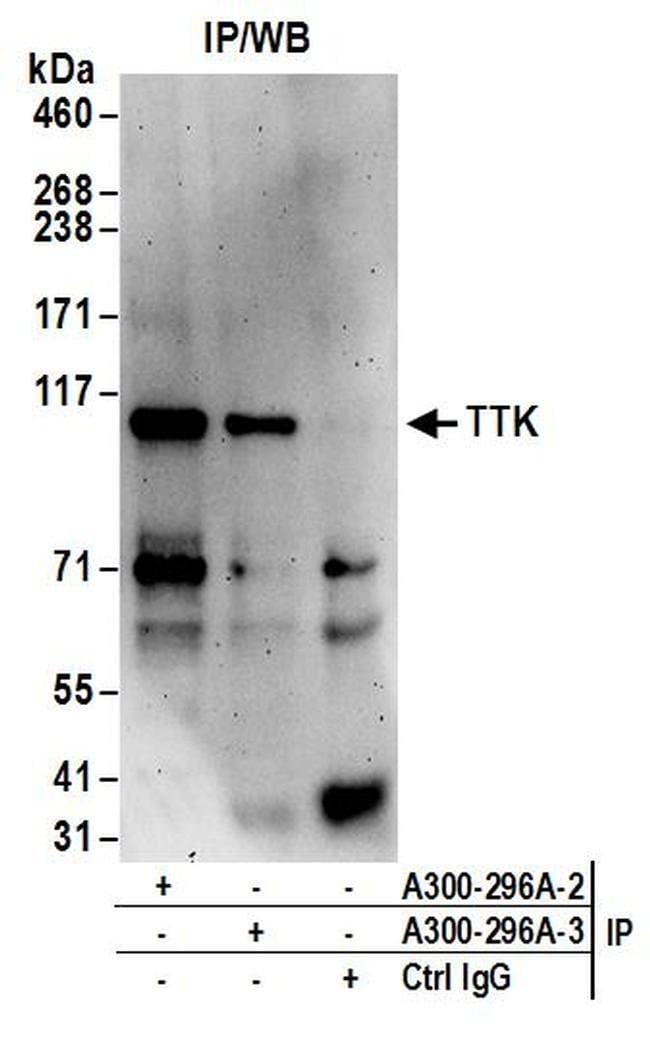
TTK Rabbit anti-Human, Polyclonal, Bethyl Laboratories

Description
The recommended shelf life for this product is 1 year from date of receipt.
Protein kinases are enzymes that transfer a phosphate group from a phosphate donor, generally the g phosphate of ATP, onto an acceptor amino acid in a substrate protein. By this basic mechanism, protein kinases mediate most of the signal transduction in eukaryotic cells, regulating cellular metabolism, transcription, cell cycle progression, cytoskeletal rearrangement and cell movement, apoptosis, and differentiation. With more than 500 gene products, the protein kinase family is one of the largest families of proteins in eukaryotes. The family has been classified in 8 major groups based on sequence comparison of their tyrosine (PTK) or serine/threonine (STK) kinase catalytic domains. The STE group (homologs of yeast Sterile 7, 11, 20 kinases) consists of 50 kinases related to the mitogen-activated protein kinase (MAPK) cascade families (Ste7/MAP2K, Ste11/MAP3K, and Ste20/MAP4K). MAP kinase cascades, consisting of a MAPK and one or more upstream regulatory kinases (MAPKKs) have been best characterized in the yeast pheromone response pathway. Pheromones bind to Ste cell surface receptors and activate yeast MAPK pathway.
Spécifications
Spécifications
| Antigène | TTK |
| Applications | Immunoprecipitation |
| Classification | Polyclonal |
| Concentration | 1 mg/ml |
| Conjugué | Unconjugated |
| Formule | phosphate, tris citrate with 0.09% sodium azide; pH 7-8 |
| Gène | TTK |
| Numéro d’acquisition du gène | P33981 |
| Alias du gène | Dual specificity protein kinase TTK, PYT |
| Symboles de gène | TTK |
| Afficher plus de résultats |