missing translation for 'onlineSavingsMsg'
Learn More

Invitrogen™ TCR gamma/delta Monoclonal Antibody (eBioGL3 (GL-3, GL3)), PE, eBioscience™, Invitrogen™

Numéro de catalogue. 5010842
Modifier l'affichage
Click to view available options
Quantité:
100 μg
50 μg
2 product options available for selection
Product selection table with 2 available options. Use arrow keys to navigate and Enter or Space to select.
Numéro de catalogue. Quantité
5010842 50 μg
5010843 100 μg
Use arrow keys to navigate between rows. Press Enter or Space to select a product option. 2 options available.
2 options
Numéro de catalogue. 5010842 Fournisseur Invitrogen™ Code fournisseur 12571181
Saison des économies
Afficher toutes les promotions

Pour de l'aide SVP utiliser la function de clavardage; nous envoyer un couriel à help@thermofisher.com ou appelez le service à la clientèle au 1-800-234-7437.

Armenian Hamster Monoclonal Antibody

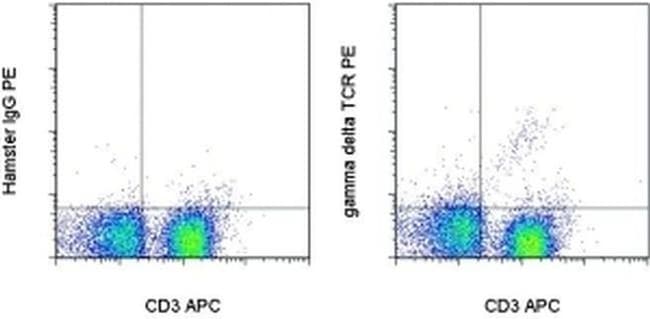
Description: The GL3 monoclonal antibody reacts with the gamma delta T-cell Receptor complex (TCR) on all gamma delta TCR bearing T cells, but it does not react with alpha beta TCR. The gamma delta TCR is present on cells in the thymus, epidermis, epithelial lining of the intestine, peritoneal cavity, and lymphoid tissues. Applications Reported: This GL3 (GL-3) antibody has been reported for use in flow cytometric analysis. It is recommended to prestain cells with anti-mouse CD16/32 (cat. 14-0161) to prevent non-specific Fc-mediated binding of the GL3 monoclonal antibody. Applications Tested: This GL3 (GL-3) antibody has been tested by flow cytometric analysis of mouse lymph node cells. This can be used at less than or equal to 0.5 μg per test. A test is defined as the amount (μg) of antibody that will stain a cell sample in a final volume of 100 μL. Cell number should be determined empirically but can range from 10^5 to 10^8 cells/test. It is recommended that the antibody be carefully titrated for optimal performance in the assay of interest. Excitation: 488-561 nm; Emission: 578 nm; Laser: Blue Laser, Green Laser, Yellow-Green Laser. Filtration: 0.2 μm post-manufacturing filtered.

TCR gamma/delta (T-cell receptor gamma/delta) are specialized T-cells in the immune system. The ability of T cell receptors (TCR) to discriminate foreign from self-peptides presented by major histocompatibility complex (MHC) class II molecules is essential for an effective adaptive immune response. TCR recognition of self-peptides has been linked to autoimmune disease. Mutant self-peptides have been associated with tumors. Engagement of TCRs by a family of bacterial toxins know as superantigens has been responsible for toxic shock syndrome. Autoantibodies to V beta segments of T cell receptors have been isolated from patients with rheumatoid arthritis (RA) and systemic lupus erythematosus (SLE). The autoantibodies block TH1-mediated inflammatory auto-destructive reactions and are believed to be a method by which the immune system compensates for disease. Most human T cells express the TCR alpha-beta and either CD4 or CD8 molecule (single positive, SP). However, a small number of T cells lack both CD4 and CD8 (double negative, DN). Increased percentages of alpha-beta DN T cells have been identified in some autoimmune and immunodeficiency disorders. Gamma-delta T cells are primarily found within the epithelium. They show less TCR diversity and recognize antigens differently than alpha-beta T cells. Subsets of gamma-delta T cells have shown antitumor and immunoregulatory activity.

Spécifications

Antigène TCR gamma/delta
Applications Flow Cytometry
Classification Monoclonal
Clone eBioGL3 (GL-3, GL3), GL3)
Concentration 0.2 mg/mL
Conjugué PE
Formule PBS with 0.09% sodium azide; pH 7.2
Gène Tcrd
Numéro d’acquisition du gène 0
Alias du gène RGD1311300; similar to T cell receptor V delta 6; T cell receptor gamma locus; T3/TCR complex; TCR delta gamma; TCR gamma/delta; TCR-CD3 complex; Tcrg; Trg; Trg@
Symboles de gène Tcrd, Tcrg
Espèces hôtes Armenian Hamster
Méthode de purification Affinity chromatography
Quantité 50 μg
Statut réglementaire RUO
Primaire ou secondaire Primary
ID du gène (Entrez) 110066, 110067
Espèces cibles Mouse
Contenu et stockage 4°C, store in dark, DO NOT FREEZE!
Type de produit Antibody
Forme Liquid
Isotype IgG
Afficher plus de résultats Afficher moins de résultats

For Research Use Only.