missing translation for 'onlineSavingsMsg'
Learn More
Learn More
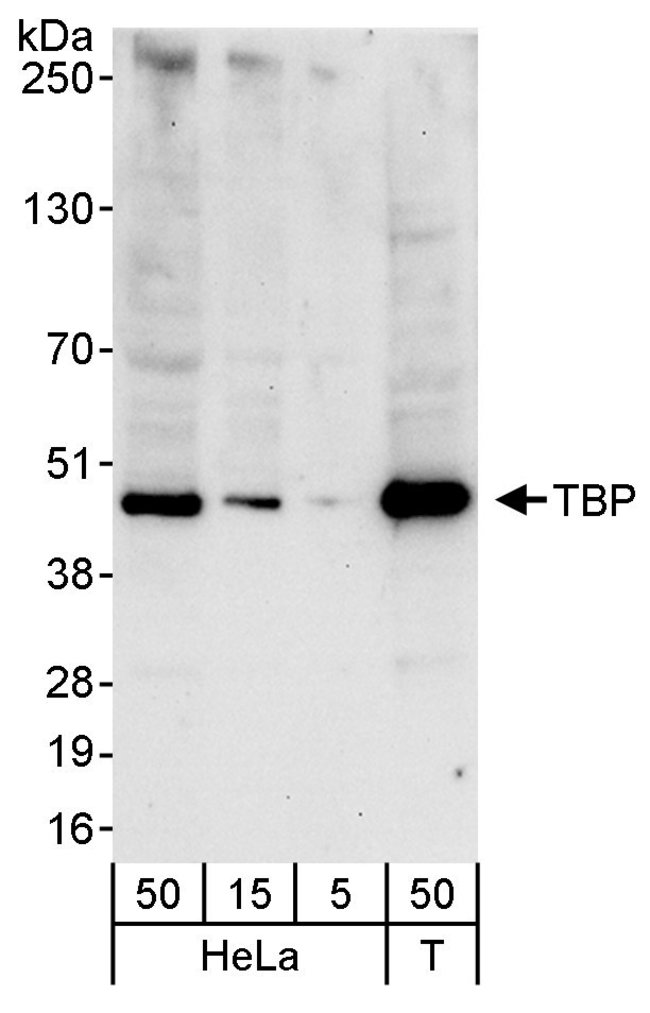
TBP Rabbit anti-Human, Polyclonal, Bethyl Laboratories

Description
The recommended shelf life for this product is 1 year from date of receipt. Based on 100% sequence identity, this antibody is predicted to react with Mouse, Chicken, Bovine and Golden hamster
Initiation of transcription by RNA polymerase II requires the activities of more than 70 polypeptides. The protein that coordinates these activities is transcription factor IID (TFIID), which binds to the core promoter to position the polymerase properly, serves as the scaffold for assembly of the remainder of the transcription complex, and acts as a channel for regulatory signals. TFIID is composed of the TATA-binding protein (TBP) and a group of evolutionarily conserved proteins known as TBP-associated factors or TAFs. TAFs may participate in basal transcription, serve as coactivators, function in promoter recognition or modify general transcription factors (GTFs) to facilitate complex assembly and transcription initiation. A distinctive feature of TBP is a long string of glutamines in the N-terminal. This region of the protein modulates the DNA binding activity of the C terminus, and modulation of DNA binding affects the rate of transcription complex formation and initiation of transcription. Mutations that expand the number of CAG repeats encoding this polyglutamine tract, and thus increase the length of the polyglutamine string, are associated with spinocerebellar ataxia 17, a neurodegenerative disorder classified as a polyglutamine disease.
Spécifications
Spécifications
| Antigène | TBP |
| Applications | Western Blot |
| Classification | Polyclonal |
| Concentration | 1 mg/ml |
| Conjugué | Unconjugated |
| Formule | phosphate, tris citrate with 0.09% sodium azide; pH 7-8 |
| Gène | TBP |
| Numéro d’acquisition du gène | P20226 |
| Alias du gène | TBP |
| Symboles de gène | TBP |
| Afficher plus de résultats |