missing translation for 'onlineSavingsMsg'
Learn More

ACROBiosystems Inc Biotinylated Rat TNFSF11 / RANKL / CD254 Protein, His,Avitag™

Numéro de catalogue. 502719017
Encompass

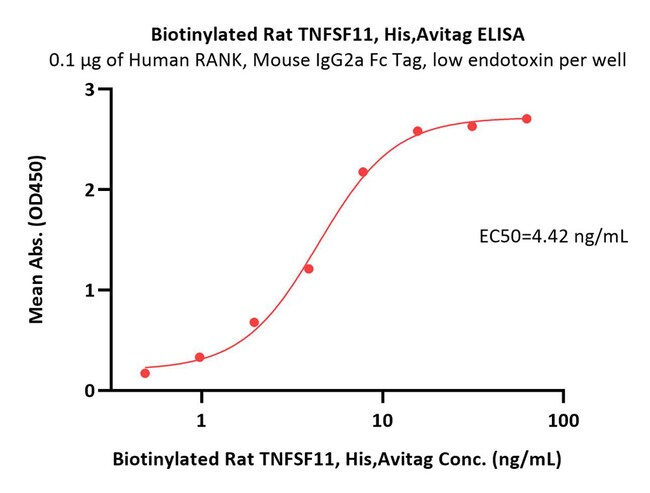
Receptor activator of nuclear factor kappa-B ligand (RANKL), also known as tumor necrosis factor ligand superfamily member 11 (TNFSF11), TNF-related activation-induced cytokine (TRANCE), osteoprotegerin ligand (OPGL), and osteoclast differentiation factor (ODF), is known as a type II membrane protein and is a member of the tumor necrosis factor (TNF) superfamily. RANKL, through its ability to stimulate osteoclast formation and activity, is a critical mediator of bone resorption and overall bone density. Some findings also suggestion some cancer cells, particularly prostate cancer cells, can activate an increase in bone remodeling and ultimately increase overall bone production.[17] This increase in bone remodeling and bone production increases the overall growth of bone metastasizes. The overall control of bone remodeling is regulated by the binding of RANKL with its receptor or its decoy receptor, respectively, RANK and OPG.
Numéro de catalogue. 502719017 Fournisseur ACROBiosystems Inc Code fournisseur RALR82Q925UG

Pour de l'aide SVP utiliser la function de clavardage; nous envoyer un couriel à help@thermofisher.com ou appelez le service à la clientèle au 1-800-234-7437.

Receptor activator of nuclear factor kappa-B ligand (RANKL), also known as tumor necrosis factor ligand superfamily member 11 (TNFSF11), TNF-related activation-induced cytokine (TRANCE), osteoprotegerin ligand (OPGL), and osteoclast differentiation factor (ODF), is known as a type II membrane protein and is a member of the tumor necrosis factor (TNF) superfamily. RANKL, through its ability to stimulate osteoclast formation and activity, is a critical mediator of bone resorption and overall bone density. Some findings also suggestion some cancer cells, particularly prostate cancer cells, can activate an increase in bone remodeling and ultimately increase overall bone production.[17] This increase in bone remodeling and bone production increases the overall growth of bone metastasizes. The overall control of bone remodeling is regulated by the binding of RANKL with its receptor or its decoy receptor, respectively, RANK and OPG.