Learn More
Invitrogen™ RANKL (soluble) Polyclonal Antibody, PeproTech®, Invitrogen™

Description
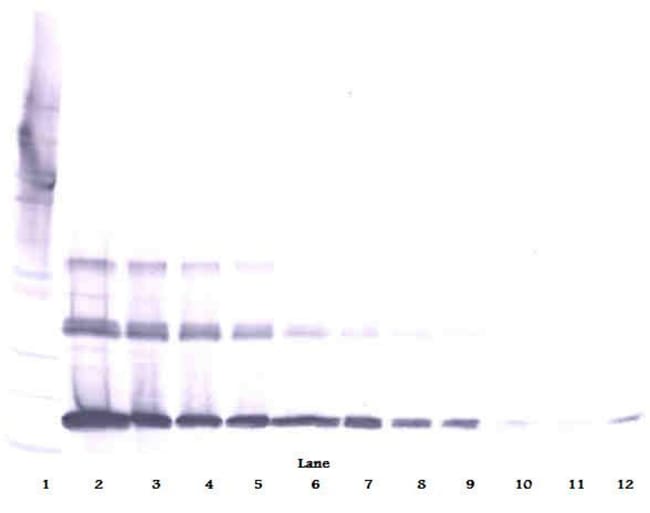
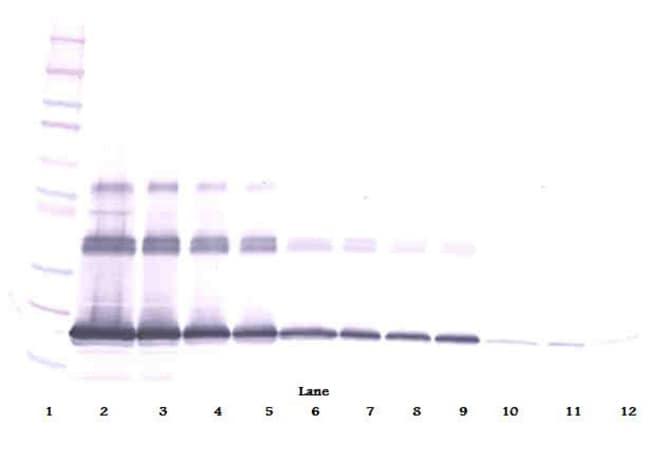
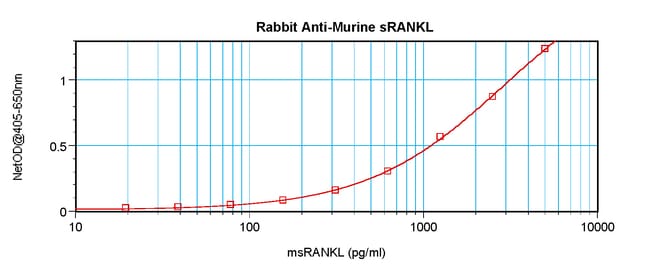
AA Sequence of recombinant protein: PAMMEGSWLD VAQRGKPEAQ PFAHLTINAA SIPSGSHKVT LSSWYHDRGW AKISNMTLSN GKLRVNQDGF YYLYANICFR HHETSGSVPT DYLQLMVYVV KTSIKIPSSH NLMKGGSTKN WSGNSEFHFY SINVGGFFKL RAGEEISIQV SNPSLLDPDQ DATYFGAFKV QDID. Preparation: Produced from sera of rabbits immunized with highly pure Recombinant Murine sRANK Ligand. Anti-Murine sRANK Ligand-specific antibody was purified by affinity chromatography employing an immobilized Murine sRANK Ligand matrix. Sandwich ELISA: To detect Murine sRANK Ligand by sandwich ELISA (using 100 μL/well antibody solution) a concentration of 0.5-2.0 μg/mL of this antibody is required. This antigen affinity purified antibody, in conjunction with PeproTech Biotinylated Anti-Murine sRANKL (500-P63Bt) as a detection antibody, allows the detection of at least 0.2-0.4 ng/well of Recombinant Murine sRANK Ligand. Western Blot: To detect Murine sRANK Ligand by Western Blot analysis this antibody can be used at a concentration of 0.1-0.2 μg/mL. Used in conjunction with compatible secondary reagents the detection limit for Recombinant Murine sRANK Ligand is 1.5-3.0 ng/lane, under either reducing or non-reducing conditions.
Spécifications
Spécifications
| Antigène | RANKL (soluble) |
| Applications | ELISA, Western Blot |
| Classification | Polyclonal |
| Concentration | 0.1-1.0 mg/mL |
| Conjugué | Unconjugated |
| Formule | PBS with no preservative |
| Gène | TNFSF11 |
| Numéro d’acquisition du gène | O35235 |
| Alias du gène | CD254; H-RANK-L; hRANKL2; Ly109l; M-Rank-L; ODF; OPG; OPG ligand; OPGL; OPTB2; Osteoclast differentiation factor; osteoprotegerin ligand; Rankl; rank-l; receptor activator of NF-kappaB ligand; receptor activator of nuclear factor kappa B ligand; receptor activator of nuclear factor kappa-B ligand; RP11-86N24.2; sOdf; srankl; TNF-related activation-induced cytokine; Tnfsf11; TNLG6B; Trance; tumor necrosis factor (ligand) superfamily member 11; tumor necrosis factor (ligand) superfamily, member 11; tumor necrosis factor ligand 6B; tumor necrosis factor ligand superfamily member 11; Tumor necrosis factor ligand superfamily member 11, membrane form; Tumor necrosis factor ligand superfamily member 11, soluble form; tumor necrosis factor superfamily member 11; tumor necrosis factor-related activation-induced cytokine |
| Symboles de gène | TNFSF11 |
| Afficher plus de résultats |