missing translation for 'onlineSavingsMsg'
Learn More
Learn More
Invitrogen™ PSD-95 Recombinant Mouse Monoclonal Antibody (7E3-1B8)
Description
This is an engineered recombinant antibody that was developed to provide superior sensitivity without changing the paratope. Recombinant Mouse monoclonal antibodies are produced using in vitro expression systems. Recombinant antibodies are produced using specific genes that code for the desired antibodies. These genes are cloned into an expression vector and expressed in vitro. The advantages of recombinant antibodies include better specificity and lot-to-lot consistency. It is recommended that the antibody be carefully titrated for optimal performance in the assay of interest.
Post Synaptic Density 95 kDa (PSD-95), also known as synapse associated protein 90 kDa (SAP90), is one of a family of membrane-associated proteins found in the postsynaptic density in forebrain neurons and certain presynaptic structures in the cerebellum. Like other members of the family, PSD-95 has three 90 amino acid repeats called PDZ domains followed by an SH3 domain and a yeast guanylate kinase homology (GuK) domain. PSD-95 is believed to participate in the clustering of certain proteins, including NMDA receptors, Shaker-type potassium channels at the synaptic membrane in central nervous system (CNS) neurons. There are two principal modes of interaction between PSD-95 and other proteins. NMDA receptors and shaker-type potassium channels both share C-terminal sequence homology consisting of a threonine/serine-X-valine-COOH (T/SXV) motif. Other neuronal proteins that share this motif (beta 1 adrenergic receptor, some serotonin receptors, some sodium channel subunits, and additional potassium channel subunits), and some of these proteins may interact with PSD-95 by binding to its PDZ domains. Neuronal nitric oxide synthase (nNOS), which lacks the T/SXV motif but which has its own PDZ domain, has been shown to associate with PSD-95 in vitro through a pseudo-homotypic PDZ-PDZ interaction.
Spécifications
Spécifications
| Antigène | PSD-95 |
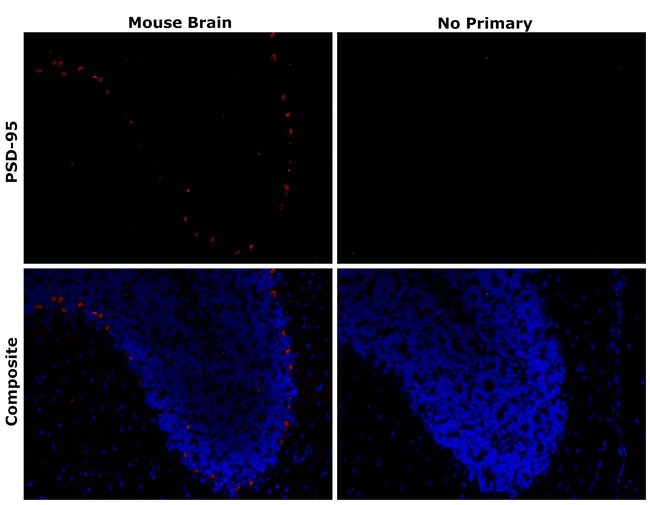
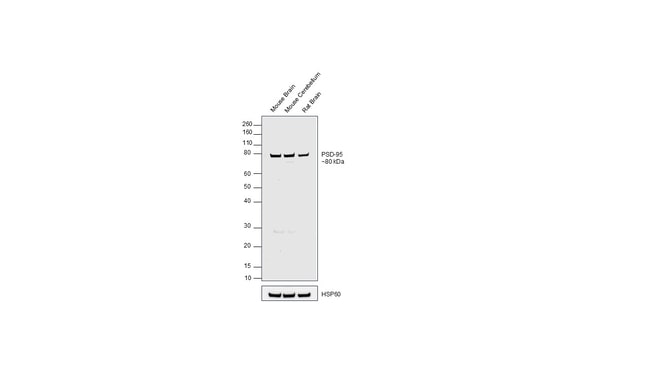
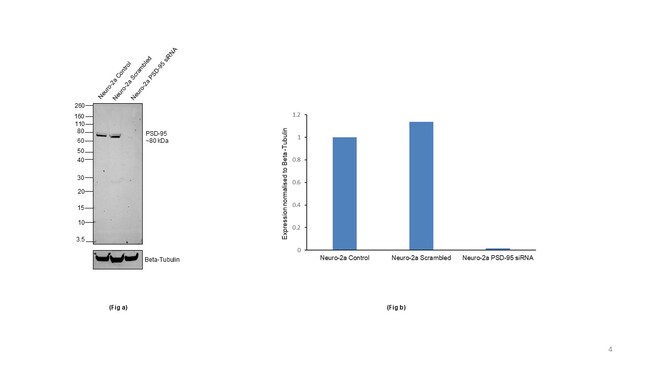
| Applications | Immunohistochemistry (Paraffin), Western Blot |
| Classification | Recombinant Monoclonal |
| Clone | 7E3-1B8 |
| Concentration | 1.0 mg/mL |
| Conjugué | Unconjugated |
| Formule | PBS with 0.09% sodium azide; pH 7.2-7.4 |
| Gène | DLG4 |
| Numéro d’acquisition du gène | P31016, P78352, Q62108 |
| Alias du gène | discs large homolog 4; discs large MAGUK scaffold protein 4; discs, large homolog 4; discs, large homolog 4 (Drosophila); disks large homolog 4; Dlg4; Dlgh4; FLJ97752; FLJ98574; post synaptic density; postsynaptic density protein 95; post-synaptic density protein 95; PSD95; PSD-95; PSD-95 alpha 2b; PSD-95 beta; Sap90; SAP-90; SAP90A; Synapse-associated protein 90; synapse-associated protein SAP90; Tax interaction protein 15 |
| Afficher plus de résultats |