missing translation for 'onlineSavingsMsg'
Learn More

Invitrogen™ Placental Alkaline Phosphatase Monoclonal Antibody (8B6), Biotin, eBioscience™
GREENER_CHOICE

Numéro de catalogue. 501122620
Modifier l'affichage
Click to view available options
Quantité:
100 μg
1 product options available for selection
Product selection table with 1 available options. Use arrow keys to navigate and Enter or Space to select.
Numéro de catalogue. Quantité
501122620 100 μg
Use arrow keys to navigate between rows. Press Enter or Space to select a product option. 1 options available.
1 options
Numéro de catalogue. 501122620 Fournisseur Invitrogen™ Code fournisseur 13987082

Pour de l'aide SVP utiliser la function de clavardage; nous envoyer un couriel à help@thermofisher.com ou appelez le service à la clientèle au 1-800-234-7437.

Mouse Monoclonal Antibody

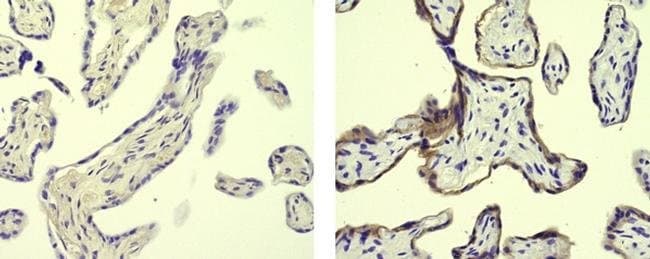
The monoclonal antibody 8B6 recognizes human Placental Alkaline Phosphatase (PLAP), a 130 (or 130 with 65 kDa) enzyme expressed by placental syncytiotrophoblastoid cells. This enzyme has slightly different enzyme kinetics from other phosphatases. PLAP can be found anchored to the plasma membrane in addition to the cytoplasm. Expression is found in several germ line cancers; ovarian and testicular. Expression is also present in human embryonic stem cells and bone marrow-derived mesenchymal stromal cells. This 8B6 antibody reacts with both the Regan and Nagao isozymes. Applications Reported: This 8B6 antibody has been reported for use in immunohistochemical staining of frozen (IHC-F) and formalin-fixed paraffin embedded (IHC-P) tissue, and ELISA. Applications Tested: This 8B6 antibody has been tested by immunohistochemistry on formalin-fixed paraffin embedded (FFPE) human placenta with trypsin digestion. This antibody can be used at less than or equal to 20 μg/mL. It is recommended that the antibody be carefully titrated for optimal performance in the assay of interest. Filtration: 0.2 μm post-manufacturing filtered.

Placental Alkaline Phosphatase plays an important role in the regulation of specific inflammatory disease processes. There are at least four distinct but related alkaline phosphatases: intestinal, placental, placental-like, and liver/bone/kidney for this form of alkaline phosphatase have been well characterized. Placental Alkaline Phosphatase reacts with a membrane-bound isoenzyme (Regan and Nagao type) of Placental Alkaline Phosphatase (PLAP) occurring in the placenta during the 3rd trimester of gestation. Placental Alkaline Phosphatase is useful in the identification of testicular germ cell tumors. Unlike germ cell tumors, PLAP-positive somatic cell tumors uniformly express epithelial membrane antigen (EMA). A proposed function of Placental Alkaline Phosphatase is matrix mineralization; however, mice that lack a functional form of this enzyme show normal skeletal development. Placental Alkaline Phosphatase has been linked directly to hypophosphatasia, a disorder that is characterized by hypercalcemia and includes skeletal defects. The character of hypophosphatasia can vary, however, depending on the specific mutation since this determines age of onset and severity of symptoms.

Spécifications

Antigène Placental Alkaline Phosphatase
Applications ELISA, Immunohistochemistry (Frozen), Immunohistochemistry (Paraffin)
Classification Monoclonal
Clone 8B6
Concentration 0.5 mg/mL
Conjugué Biotin
Formule PBS with 0.09% sodium azide; pH 7.2
Gène ALPP
Numéro d’acquisition du gène P05187
Alias du gène Alkaline phosphatase placental type; Alkaline phosphatase Regan isozyme; alkaline phosphatase, placental; alkaline phosphatase, placental type; alkaline phosphomonoesterase; ALP; Alp1; ALPP; AP-TNAP; DOA1; FLJ11281; FLJ40094; FLJ61142; FLJ93059; Germ-cell alkaline phosphatase; glycerophosphatase; HOPS; MGC161443; MGC167935; nagao Isozyme; P PLAP; PALP; PLA2P; PLAA; placental alkaline phosphatase 1; placental heat-stable alkaline phosphatase; PLAP; PLAP1; PLAP-1; rCG23846-like; Regan isozyme; TNAP; TNSALP
Symboles de gène ALPP
Espèces hôtes Mouse
Méthode de purification Affinity chromatography
Quantité 100 μg
Statut réglementaire RUO
Primaire ou secondaire Primary
ID du gène (Entrez) 250
Espèces cibles Human
Contenu et stockage 4°C, store in dark, DO NOT FREEZE!
Type de produit Antibody
Forme Liquid
Isotype IgG2a κ
Afficher plus de résultats Afficher moins de résultats