missing translation for 'onlineSavingsMsg'
Learn More
Learn More
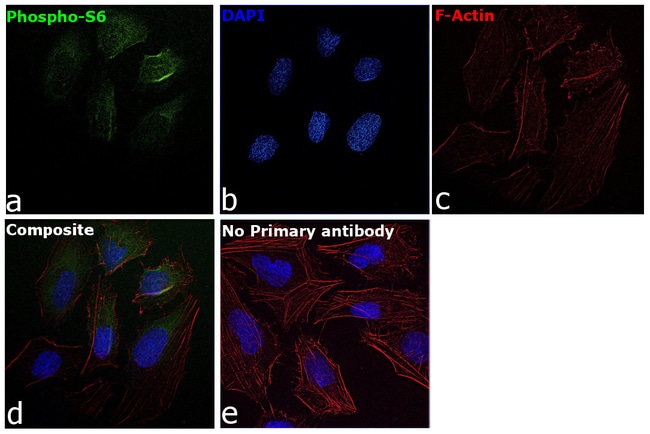
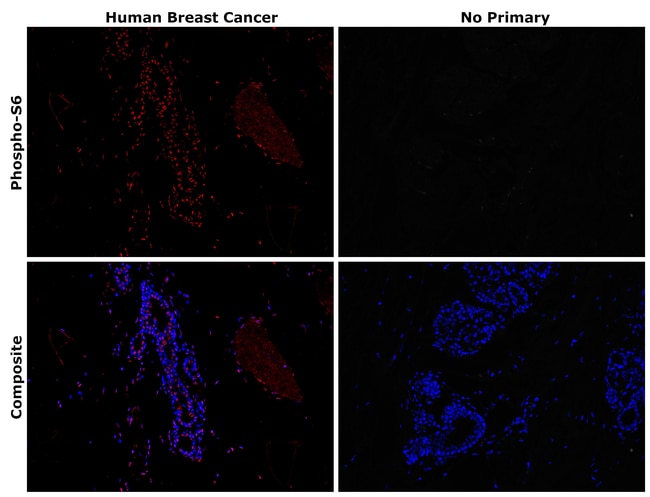
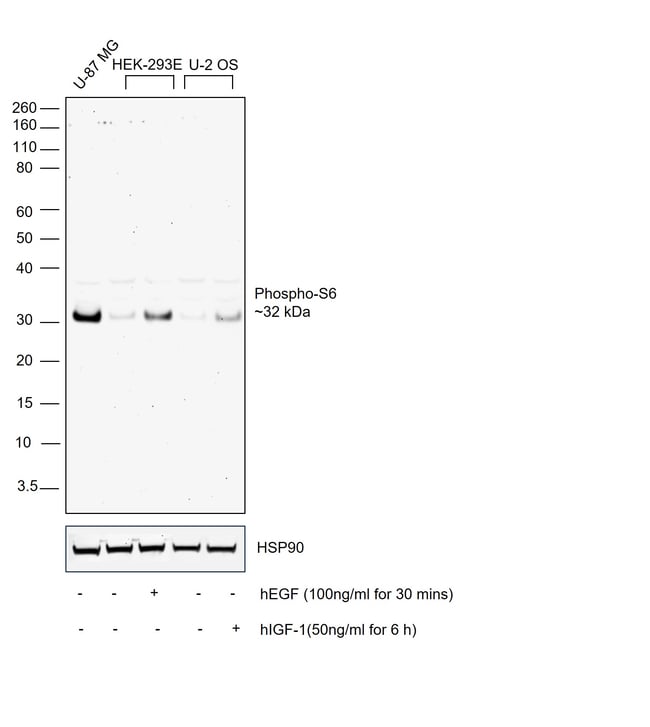
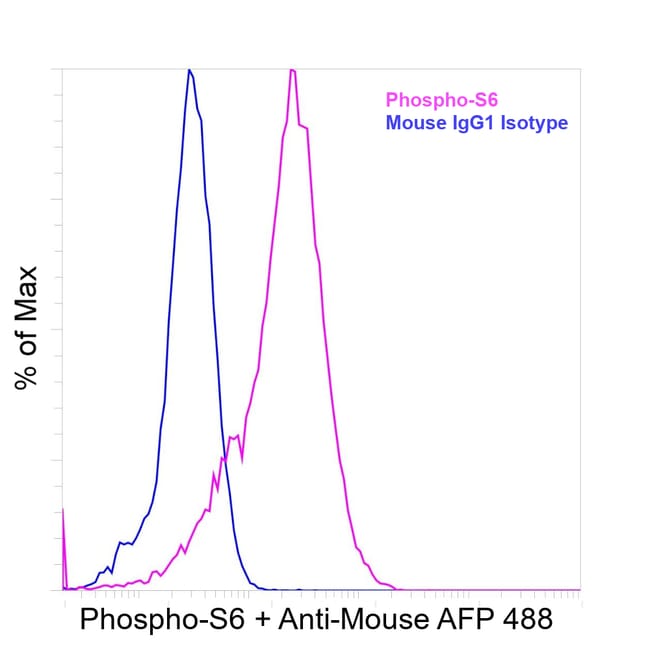
Invitrogen™ Phospho-S6 (Ser235, Ser236) Recombinant Mouse Monoclonal Antibody (cupk43k)
Description
Recombinant mouse monoclonal antibodies are produced using in vitro expression systems. Recombinant antibodies are produced using specific genes that code for the desired antibodies. These genes are cloned into an expression vector and expressed in vitro. The advantages of recombinant antibodies include better specificity and lot-to-lot consistency. It is recommended that the antibody be carefully titrated for optimal performance in the assay of interest.
Ribosomes, the organelles that catalyze protein synthesis, consist of a small 40S subunit and a large 60S subunit. Together these subunits are composed of 4 RNA species and approximately 80 structurally distinct proteins. This gene encodes a cytoplasmic ribosomal protein that is a component of the 40S subunit. The protein belongs to the S6E family of ribosomal proteins. It is the major substrate of protein kinases in the ribosome, with subsets of five C-terminal serine residues phosphorylated by different protein kinases. Phosphorylation is induced by a wide range of stimuli, including growth factors, tumor-promoting agents, and mitogens. Dephosphorylation occurs at growth arrest. The protein may contribute to the control of cell growth and proliferation through the selective translation of particular classes of mRNA. As is typical for genes encoding ribosomal proteins, there are multiple processed pseudogenes of this gene dispersed through the genome.
Spécifications
Spécifications
| Antigène | Phospho-S6 (Ser235, Ser236) |
| Applications | Flow Cytometry, Immunohistochemistry (Paraffin), Western Blot, Immunocytochemistry |
| Classification | Recombinant Monoclonal |
| Clone | cupk43k |
| Concentration | 1.0 mg/mL |
| Conjugué | Unconjugated |
| Formule | PBS with 0.09% sodium azide; pH 7.2-7.4 |
| Gène | RPS6 |
| Numéro d’acquisition du gène | P62753, P62754 |
| Alias du gène | (Rp)S6; 40S ribosomal protein S6; air[8]; air8; anon-WO02059370.61; CG10944; CG10944-PA; CG10944-PB; Dmel\CG10944; Dmel_CG10944; DS6; hemocytes enlarged; hen; l(1)air[8]; l(1)air8; l(1)hen; LD31286p; lethal(1)aberrant immune response[8]; lethal-(1)-haemocytes enlarged; lethal-aberrant-immune-response-8; M(1)7BC; M(1)7C; minute; minute (1) 7BC; OK/SW-cl.2; OTTHUMP00000021121; OTTHUMP00000021122; Phosphoprotein NP33; pp30; ribosomal protein S6; Rp S6; RP11-513M16.6; RPS6; RpS6-PA; RpS6-PB; RS6; S6; S6 ribosomal protein; S6R; Small ribosomal subunit protein eS6; wu:fa92e06; wu:fb64g06; zgc:92237 |
| Afficher plus de résultats |