missing translation for 'onlineSavingsMsg'
Learn More
Learn More
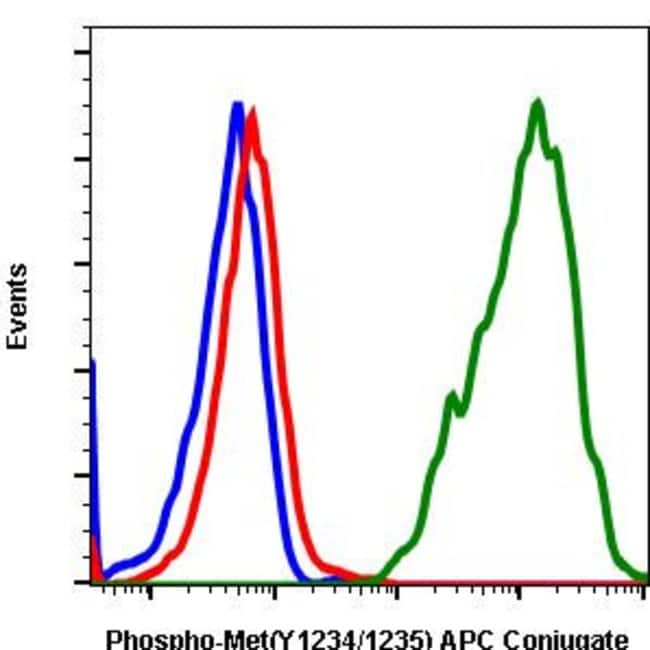
Invitrogen™ Phospho-c-Met (Tyr1234, Tyr1235) Recombinant Rabbit Monoclonal Antibody (MetY12341235-6F11), APC
Description
Recombinant rabbit monoclonal antibodies are produced using in vitro expression systems. The expression systems are developed by cloning in the specific antibody DNA sequences from immunoreactive rabbits. Then, individual clones are screened to select the best candidates for production. The advantages of using recombinant rabbit monoclonal antibodies include: better specificity and sensitivity, lot-to-lot consistency, animal origin-free formulations, and broader immunoreactivity to diverse targets due to larger rabbit immune repertoire.
MET (cMET) is a receptor-like tyrosine kinase whose dysregulation has been linked to many types of human malignancies. After activation of the ligand, MET interacts with the PI3-kinase subunit PIK3R1, PLCG1, SRC, GRB2, and STAT3. There interactions lead to the activation of signaling cascades including RAS-ERK, PI3, kinase-AKT, and PLCgamma-PKC. MET plays a role in embryonic development including gastrulation, development of muscles and neurons, angiogenesis, and kidney formation. It also plays a role in adults including wound healing, organ regeneration, and tissue remodeling. MET has been linked to cancers including gastric, renal, and breast; therefore, making it a target for cancer therapeutics and diagnostic testing.
Spécifications
Spécifications
| Antigène | Phospho-c-Met (Tyr1234, Tyr1235) |
| Applications | Flow Cytometry |
| Classification | Recombinant Monoclonal |
| Clone | MetY12341235-6F11 |
| Conjugué | APC |
| Formule | PBS with 0.2% BSA and 0.09% sodium azide; pH 7.4 |
| Gène | MET |
| Numéro d’acquisition du gène | P08581, P16056 |
| Alias du gène | AI838057; AUTS9; bHLHe59; CG1705; CG1705-PA; CG1705-PB; cmet; c-met; c-met proto-oncogene; c-Met receptor tyrosine kinase; c-Met/HGF receptor; D249; DFNB97; Dmel\CG1705; Dmel_CG1705; DmMet; EC 2.7.10.1; Hepatocyte growth factor receptor; HGF; HGF receptor; HGF receptor c-Met; HGF/SF receptor; HGFR; HGF-SF receptor; juvenile hormone resistance; met; met proto-oncogene; met proto-oncogene (hepatocyte growth factor receptor); met proto-oncogene tyrosine kinase; MET proto-oncogene, receptor tyrosine kinase; Met/Met1; Met; protein tyrosin kinase; methoprene tolerant; Methoprene-tolerant; Methoprene-tolerant protein; Met-PA; Met-PB; Mett; oncogene MET; Par4; Proto-oncogene c-Met; RCCP2; resistance (1) juvenile H; resistance to juvenile hormone; Rst(1)JH; sc MET; scatter factor receptor; SF receptor; soluble c met; tyrosine-protein kinase Met |
| Symboles de gène | MET |
| Afficher plus de résultats |