missing translation for 'onlineSavingsMsg'
Learn More
Learn More
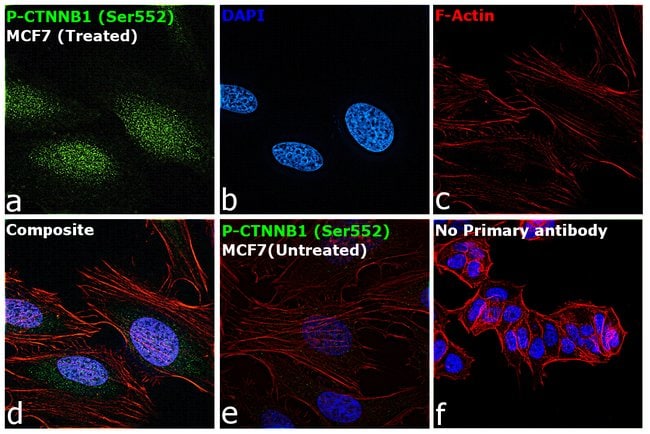
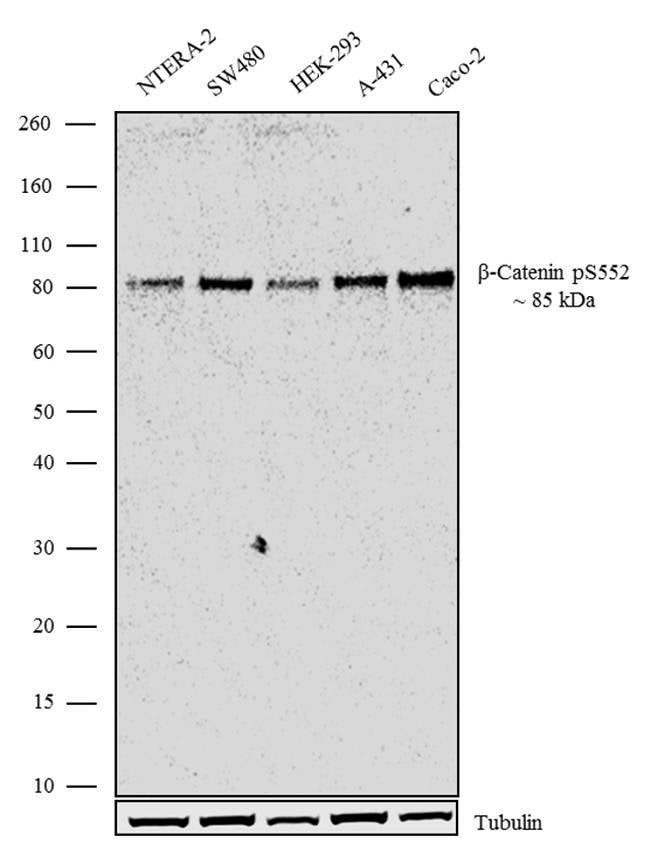
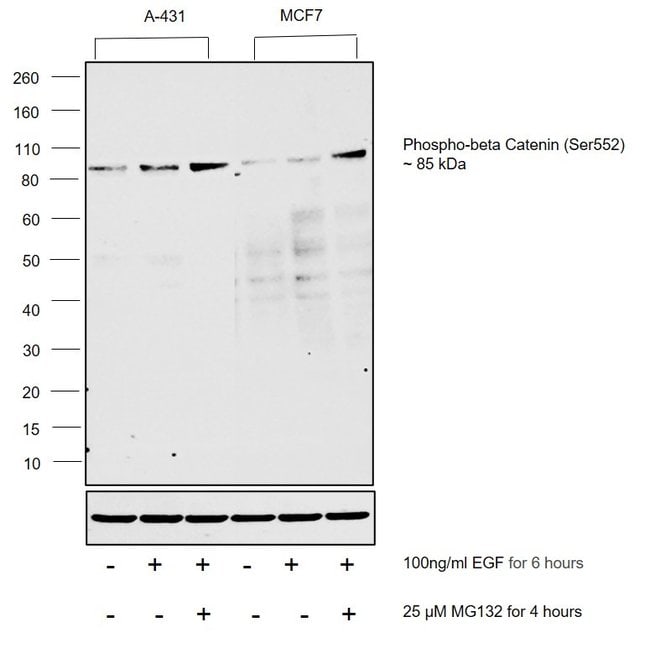
Invitrogen™ Phospho-beta Catenin (Ser552) Recombinant Rabbit Monoclonal Antibody (1H29L24)
Description
This antibody is predicted to react with Monkey, Pig, Horse Recombinant rabbit monoclonal antibodies are produced using in vitro expression systems. The expression systems are developed by cloning in the specific antibody DNA sequences from immunoreactive rabbits. Then, individual clones are screened to select the best candidates for production. The advantages of using recombinant rabbit monoclonal antibodies include: better specificity and sensitivity, lot-to-lot consistency, animal origin-free formulations, and broader immunoreactivity to diverse targets due to larger rabbit immune repertoire.
Beta-catenin, an adherens junction (AJ) protein, was originally identified as a component of cell-cell adhesion structures. AJs are necessary for the creation and maintenance of epithelial cell layers by regulating cell growth and adhesion between cells. Beta-catenin interacts with the cytoplasmic domain of E-cadherin and links E-cadherin to alpha-catenin, which in turn mediates anchorage of the E-cadherin complex to the cortical actin cytoskeleton. Studies show that Beta-catenin also binds to another cytoskeletal complex containing the adenomatous polyposis coli protein and microtubules, and interacts with several signaling pathways that include tyrosine kinases, phosphatases and Wnt/Wingless. The interplay between beta-catenin, cytoskeletal complexes and signaling pathways may regulate morphogenesis. Beta-catenin is expressed in several hair follicle cell types, basal and peripheral matrix cells, and cells of the outer and inner root sheats. A pathological role of beta-catenin has been identified in pilomatrixoma (PTR), medulloblastoma (MDB), colorectal cancer (CRC), ovarian cancer, and tumor development. In the nucleus, beta-catenin serves to co activate a family of Lef/Tcf transcription factors that stimulate transcription of target genes including those encoding cyclin D and c-myc that promote cell proliferation. The influence on cell proliferation is the molecular basis for the role of beta-catenin in tumorgenesis, specifically, solid tumors of the breast, colon, liver, lung, gastric, prostate, and skin.
Spécifications
Spécifications
| Antigène | Phospho-beta Catenin (Ser552) |
| Applications | Western Blot, Immunocytochemistry |
| Classification | Recombinant Monoclonal |
| Clone | 1H29L24 |
| Concentration | 0.5 mg/mL |
| Conjugué | Unconjugated |
| Formule | PBS with 0.09% sodium azide; pH 7.2-7.4 |
| Gène | CTNNB1 |
| Numéro d’acquisition du gène | P35222 |
| Alias du gène | armadillo; armadillo homolog; Bcatenin; b-catenin; beta 1 88kDa; beta catenin; Betacatenin; beta-catenin; beta-catenin 1; Bfc; C20orf33; Cadherin associated protein; catenin; catenin (cadherin associated protein), beta 1; catenin (cadherin associated protein), beta 1, 88kDa; catenin (cadherin-associated protein) beta 1; catenin (cadherin-associated protein), beta 1; catenin (cadherin-associated protein), beta 1, 88kDa; Catenin b 1; Catenin b1; catenin beta; catenin beta 1; catenin beta 1 L homeolog; Catenin beta1; Catenin beta-1; Catenin β 1; Catenin β1; Catnb; CHBCAT; CTNB1; CTNNB; ctnnb1; ctnnb1.L; ctnnb1-a; ctnnb1-b; dJ633O20.1; DKFZp686D02253; FLJ25606; FLJ37923; id:ibd2058; Mesc; MRD19; NAP; NYD-SP19; OK/SW-cl.35; OTTHUMP00000209289; P14L; PP8304; PRO2286; RP5-1118M15.1; wu:fb73e10; wu:fi81c06; wu:fk25h01; XELAEV_18031149mg; β catenin; βcatenin |
| Afficher plus de résultats |