Learn More
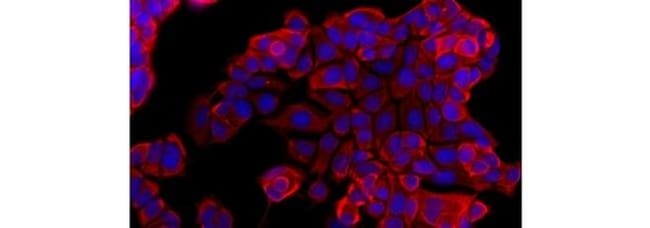
Invitrogen™ Pan Cytokeratin Monoclonal Antibody (AE1/AE3), eFluor™ 570, eBioscience™, Invitrogen™
Description
Description: The monoclonal antibodies AE1 and AE3 recognize many of the acidic and basic cytokeratin family members. Cytokeratins are intermediate filament proteins comprising one component of the cytoskeleton. There are two large families of cytokeratins, acidic and basic, but all contain the same basic domains (i.e. an alpha-helical core with an N- and C-terminal domain). The proteins are expressed in epithelial cells, but are developmentally regulated. Many tumors also express these proteins and their expression can help identify the origin of a neoplasm. The AE3 monoclonal antibody recognizes the 65 to 67 triplet, 64, 59, 58, 56, 54 and 52kD proteins also known as cytokeratin 1, 2, 3, 4, 5, 6, 7, and 8 while the AE1 antibody recognizes 56.5, 54', 50, 50', 48, and 40 kDa proteins (also known as CK10, 14, 15, 16 and 19). These antibodies can be used on a wide array of tissue samples from mouse, human, rat, primates (cynomolgus and rhesus), dog, cat, rabbit, and chicken. Applications Reported: This AE1/AE3 antibody has been reported for use in immunohistochemical staining, immunocytochemistry, immunohistochemical staining of frozen tissue sections, and immunohistochemical staining of formalin-fixed paraffin embedded tissue sections. Applications Tested: This AE1/AE3 antibody has been tested by immunocytochemistry on methanol-fixed MCF7 cells and can be used at less than or equal to 1 μg/mL.
Spécifications
Spécifications
| Antigène | Pan Cytokeratin |
| Applications | Immunohistochemistry (Frozen), Immunohistochemistry (Paraffin), Immunocytochemistry |
| Classification | Monoclonal |
| Clone | AE1/AE3 |
| Concentration | 0.2 mg/mL |
| Conjugué | eFluor 570 |
| Formule | PBS with 0.09% sodium azide; pH 7.2 |
| Gène | KRT19 |
| Numéro d’acquisition du gène | P02533, P02535, P02538, P04104, P04264, P05783, P05784, P05787, P07744, P08727, P08729, P08730, P08779, P11679, P12035, P13645, P13646, P13647, P19001, P19012, P19013, P35908, P50446, Q01546, Q04695, Q29426, Q3TTY5, Q3UV17, Q61414, Q61781, Q6EIY9, Q6EIZ0, Q6EIZ1, Q6IFZ6, Q7Z794, Q922U2, Q9DCV7, Q9QWL7, Q9Z2K1 |
| Alias du gène | 2310016L08Rik; 3300001P10Rik; 39.1; 40-kDa keratin intermediate filament; 47 kDa cytokeratin; 56 kDa cytokeratin; 57kd keratin; 57kDa keratin; 58 kDa cytokeratin; 60-kDa keratin; 63kDa Keratin; 65 kDa cytokeratin; 67 kDa cytokeratin; AA960620; adult keratin; AI324768; AI528832; AI626930; AI663979; AL022697; alpha keratin; AU019895; AW108092; AW146334; basic epidermal type II cytokeratin (carboxy-terminal region, clone pUF164); BB005427; BCIE; BIE; Card2; cell proliferation-inducing gene 46 protein; CK 2e; CK1; CK-1; CK10; CK-10; CK13; CK-13; CK14; CK-14; CK15; CK-15; CK16; CK-16; CK-17; CK18; CK-18; CK19; CK-19; CK-1B; CK-2e; CK3; CK-3; CK4; CK-4; CK5; CK-5; ck55; CK6A; CK-6A; CK6C; CK-6C; CK6D; CK-6D; CK-6E; CK7; CK-7; CK8; CK-8; CYK18; CYK4; CYK8; CYKER; cytokeratin 1; cytokeratin 10; cytokeratin 13; cytokeratin 14; cytokeratin 15; cytokeratin 16; cytokeratin 18; cytokeratin 19; cytokeratin 3; cytokeratin 4; cytokeratin 5; cytokeratin 6A; cytokeratin 6C; cytokeratin 6D; cytokeratin 7; cytokeratin 8; cytokeratin 8 (370 AA); cytokeratin endo A; Cytokeratin endo B; cytokeratin otokeratin; cytokeratin type II; cytokeratin type II, component Ib/c; cytokeratin type II, component III; cytokeratin VIB; cytokeratin VII; cytokeratin-1; Cytokeratin-10; cytokeratin-13; Cytokeratin-14; cytokeratin-15; Cytokeratin-16; cytokeratin-17; Cytokeratin-18; cytokeratin-19; Cytokeratin-1B; Cytokeratin-2e; cytokeratin-3; Cytokeratin-4; cytokeratin-5; Cytokeratin-6A; cytokeratin-6B; cytokeratin-6C; Cytokeratin-6D; cytokeratin-6E; cytokeratin-7; Cytokeratin-8; cytokeratin-A; Cytoskeletal 57 kDa keratin; D130054E02Rik; D15Wsu77e; DDD; DDD1; ear specific cytokeratin; EBS2; ebs3; ebs4; EGK_03684; EGK_03685; EHK; EHK1; Endo B; EndoA; EndoC; epidermal keratin 10; epidermal keratin VII; epidermolysis bullosa simplex 2 Dowling-Meara/Kobner/Weber-Cockayne types; epidermolysis bullosa simplex, Dowling-Meara, Koebner; epidermolytic hyperkeratosis 1; epidermolytic hyperkeratosis; keratosis palmaris et plantaris; epithelial keratin 1; epithelial keratin 10; epithelial keratin 2e; Epithelial keratin-1; Epithelial keratin-2e; EPPK; fgk; fin and gill keratin; FNEPPK; focal non-epidermolytic palmoplantar keratoderma; GK-19; Hair alpha protein; HMWCK; Hom s 5; I79_019823; I79_021074; I79_023185; I79_024335; intermediate filament protein; K1; K10; K13; K14; K15; K16; K17; K18; K19; K1B; K1C1; K1CO; K1CP; K1CS; K2C7; K2C8; K2e; K3; K3 keratin; K4; K5; K6A; K6a keratin; K6C; K6D; K7; K77; K8; Ka10; Ka13; Ka14; Ka15; Ka16; Ka17; Ka19; kamp-keratin derived antimicrobial peptide; Kb1; Kb2; Kb4; Kb7; KDAMP; KER1; Ker10; Ker2; KERA; keratin; keratin 1; keratin 1 (epidermolytic hyperkeratosis); keratin 1, type II; keratin 10; keratin 10 (epidermolytic hyperkeratosis); keratin 10 (epidermolytic hyperkeratosis; keratosis palmaris et plantaris); keratin 10, type I; keratin 10, type I L homeolog; keratin 10, type I S homeolog; keratin 12, gene 2 S homeolog; keratin 13; keratin 13, type I; keratin 13, type I S homeolog; keratin 14; keratin 14 (epidermolysis bullosa simplex, Dowling-Meara, Koebner); keratin 14, type I; keratin 14, type I L homeolog; keratin 15; keratin 15, gene 1 S homeolog; keratin 15, type I; keratin 16; keratin 16 (focal non-epidermolytic palmoplantar keratoderma); keratin 16, type I; keratin 16, type I S homeolog; keratin 17; keratin 17 L homeolog; keratin 17, type I; keratin 17, type I L homeolog; keratin 18; keratin 18, type I; keratin 19; keratin 19 S homeolog; keratin 19 S homeolog; keratin 19; keratin 19, type I; Keratin 1B; keratin 2; keratin 2 (epidermal ichthyosis bullosa of Siemens); keratin 2 epidermis; keratin 2, type II; keratin 24; keratin 2A; keratin 2A (epidermal ichthyosis bullosa of Siemens); keratin 3; keratin 3, type II; keratin 4; keratin 4, type II; keratin 5; keratin 5 (epidermolysis bullosa simplex Dowling-Meara/Kobner/Weber-Cockayne types); keratin 5 (epidermolysis bullosa simplex, Dowling-Meara/Kobner/Weber-Cockayne types) |
| Afficher plus de résultats |
For Research Use Only.