Learn More
Invitrogen™ OCT3/4 Recombinant Rat Monoclonal Antibody (EM92), Alexa Fluor™ Plus 555
Description
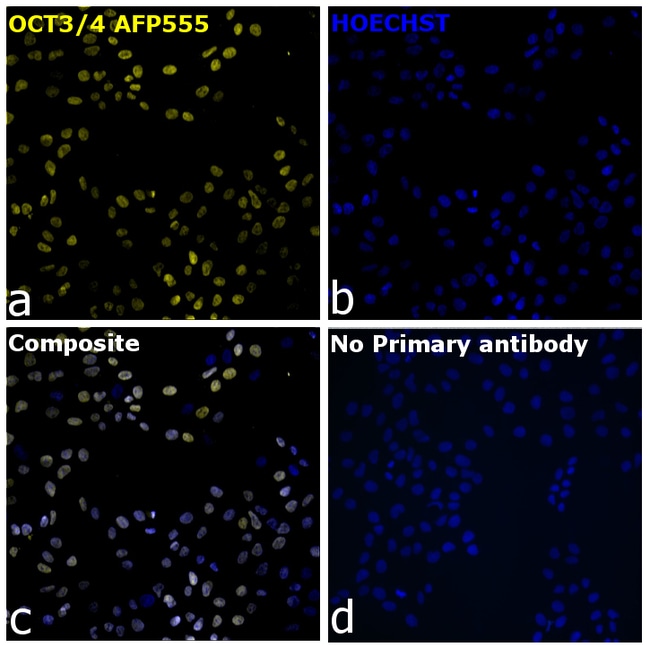
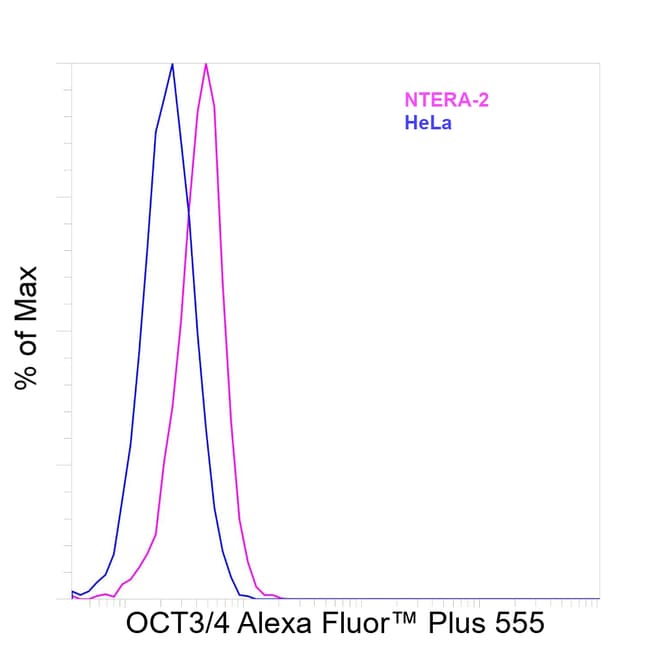
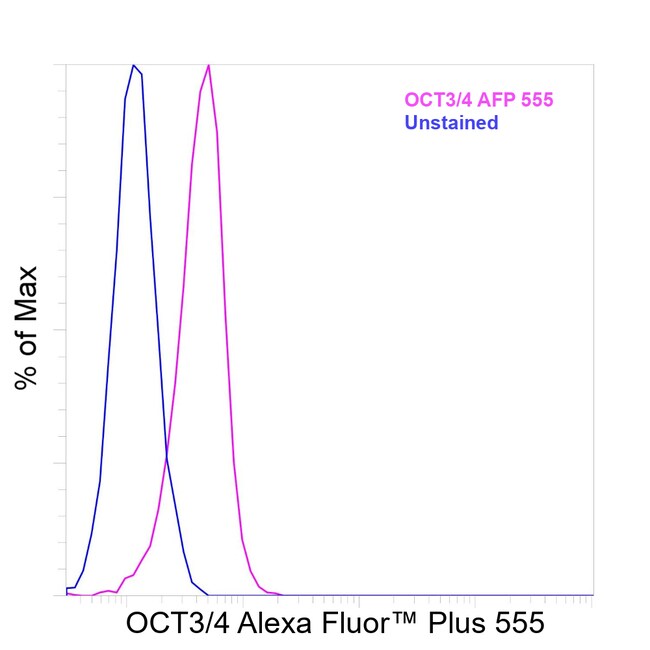
Alexa Fluor™ Plus recombinant antibodies are conjugated using new, proprietary dye chemistry so you can generate stunning data. Alexa Fluor™ Plus antibodies represent an advancement in fluorescent conjugate technology. Alexa Fluor™ Plus antibodies provide brighter signal compared to leading Alexa Fluor™ antibodies, providing you with better signal-to-noise for your critical experiments. These antibodies show better specificity and lot-to-lot consistency as these are recombinant antibodies, generated by cloning specific genes for the desired antibodies into an expression vector and expressed in vitro. Using conjugate solutions: Centrifuge the protein conjugate solution briefly in a microcentrifuge before use; add only the supernatant to the experiment. This step will help eliminate any protein aggregates that may have formed during storage, thereby reducing nonspecific background staining. Applications Tested: This EM92 antibody has been tested by Immunocytochemistry and flow cytometry applications analysis of NTERA-2 cells. It is recommended that the antibody be carefully titrated for optimal performance in the assay of interest. Excitation: 553 nm; Emission: 568 nm; Laser: Yellow Laser Filtration: 0.2 μm post-manufacturing filtered.
Spécifications
Spécifications
| Antigène | OCT3/4 |
| Applications | Flow Cytometry, Immunocytochemistry |
| Classification | Recombinant Monoclonal |
| Clone | EM92 |
| Concentration | 1.0 mg/mL |
| Conjugué | Alexa Fluor Plus 555 |
| Formule | Proprietary buffer with 0.008% Bromonitrodioxane, 0.008% Methylisothiazolone; pH 6.8 |
| Gène | POU5F1 |
| Numéro d’acquisition du gène | Q01860 |
| Alias du gène | 2-Oct; 3-Oct; 4-Oct; cb197; chunp6868; DADB-104B20.2; etID49452.21; gp9; gp-9; HGNC:9221; homeobox protein; lymphoid-restricted immunoglobulin octamer-binding protein NF-A2; MGC22487; NF-A3; Oct2; Oct-2; Oct2a; Oct2b; OCT3; Oct-3; Oct3/4; Oct-3/4; OCT4; Oct-4; Octamer-binding protein 2; octamer-binding protein 3; Octamer-binding protein 4; octamer-binding transcription factor 2; Octamer-binding transcription factor 3; OTF2; OTF-2; OTF3; Otf-3; Otf3g; Otf3-rs7; Otf4; Otf-4; OTTHUMP00000221150; OTTHUMP00000221151; POU class 2 homeobox 2; POU class 5 homeobox 1; POU class 5 homeobox 1 transcript variant OCT4B1; POU class 5 homeobox 1 transcript variant OCT4B2; POU class 5 homeobox 1 transcript variant OCT4B3; POU class 5 homeobox 1 transcript variant OCT4B4; POU class 5 homeobox 1 transcript variant OCT4B5; POU class 5 homeobox 1 transcript variant OCT4B6; POU domain class 5 transcription factor 1; POU domain gene 2; POU domain protein 2; POU domain transcription factor OCT4; POU domain, class 2, transcription factor 2; POU domain, class 5, transcription factor 1; POU domain, class 5, transcription factor 3; pou2; pou-2; POU2F2; Pou5f1; pou5f1 protein; pou5f3; POU-type homeodomain-containing DNA-binding protein; spg; spg/pou2; spiel-ohne-grenzen; spiel-ohne-grenzen/pou2; wu:fd18d06 |
| Afficher plus de résultats |