missing translation for 'onlineSavingsMsg'
Learn More

New England Biolab Ltd Shrimp Alkaline Phosphatase (rSAP) 500 units

Numéro de catalogue. NC0524558
Encompass

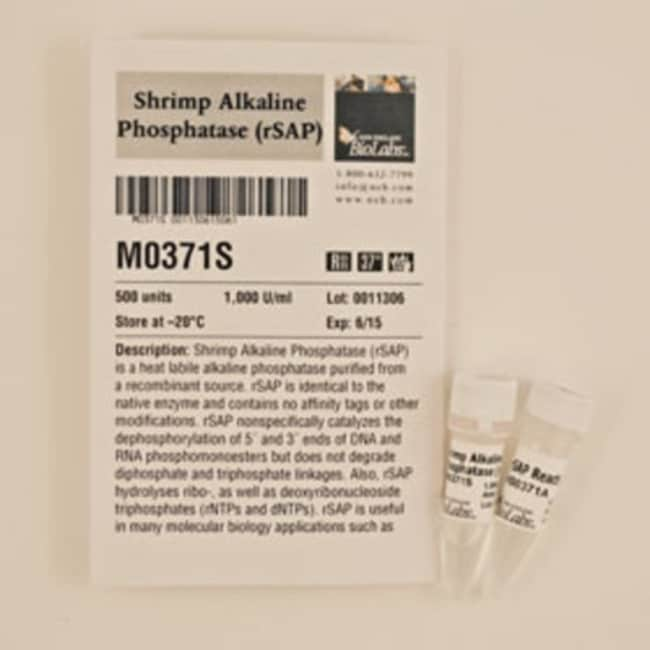
Shrimp Alkaline Phosphatase (rSAP) is a heat labile alkaline phosphatase purified from a recombinant source. rSAP is identical to the native enzyme and contains no affinity tags or other modifications. rSAP nonspecifically catalyzes the dephosphorylation of 5 and 3 ends of DNA and RNA phosphomonoesters. Also, rSAP hydrolyses ribo-, as well as deoxyribonucleoside triphosphates (NTPs and dNTPs). rSAP is useful in many molecular biology applications such as the removal of phosphorylated ends of DNA and RNA for subsequent use in cloning or end-labeling of probes. In cloning, dephosphorylation prevents religation of linearized plasmid DNA. The enzyme acts on 5 protruding, 5 recessed and blunt ends. rSAP may also be used to degrade unincorporated dNTPs in PCR reactions to prepare templates for DNA sequencing or SNP analysis. rSAP is completely and irreversibly inactivated by heating at 65C for 5 minutes, thereby making removal of rSAP prior to ligation or end-labeling unnecessary.
Numéro de catalogue. NC0524558 Fournisseur New England Biolab Ltd Code fournisseur M0371S

Pour de l'aide SVP utiliser la function de clavardage; nous envoyer un couriel à help@thermofisher.com ou appelez le service à la clientèle au 1-800-234-7437.

Shrimp Alkaline Phosphatase (rSAP) is a heat labile alkaline phosphatase purified from a recombinant source. rSAP is identical to the native enzyme and contains no affinity tags or other modifications. rSAP nonspecifically catalyzes the dephosphorylation of 5 and 3 ends of DNA and RNA phosphomonoesters. Also, rSAP hydrolyses ribo-, as well as deoxyribonucleoside triphosphates (NTPs and dNTPs). rSAP is useful in many molecular biology applications such as the removal of phosphorylated ends of DNA and RNA for subsequent use in cloning or end-labeling of probes. In cloning, dephosphorylation prevents religation of linearized plasmid DNA. The enzyme acts on 5 protruding, 5 recessed and blunt ends. rSAP may also be used to degrade unincorporated dNTPs in PCR reactions to prepare templates for DNA sequencing or SNP analysis. rSAP is completely and irreversibly inactivated by heating at 65C for 5 minutes, thereby making removal of rSAP prior to ligation or end-labeling unnecessary.