missing translation for 'onlineSavingsMsg'
Learn More

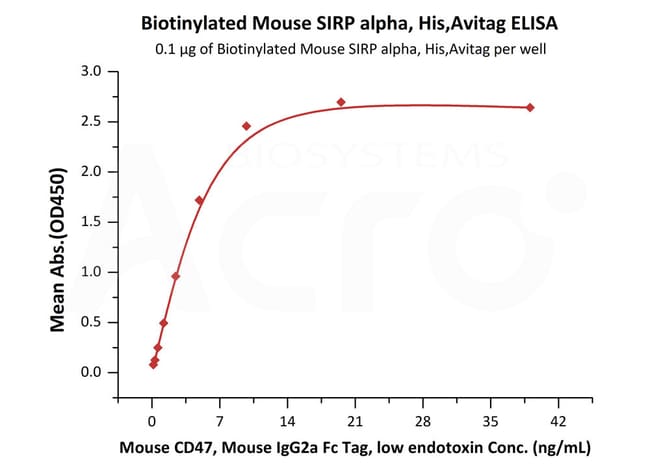
ACROBiosystems Inc Biotinylated Mouse SIRP alpha, His,Avitag (SIA-M82E2) is expressed from human 293 cells (HEK293). It contains AA Lys 32 - Asn 373 (Accession # P97797-1).

Numéro de catalogue. 502231346
Encompass

Tyrosine-protein phosphatase non-receptor type substrate 1 (SHPS1) is also known as CD172 antigen-like family member A (CD172a), Macrophage fusion receptor, MyD-1 antigen, Signal-regulatory protein alpha (SIRPA or SIRP alpha) or p84, is a member of the SIRP family, and also belongs to the immunoglobulin superfamily. SIRP alpha is Ubiquitous and highly expressed in brain. SIRPA / CD172a is immunoglobulin-like cell surface receptor for CD47 and acts as docking protein and induces translocation of PTPN6, PTPN11 and other binding partners from the cytosol to the plasma membrane. SIRPA / SHPS-1 supports adhesion of cerebellar neurons, neurite outgrowth and glial cell attachment and may play a key role in intracellular signaling during synaptogenesis and in synaptic function By similarity.
Numéro de catalogue. 502231346 Fournisseur ACROBiosystems Inc Code fournisseur SIAM82E225UG

Pour de l'aide SVP utiliser la function de clavardage; nous envoyer un couriel à help@thermofisher.com ou appelez le service à la clientèle au 1-800-234-7437.

Tyrosine-protein phosphatase non-receptor type substrate 1 (SHPS1) is also known as CD172 antigen-like family member A (CD172a), Macrophage fusion receptor, MyD-1 antigen, Signal-regulatory protein alpha (SIRPA or SIRP alpha) or p84, is a member of the SIRP family, and also belongs to the immunoglobulin superfamily. SIRP alpha is Ubiquitous and highly expressed in brain. SIRPA / CD172a is immunoglobulin-like cell surface receptor for CD47 and acts as docking protein and induces translocation of PTPN6, PTPN11 and other binding partners from the cytosol to the plasma membrane. SIRPA / SHPS-1 supports adhesion of cerebellar neurons, neurite outgrowth and glial cell attachment and may play a key role in intracellular signaling during synaptogenesis and in synaptic function By similarity.