Learn More
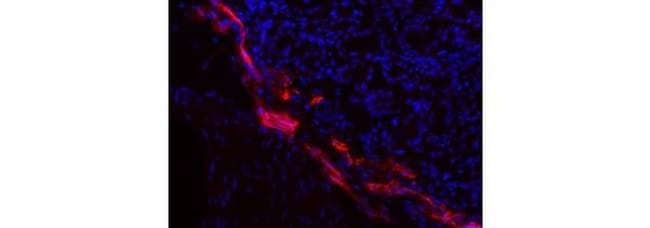
Invitrogen™ LYVE1 Monoclonal Antibody (ALY7), eFluor™ 660, eBioscience™, Invitrogen™

Description
Description: The monoclonal antibody ALY7 recognizes mouse LYVE-1, a transmembrane glycoprotein with similarity to CD44. The extracellular domain contains a conserved hyaluro binding domain also found in CD44. Expression is found on lymphatic and liver endothelial cells and some populations of macrophages. The lymphatic system is responsible for transporting proteins and cells (especially dendritic cells) to tissues throughout the body, thereby acting as immune surveyors. LYVE-1 is one characteristic protein, along with podoplanin, PROX-1, Tie-2 and VEGFR-3, that is expressed on lymphatic endothelial cells (LECS). The ligand for LYVE-1 is hyaluro, a large mucopolysaccharide. Although LYVE-1 can bind hyaluro in vitro, the site for ligand binding in vivo is masked by sialyated O-linked glycan chains. It is postulated that binding to ligand requires modification/unmasking to expose the binding site. The development and remodeling of the endothelium after injury is an area of extensive study. When transplanted, hematopoietic stem cells (HSCs) can give rise to LECs that integrate into the endothelium in normal and metastatic tissue. Applications Reported: This ALY7 antibody has been reported for use in flow cytometric analysis and immunohistology staining of frozen tissue sections. Applications Tested: This ALY7 antibody has been tested by flow cytometric analysis of transfected cells or IHC on mouse tissue. This can be used at 1-10 μg/mL for IHC.
Spécifications
Spécifications
| Antigène | LYVE1 |
| Applications | Flow Cytometry, Immunohistochemistry (Frozen), Immunocytochemistry |
| Classification | Monoclonal |
| Clone | ALY7 |
| Concentration | 0.2 mg/mL |
| Conjugué | eFluor 660 |
| Formule | PBS with 0.09% sodium azide; pH 7.2 |
| Gène | Lyve1 |
| Numéro d’acquisition du gène | Q8BHC0 |
| Alias du gène | 1200012G08Rik; cell surface retention sequence binding protein-1; cell surface retention sequence-binding protein 1; CRSBP1; CRSBP-1; extra cellular link domain-containing 1; extracellular link domain containing 1; extracellular link domain-containing 1; extracellular link domain-containing protein 1; HAR; hyaluronic acid receptor; lymphatic endothelial hyaluronan receptor LYVE-1; lymphatic vessel endothelial HA receptor-1; lymphatic vessel endothelial HA recptor-1; lymphatic vessel endothelial hyaluronan receptor 1; lymphatic vessel endothelial hyaluronic acid receptor 1; LYVE1; LYVE-1; sLyve 1; sLyve1; soluble LYVE 1; soluble LYVE1; UNQ230/PRO263; XLKD1 |
| Afficher plus de résultats |
For Research Use Only.