missing translation for 'onlineSavingsMsg'
Learn More
Learn More
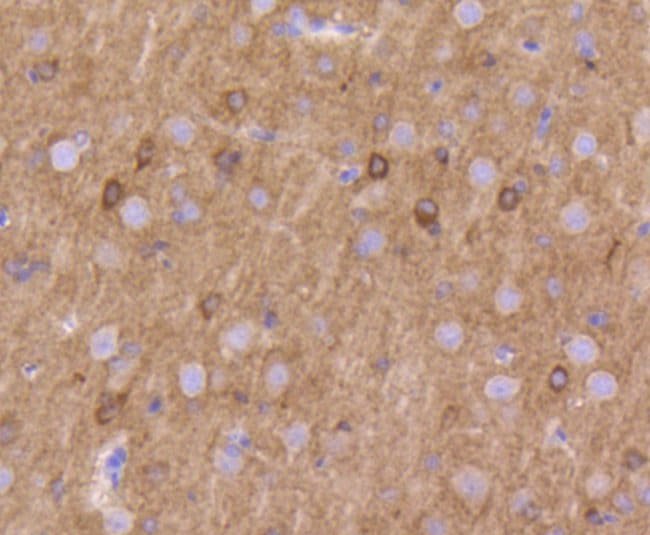

Invitrogen™ KV1.1 (KCNA1) Recombinant Rabbit Monoclonal Antibody (SN66-06)

Description
Recombinant rabbit monoclonal antibodies are produced using in vitro expression systems. The expression systems are developed by cloning in the specific antibody DNA sequences from immunoreactive rabbits. Then, individual clones are screened to select the best candidates for production. The advantages of using recombinant rabbit monoclonal antibodies include: better specificity and sensitivity, lot-to-lot consistency, animal origin-free formulations, and broader immunoreactivity to diverse targets due to larger rabbit immune repertoire.
This gene encodes a voltage-gated delayed potassium channel that is phylogenetically related to the Drosophila Shaker channel. The encoded protein has six putative transmembrane segments, and the loop between S5 and S6 forms the pore and contains the conserved selectivity filter motif. The functional channel is a homotetramer. The N-terminus of the channel is associated with beta subunits that can modify the inactivation properties of the channel as well as affect expression levels. The C-terminus of the channel is complexed to a PDZ domain protein that is responsible for channel targeting. Mutations in this gene have been associated with myokymia with periodic ataxia.
Spécifications
Spécifications
| Antigène | KV1.1 (KCNA1) |
| Applications | Immunohistochemistry (Paraffin), Western Blot |
| Classification | Recombinant Monoclonal |
| Clone | SN66-06 |
| Concentration | 1 mg/mL |
| Conjugué | Unconjugated |
| Formule | TBS with 40% Glycerol, 0.05% BSA and 0.05% sodium azide; pH 7.4 |
| Gène | Kcna1 |
| Numéro d’acquisition du gène | P10499, P16388, Q09470 |
| Alias du gène | AEMK; AI840627; brain potassium channel protein-1; EA1; HBK1; HUK1; IA; Kca1-1; Kcna; Kcna1; Kcpvd; Kv1.1; MBK1; mceph; megencephaly; MGC126782; MGC138385; MK1; Mk-1; MKI; potassium (K+) channel protein voltage dependent; potassium channel, voltage gated shaker related subfamily A, member 1; potassium voltage gated channel shaker related subfamily member 1; potassium voltage gated channel, shaker related subfamily, member 1; potassium voltage-gated channel subfamily A member 1; potassium voltage-gated channel, shaker-related subfamily, member 1; potassium voltage-gated channel, shaker-related subfamily, member 1 (episodic ataxia with myokymia); RBK1; RBKI; RCK1; Shak; Voltage-gated K(+) channel HuKI; voltage-gated potassium channel HBK1; Voltage-gated potassium channel subunit Kv1.1 |
| Afficher plus de résultats |