missing translation for 'onlineSavingsMsg'
Learn More
Learn More
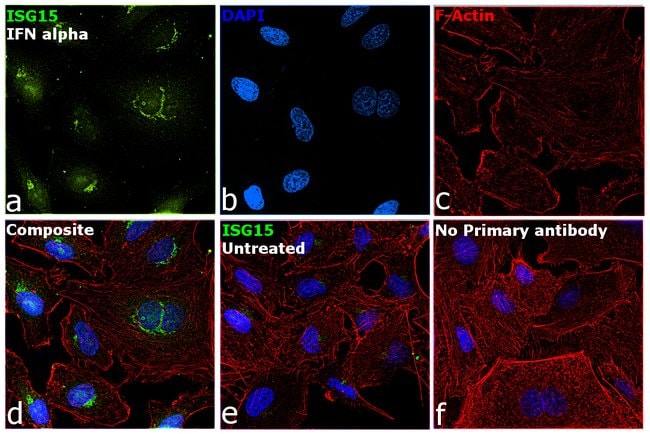

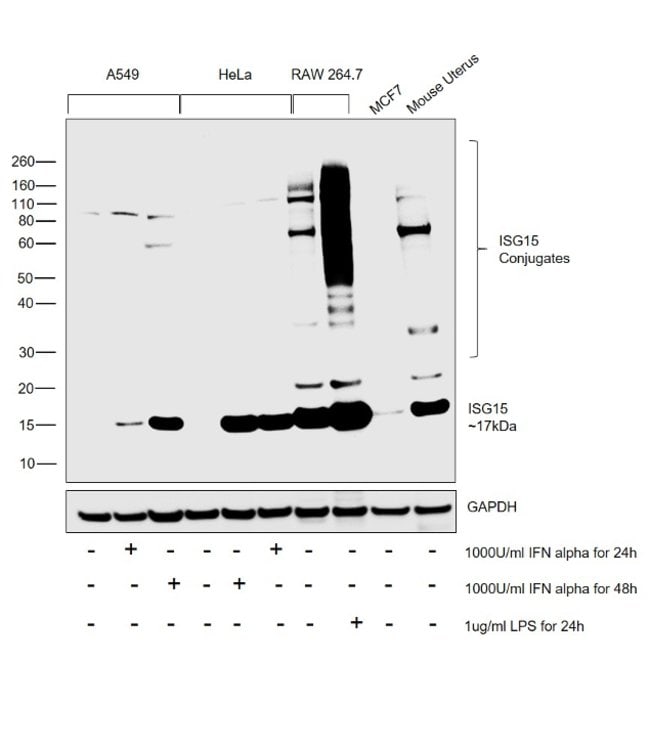
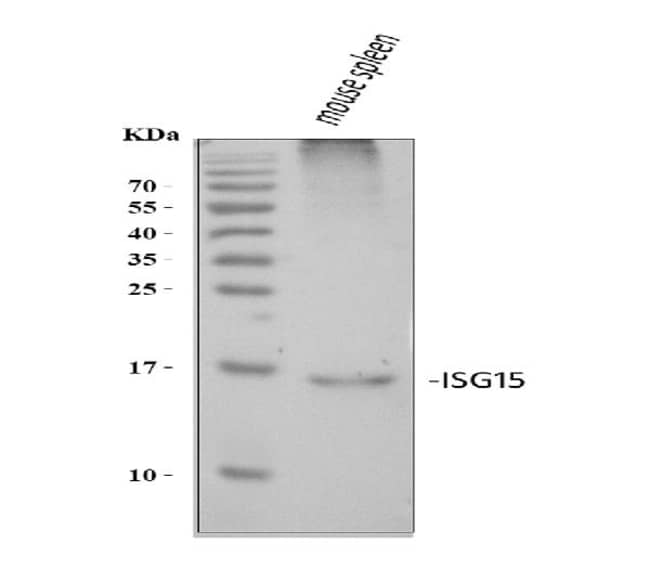
Invitrogen™ ISG15 Polyclonal Antibody

Description
Reconstitute with 0.2 mL of distilled water to yield a concentration of 500 μg/mL. Positive Control - WB: mouse spleen tissue. IHC: mouse kidney tissue.
Ubiquitin-like protein ISG15 plays a key role in the innate immune response to viral infection either via its conjugation to a target protein (ISGylation) or via its action as a free or unconjugated protein. It is secreted from monocytes in response to type I interferons and causes natural killer (NK)-cell proliferation and an augmentation of non-MCH (major histocompatibility complex)-restricted cytotoxicity. Synthesis is stimulated by IFN-alpha or IFN-beta or IFN-omega, but not IFN-gamma. ISG15 expression is also induced by overexpression of interferon regulatory factors that participate in transcriptional regulation of IFN genes, and by influenza B virus. ISG15 is secreted by cell lines of monocyte, T-lymphocyte, B-lymphocyte, human fibroblasts, and epithelial origins. Enhancement of NK cell proliferation, augmentation of non-major histocompatibility complex-restricted cytotoxicity, and induction of IFN-gamma from T cells identify ISG15 as a member of the cytokine cascade and suggest that it may be responsible for amplifying and directing some of the immunomodulatory effects of IFN-alpha or IFN-beta. ISG15 has has also been shown to function intracellularly as a ubiquitin homolog. Mutations affecting the gene can result in Immunodeficiency 38, with basal ganglia calcification (IMD38).
Spécifications
Spécifications
| Antigène | ISG15 |
| Applications | Immunocytochemistry, Immunohistochemistry (Paraffin), Western Blot |
| Classification | Polyclonal |
| Concentration | 500 μg/mL |
| Conjugué | Unconjugated |
| Formule | PBS with 5mg BSA and 0.05mg sodium azide |
| Gène | ISG15 |
| Numéro d’acquisition du gène | Q64339 |
| Alias du gène | G1P2; hUCRP; IFI15; IGI15; IMD38; interferon, alpha-inducible protein; interferon, alpha-inducible protein (clone IFI-15K); interferon-induced 15 kDa protein; interferon-induced 15-KDa protein; interferon-induced 17 kDa protein; interferon-induced 17-kDa/15-kDa protein; interferon-stimulated protein (15 kDa); interferon-stimulated protein 15; interferon-stimulated protein, 15 kDa; IP17; Irfp; Isg15; ISG15 ubiquitin like modifier; ISG15 ubiquitin-like modifier; ubiquitin cross-reactive protein; Ubiquitin-like protein ISG15; UCRP |
| Symboles de gène | ISG15 |
| Afficher plus de résultats |