Learn More
Invitrogen™ IL-8 (CXCL8) Polyclonal Antibody, PeproTech®, Invitrogen™

Description
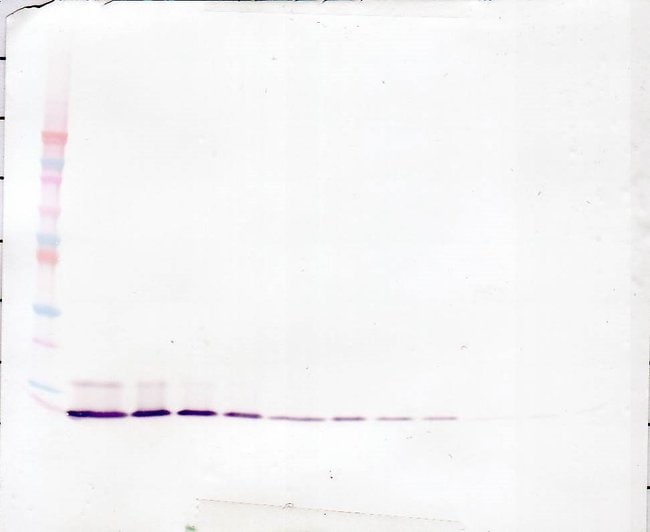
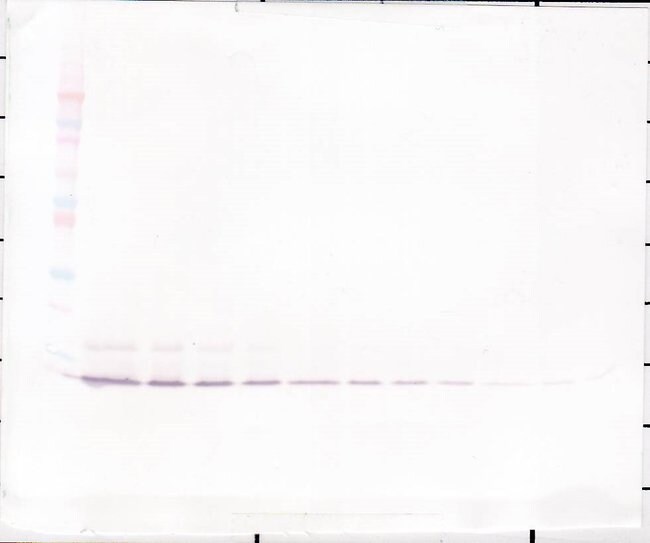
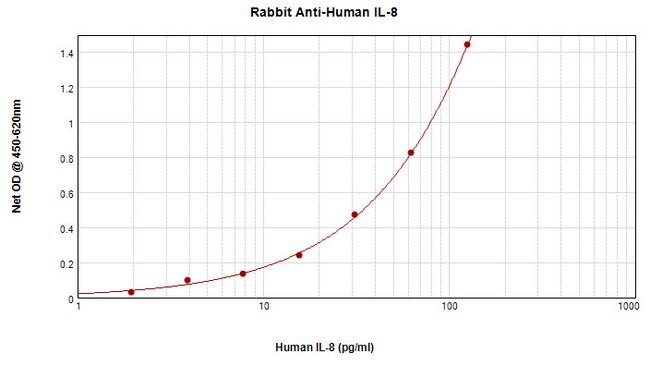
AA Sequence of recombinant protein: SAKELRCQCI KTYSKPFHPK FIKELRVIES GPHCANTEII VKLSDGRELC LDPKENWVQR VVEKFLKRAE NS. Preparation: Produced from sera of rabbits immunized with highly pure Recombinant Human IL-8 (CXCL8). Anti-Human IL-8 (CXCL8)-specific antibody was purified by affinity chromatography employing an immobilized Human IL-8 (CXCL8) matrix. Sandwich ELISA: To detect Human IL-8 (CXCL8) by sandwich ELISA (using 100 μL/well antibody solution) a concentration of 0.5-2.0 μg/mL of this antibody is required. This antigen affinity purified antibody, in conjunction with PeproTech Biotinylated Anti-Human IL-8 (CXCL8) (500-P28Bt) as a detection antibody, allows the detection of at least 0.2-0.4 ng/well of Recombinant Human IL-8 (CXCL8). Western Blot: To detect Human IL-8 (CXCL8) by Western Blot analysis this antibody can be used at a concentration of 0.1-0.2 μg/mL. When used in conjunction with compatible secondary reagents, the detection limit for Recombinant Human IL-8 (CXCL8) is 1.5-3.0 ng/lane, under either reducing or non-reducing conditions.
Spécifications
Spécifications
| Antigène | IL-8 (CXCL8) |
| Applications | ELISA, Western Blot |
| Classification | Polyclonal |
| Concentration | 0.1-1.0 mg/mL |
| Conjugué | Unconjugated |
| Formule | PBS with no preservative |
| Gène | CXCL8 |
| Numéro d’acquisition du gène | P10145 |
| Alias du gène | (Ala-IL-8)77; (Ser-IL-8)72; Alveolar macrophage chemotactic factor I; alveolar macrophage-derived chemotactic factor-I; AMCF-I; ANX7; beta endothelial cell-derived neutrophil activating peptide; beta-thromboglobulin-like protein; chemokine (C-X-C motif) ligand 8; C-X-C motif chemokine 8; C-X-C motif chemokine ligand 8; CXCL8; cytokine 8; emoctakin; GCP/IL-8 protein I; GCP/IL-8 protein II; GCP/IL-8 protein III; GCP/IL-8 protein IV; GCP/IL-8 protein V; GCP/IL-8 protein VI; GCP1; GCP-1; Granulocyte chemotactic protein 1; IL8; IL-8; IL-8(1-77); IL-8(5-77); IL-8(6-77); IL-8(7-77); IL-8(8-77); IL-8(9-77); IL8/NAP1 form I; IL8/NAP1 form II; IL8/NAP1 form III; IL8/NAP1 form IV; IL8/NAP1 form V; IL8/NAP1 form VI; ILN; Interleukin; interleukin 8; Interleukin8; interleukin-8; interleuklin-8 precursor; LECT; LUCT; lung giant cell carcinoma-derived chemotactic protein; lymphocyte derived neutrophil activating peptide; Lymphocyte-derived neutrophil-activating factor; LYNAP; MDNCF; MDNCF-a; MDNCF-b; MDNCF-c; MONAP; Monocyte-derived neutrophil chemotactic factor; monocyte-derived neutrophil-activating peptide; NAF; NAP1; NAP-1; neutrophil activating peptide 1; neutrophil and T-lymphocyte chemotactic and activating factor; Neutrophil attractant/activation protein 1; neutrophil attractant/activation protein-1; Neutrophil-activating factor; neutrophil-activating peptide 1; Neutrophil-activating protein 1; Permeability factor 1; PF1; Protein 3-10C; RP11-537A6.8; RPF1; small inducible cytokine subfamily B, member 8; SNX; SYNEXIN; T-cell chemotactic factor; tumor necrosis factor-induced gene 1 |
| Symboles de gène | CXCL8 |
| Afficher plus de résultats |