missing translation for 'onlineSavingsMsg'
Learn More

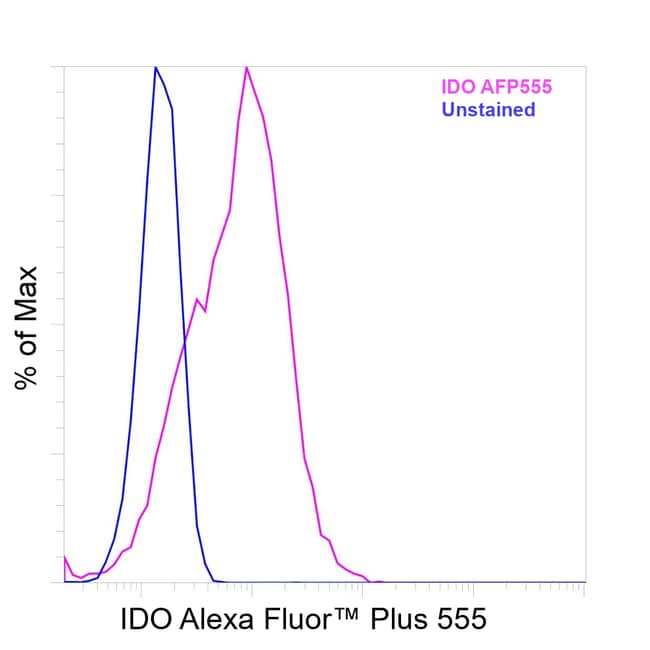
Invitrogen™ IDO Recombinant Mouse Monoclonal Antibody (eyedio), Alexa Fluor™ Plus 555

Numéro de catalogue. 740095MP555
Modifier l'affichage
Click to view available options
Quantité:
20 μL
50 μL
2 product options available for selection
Product selection table with 2 available options. Use arrow keys to navigate and Enter or Space to select.
Numéro de catalogue. Quantité
740095MP555 50 μL
5000876843 20 μL
Use arrow keys to navigate between rows. Press Enter or Space to select a product option. 2 options available.
2 options
Numéro de catalogue. 740095MP555 Fournisseur Invitrogen™ Code fournisseur 740095MP555
Saison des économies
Afficher toutes les promotions

Pour de l'aide SVP utiliser la function de clavardage; nous envoyer un couriel à help@thermofisher.com ou appelez le service à la clientèle au 1-800-234-7437.

Mouse Recombinant Monoclonal Antibody

Alexa Fluor™ Plus recombinant antibodies are conjugated using new, proprietary dye chemistry so you can generate stunning data. Alexa Fluor™ Plus antibodies represent an advancement in fluorescent conjugate technology. Alexa Fluor™ Plus antibodies provide brighter signal compared to leading Alexa Fluor™ antibodies, providing you with better signal-to-noise for your critical experiments. These antibodies show better specificity and lot-to-lot consistency as these are recombinant antibodies, generated by cloning specific genes for the desired antibodies into an expression vector and expressed in vitro. Using conjugate solutions: Centrifuge the protein conjugate solution briefly in a microcentrifuge before use; add only the supernatant to the experiment. This step will help eliminate any protein aggregates that may have formed during storage, thereby reducing nonspecific background staining. It is recommended that the antibody be carefully titrated for optimal performance in the assay of interest. Excitation: 553 nm; Emission: 568 nm; Laser: Yellow Laser Filtration: 0.2 μm post-manufacturing filtered.

IDO1 is an intracellular heme-containing enzyme that catalyzes the oxidative cleavage of the indole ring of several important regulatory molecules like tryptophan, serotonin, and melatonin. By doing this, IDO1 initiates the production of biologically active metabolites, commonly referred to as kynurenines. IDO1 is widely expressed in a variety of human tissues as well as in macrophages and dendritic cells (DCs). In inflammation, interferons (IFNs) act on specific receptors to trigger IDO1 induction. The production of IFN-gamma and induction of IDO1 represent important antimicrobial mechanisms. Degradation and depletion of tryptophan by IDO1 inhibits the growth of viruses, bacteria and parasites. Furthermore, IDO1 plays a complex and crucial role in immunoregulation during infection, pregnancy, autoimmunity, transplantation, and neoplasia.

Spécifications

Antigène IDO
Applications Flow Cytometry
Classification Recombinant Monoclonal
Clone eyedio
Concentration 1 mg/mL
Conjugué Alexa Fluor Plus 555
Formule Proprietary buffer with 0.008% Bromonitrodioxane, 0.008% Methylisothiazolone; pH 6.3-7.3
Gène Ido1
Numéro d’acquisition du gène P14902
Alias du gène EC 1.13.11.52; IDO; IDO1; IDO-1; INDO; indolamine 2,3 dioxygenase; indole 2,3-dioxygenase; indoleamine; indoleamine 2,3-dioxygenase 1; indoleamine 23-dioxygenase; Indoleamine-2; indoleamine-pyrrole 2,3 dioxygenase; indoleamine-pyrrole 2,3-dioxygenase
Symboles de gène Ido1
Espèces hôtes Mouse
Méthode de purification Protein A/G
Quantité 50 μL
Statut réglementaire RUO
Primaire ou secondaire Primary
ID du gène (Entrez) 3620
Espèces cibles Human
Contenu et stockage 4°C, store in dark, DO NOT FREEZE!
Type de produit Antibody
Forme Liquid
Isotype IgG1 κ
Afficher plus de résultats Afficher moins de résultats