missing translation for 'onlineSavingsMsg'
Learn More

ACROBiosystems Inc Biotinylated Human LAP (TGF-beta 1) (C33S) Protein, Fc,Avitag™ (MALS verified)

Numéro de catalogue. 502719210
Encompass

Transforming growth factor beta 1 ( TGFB1) is also known as TGF-1, CED, DPD1, TGFB. is a polypeptide member of the transforming growth factor beta superfamily of cytokines. It is a secreted protein that performs many cellular functions, including the control of cell growth, cell proliferation, cell differentiation and apoptosis. The TGFB1 protein helps control the growth and division (proliferation) of cells, the process by which cells mature to carry out specific functions (differentiation), cell movement (motility), and the self-destruction of cells (apoptosis). The TGFB1 protein is found throughout the body and plays a role in development before birth, the formation of blood vessels, the regulation of muscle tissue and body fat development, wound healing, and immune system function. TGFB1 is particularly abundant in tissues that make up the skeleton, where it helps regulate bone growth, and in the intricate lattice that forms in the spaces between cells (the extracellular matrix)
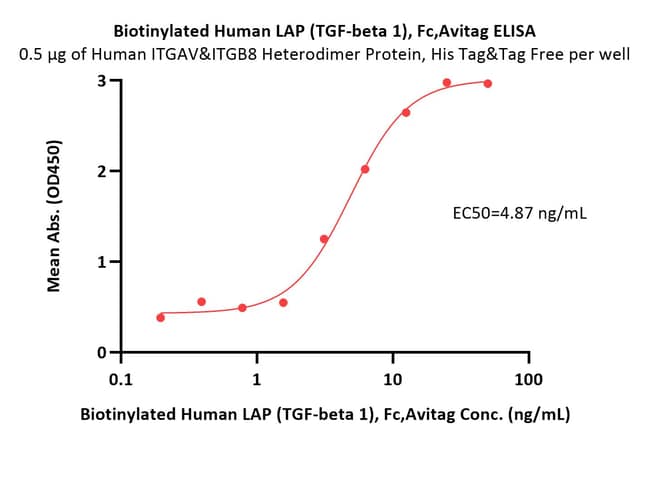
Numéro de catalogue. 502719210 Fournisseur ACROBiosystems Inc Code fournisseur LAPH82F8200UG

Pour de l'aide SVP utiliser la function de clavardage; nous envoyer un couriel à help@thermofisher.com ou appelez le service à la clientèle au 1-800-234-7437.

Transforming growth factor beta 1 ( TGFB1) is also known as TGF-1, CED, DPD1, TGFB. is a polypeptide member of the transforming growth factor beta superfamily of cytokines. It is a secreted protein that performs many cellular functions, including the control of cell growth, cell proliferation, cell differentiation and apoptosis. The TGFB1 protein helps control the growth and division (proliferation) of cells, the process by which cells mature to carry out specific functions (differentiation), cell movement (motility), and the self-destruction of cells (apoptosis). The TGFB1 protein is found throughout the body and plays a role in development before birth, the formation of blood vessels, the regulation of muscle tissue and body fat development, wound healing, and immune system function. TGFB1 is particularly abundant in tissues that make up the skeleton, where it helps regulate bone growth, and in the intricate lattice that forms in the spaces between cells (the extracellular matrix)