Learn More
Invitrogen™ FGF9 Polyclonal Antibody, PeproTech®, Invitrogen™

Description
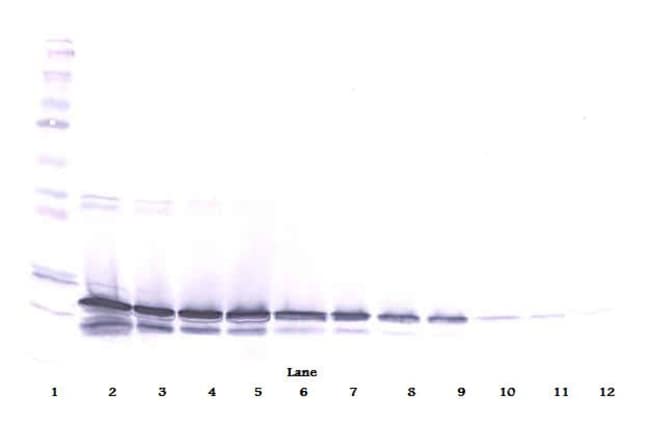
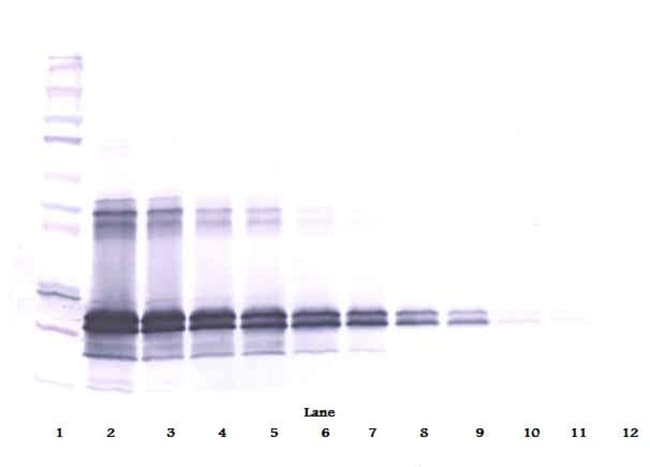
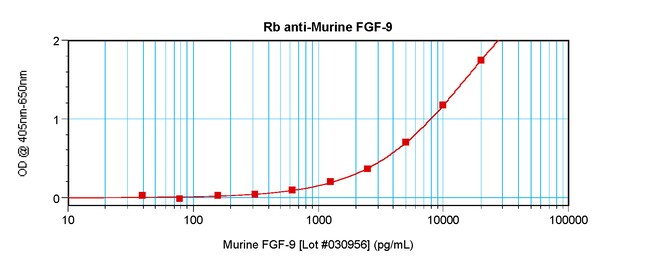
AA Sequence of recombinant protein: PLGEVGSYFG VQDAVPFGNV PVLPVDSPVL LNDHLGQSEA GGLPRGPAVT DLDHLKGILR RRQLYCRTGF HLEIFPNGTI QGTRKDHSRF GILEFISIAV GLVSIRGVDS GLYLGMNEKG ELYGSEKLTQ ECVFREQFEE NWYNTYSSNL YKHVDTGRRY YVALNKDGTP REGTRTKRHQ KFTHFLPRPV DPDKVPELYK DILSQS. Preparation: Produced from sera of rabbits immunized with highly pure Recombinant Murine FGF-9. Anti-Murine FGF-9-specific antibody was purified by affinity chromatography employing an immobilized Murine FGF-9 matrix. Sandwich ELISA: To detect Murine FGF-9 by sandwich ELISA (using 100 μL/well antibody solution) a concentration of 0.5-2.0 μg/mL of this antibody is required. This antigen affinity purified antibody, in conjunction with PeproTech Biotinylated Anti-Murine FGF-9 (500-P66Bt) as a detection antibody, allows the detection of at least 0.2-0.4 ng/well of Recombinant Murine FGF-9. Western Blot: To detect mFGF-9 by Western Blot analysis this antibody can be used at a concentration of 0.1-0.2 μg/mL. Used in conjunction with compatible secondary reagents the detection limit for Recombinant mFGF-9 is 1.5-3.0 ng/lane, under either reducing or non-reducing conditions.
Spécifications
Spécifications
| Antigène | FGF9 |
| Applications | ELISA, Western Blot |
| Classification | Polyclonal |
| Concentration | 0.1-1.0 mg/mL |
| Conjugué | Unconjugated |
| Formule | PBS with no preservative |
| Gène | FGF9 |
| Numéro d’acquisition du gène | P54130 |
| Alias du gène | Eks; elbow knee synostosis; FGF; Fgf9; FGF-9; Fibroblast growth factor; Fibroblast growth factor 9; fibroblast growth factor 9 (glia-activating factor); GAF; glia activating factor; glia-activating factor; HBFG-9; HBGF-9; Heparin-binding growth factor 9; M-FGF-9; SYNS3 |
| Symboles de gène | FGF9 |
| Afficher plus de résultats |