Learn More
PeproTech FGF4 Polyclonal Antibody, PeproTech®, Invitrogen™

Description
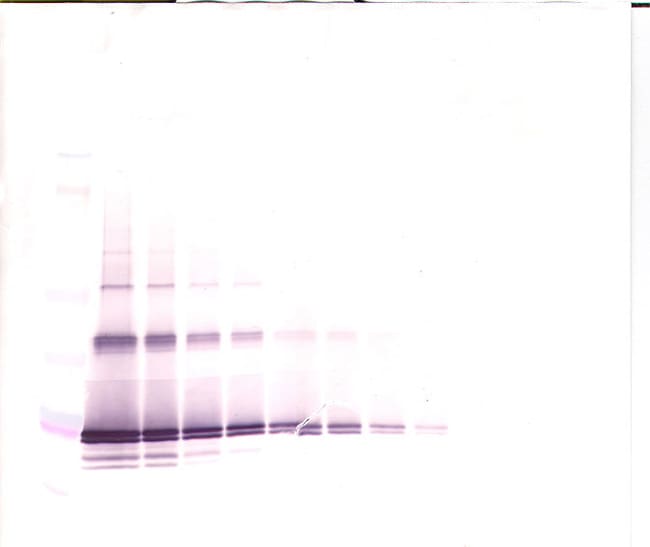
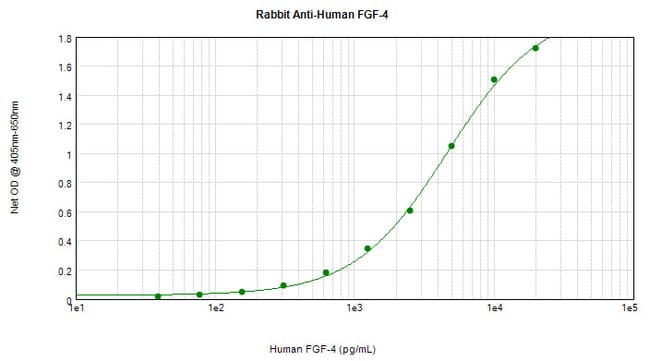
AA Sequence of recombinant protein: GRGGAAAPTA PNGTLEAELE RRWESLVALS LARLPVAAQP KEAAVQSGAG DYLLGIKRLR RLYCNVGIGF HLQALPDGRI GGAHADTRDS LLELSPVERG VVSIFGVASR FFVAMSSKGK LYGSPFFTDE CTFKEILLPN NYNAYESYKY PGMFIALSKN GKTKKGNRVS PTMKVTHFLP RL. Preparation: Produced from sera of rabbits immunized with highly pure Recombinant Human FGF-4. Anti-Human FGF-4-specific antibody was purified by affinity chromatography employing an immobilized Human FGF-4 matrix. Sandwich ELISA: To detect Human FGF-4 by sandwich ELISA (using 100 μL/well antibody solution) a concentration of 0.5-2.0 μg/mL of this antibody is required. This antigen affinity purified antibody, in conjunction with PeproTech Biotinylated Anti-Human FGF-4 (500-P158Bt) as a detection antibody, allows the detection of at least 0.2-0.4 ng/well of Recombinant Human FGF-4. Western Blot: To detect Human FGF-4 by Western Blot analysis this antibody can be used at a concentration of 0.1-0.2 μg/mL. Used in conjunction with compatible secondary reagents the detection limit for Recombinant Human FGF-4 is 1.5-3.0 ng/lane, under either reducing or non-reducing conditions.
Spécifications
Spécifications
| Antigen | FGF4 |
| Applications | ELISA, Western Blot |
| Classification | Polyclonal |
| Concentration | 0.1-1.0 mg/mL |
| Conjugate | Unconjugated |
| Formulation | PBS with no preservative |
| Gene | Fgf4 |
| Gene Accession No. | P08620 |
| Gene Alias | FGF; FGF4; Fgf-4; Fgfk; Fibroblast growth factor; fibroblast growth factor 4; fibroblast growth factor 4 splice isoform; HBGF-4; heparin secretory transforming protein 1; heparin secretory-transforming protein 1; heparin-binding growth factor 1; heparin-binding growth factor 4; HST; Hst1; hst-1; HSTF1; HSTF-1; human stomach cancer, transforming factor from FGF-related oncogene; kaposi sarcoma oncogene; Kfgf; K-FGF; K-fibroblast growth factor; KS3; oncogene HST; transforming protein KS3 |
| Gene Symbols | Fgf4 |
| Afficher plus de résultats |