missing translation for 'onlineSavingsMsg'
Learn More
Learn More
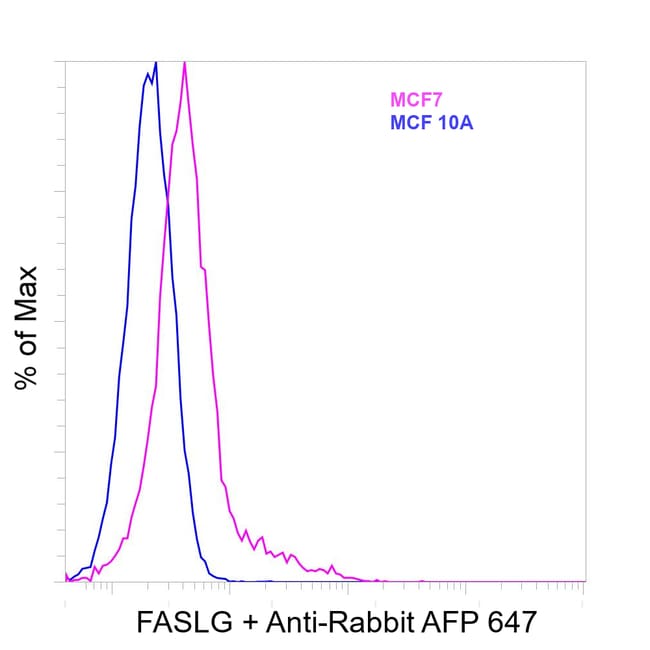
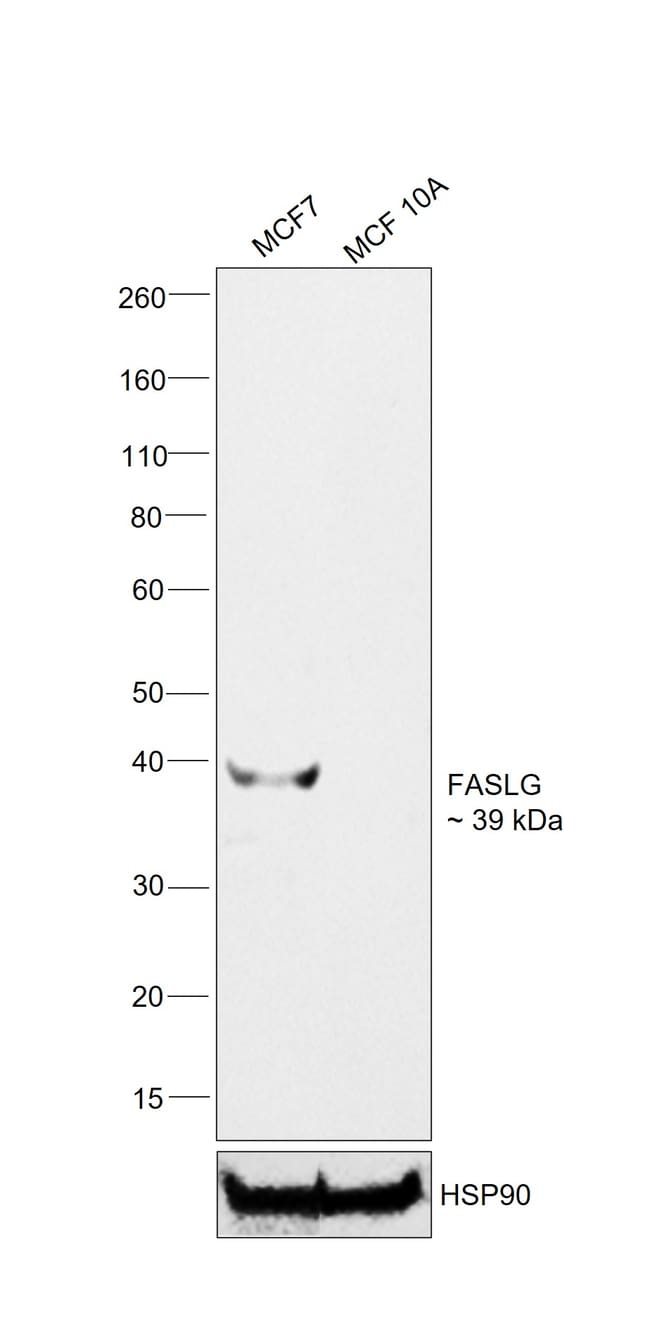
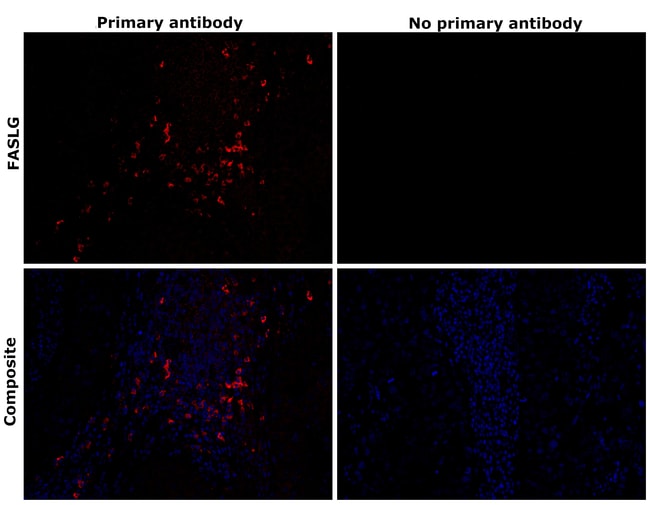
Invitrogen™ FASLG Recombinant Rabbit Monoclonal Antibody (R4-MP1-L19)
Description
Recombinant Rabbit monoclonal antibodies are produced using in vitro expression systems. Recombinant antibodies are produced using specific genes that code for the desired antibodies. These genes are cloned into an expression vector and expressed in vitro. The advantages of recombinant antibodies include better specificity and lot-to-lot consistency. It is recommended that the antibody be carefully titrated for optimal performance in the assay of interest.
CD178 (Fas ligand, FasL) is a type-II-membrane protein, whose N-terminus is in the cytoplasm and its C-terminal region extends into the extracellular space. Its receptor, FasR, is a cell-surface-type-I-membrane protein and a member of the tumor necrosis factor (TNF) and nerve growth factor (NGF) receptor family. As a member of the TNF-cytokine family CD178 induces apoptosis when interacting with FasR. CD178 may exist as either membrane bound (45 kD) or soluble forms (26 kD). The soluble protein can be released from cells upon cleavage by metalloproteinases. Binding of CD178 to Fas leads to oligomerization of the receptor and triggers apoptotic cell death through the interaction of other proteins. CD178 is predominantly expressed in activated T-lymphocytes and natural killer (NK) cells also it is expressed in the tissues of immune-privilege sites such as testis and eye. CD178 expression is also reported in various tissues as thymus, liver, ovary, lung, heart and kidney. It is assumed that induction of apoptosis through CD178 is predominantly involved in anti-viral immune responses. CD178 is a cell surface molecule belonging to the tumor necrosis factor family, binds to its receptor Fas, thus inducing apoptosis. Various cells express FAS, where CD178 is expressed predominantly on activated T cells. FAS and CD178 are involved in the down-regulation of immune reactions as well as T cell-mediated cytotoxicity. CD178 concentration has also been shown to be associated with atherosclerosis and inflammatory disease, in patients with hypertension. The Fas/ CD178 system has been shown to play a role in a number of human diseases, for example AIDS, hepatitis or cancer.
Spécifications
Spécifications
| Antigène | FASLG |
| Applications | Flow Cytometry, Immunohistochemistry (Paraffin), Western Blot |
| Classification | Recombinant Monoclonal |
| Clone | R4-MP1-L19 |
| Concentration | 1 mg/mL |
| Conjugué | Unconjugated |
| Formule | PBS with 0.09% sodium azide; pH 7.2-7.4 |
| Gène | Faslg |
| Numéro d’acquisition du gène | P48023 |
| Alias du gène | ADAM10-processed FasL form; ALPS1B; APL; Apoptosis (APO 1) antigen ligand 1; apoptosis (APO-1) antigen ligand 1; Apoptosis (APO-1) antigen ligand 1 (Fas antigen ligand); apoptosis antigen ligand; APT1LG1; APTL; CD178; CD178 antigen; CD95 ligand; CD95 ligand protein;Generalized lymphoproliferative disease (Gld); Cd95l; CD95-L; CD95L protein; fas antigen ligand; Fas ligand; Fas ligand (TNF superfamily, member 6); Fasl; Fas-L; FasL ICD; FasL intracellular domain; Faslg; Fas-LG; generalized lymphoproliferative disease; gld; mutant tumor necrosis factor family member 6; Receptor-binding FasL ectodomain; sFasL; Soluble Fas ligand; soluble form; SPA; SPPL2A-processed FasL form; TNFL; Tnfsf6; TNLG1A; Tumor necrosis factor (ligand) superfamily member 6; Tumor necrosis factor (ligand) superfamily member 6 (apoptosis (APO-1) antigen ligand 1) (Fas antigen ligand); Tumor necrosis factor (ligand) superfamily, member 6 (apoptosis (APO-1) antigen ligand 1) (Fas antigen ligand); Tumor necrosis factor ligand; tumor necrosis factor ligand 1A; tumor necrosis factor ligand superfamily member 6; Tumor necrosis factor ligand superfamily member 6 (TNFL6 / TNFSF6); Tumor necrosis factor ligand superfamily member 6, membrane form; Tumor necrosis factor ligand superfamily member 6, soluble form |
| Afficher plus de résultats |