Learn More

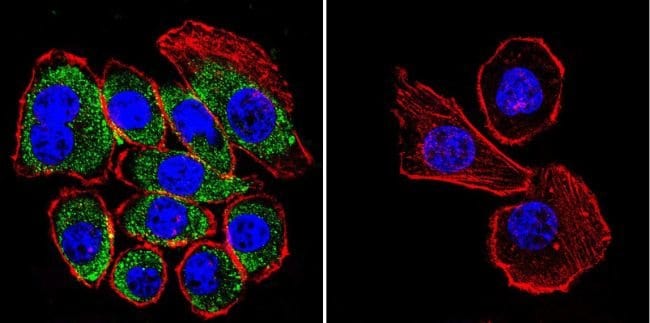
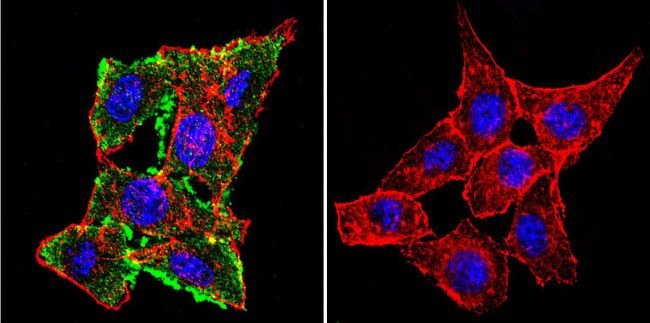
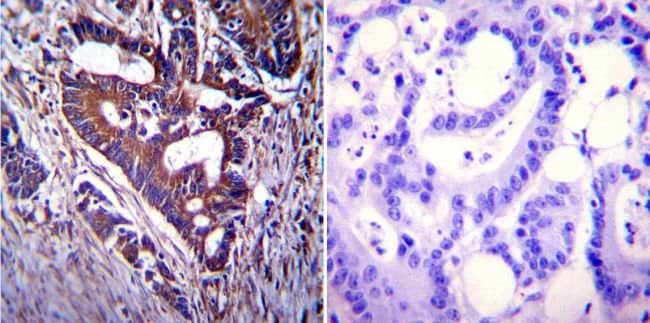

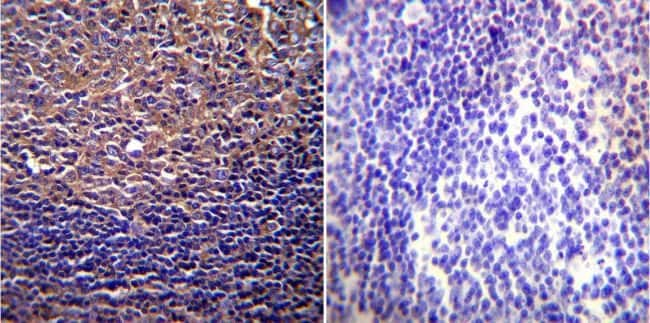
Invitrogen™ CFTR Monoclonal Antibody (CF3)

Description
MA1-935 detects cystic fibrosis transmembrane conductance factor (CFTR) in human and mouse tissues. MA1-935 has been successfully used in Western blot, immunofluorescence and immunoprecipitation procedures. By Western blot, this antibody detects a single ~170 kDa protein representing CFTR in T84 whole cell extract. Immunofluorescence staining of CFTR in mouse epithelial cells with MA1-935 results in cell surface staining, consistent with localization at the plasma membrane. This antibody also detects one or more immunologically related proteins in mouse cell line Heb7a that does not contain CFTR mRNA. MA1-935 can also be used to inhibit the epithelial uptake of S. typhi in some mouse cell lines. MA1-935 immunizing peptide corresponds to amino acid residues 103-117 found in the first extracellular loop of human and rabbit CFTR. This sequence is highly conserved in mouse, sheep, cow, and Xenopus laevis.
Spécifications
Spécifications
| Antigène | CFTR |
| Applications | Flow Cytometry, Immunohistochemistry (Paraffin), Immunoprecipitation, Western Blot, Immunocytochemistry |
| Classification | Monoclonal |
| Clone | CF3 |
| Concentration | Conc. Not Determined |
| Conjugué | Unconjugated |
| Formule | Ascites with 0.05% sodium azide |
| Gène | CFTR |
| Numéro d’acquisition du gène | P13569, P26361 |
| Alias du gène | ABC35; Abcc7; ATP Binding Cassette Superfamily C Member 7 (ABCC7); ATP-binding cassette sub-family C member 7; ATP-binding cassette transporter sub-family C member 7; ATP-binding cassette, subfamily c, member 7; AW495489; cAMP-dependent chloride channel; CF; CFTR; CFTR/MRP; Channel conductance-controlling ATPase; cystic fibrosis transmembrane conductance regulator; cystic fibrosis transmembrane conductance regulator (ATP-binding cassette sub-family C, member 7); cystic fibrosis transmembrane conductance regulator homolog; cystic fibrosis transmembrane conductance regulator homolog; ATP-binding cassette, subfamily c, member 7; dJ760C5.1; MRP7; RGD1561193; tcag7.78; TNR CFTR; TNR-CFTR |
| Afficher plus de résultats |