Learn More

Invitrogen™ CD8a Monoclonal Antibody (AMC908), eBioscience™, Invitrogen™

Description
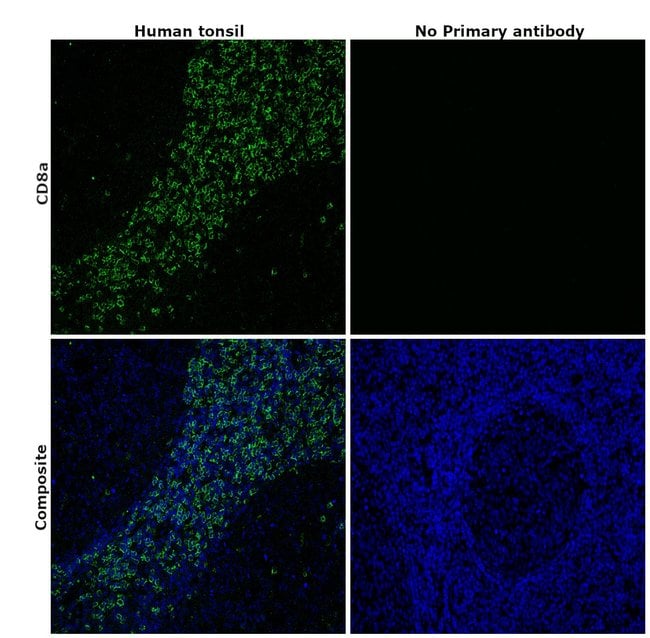
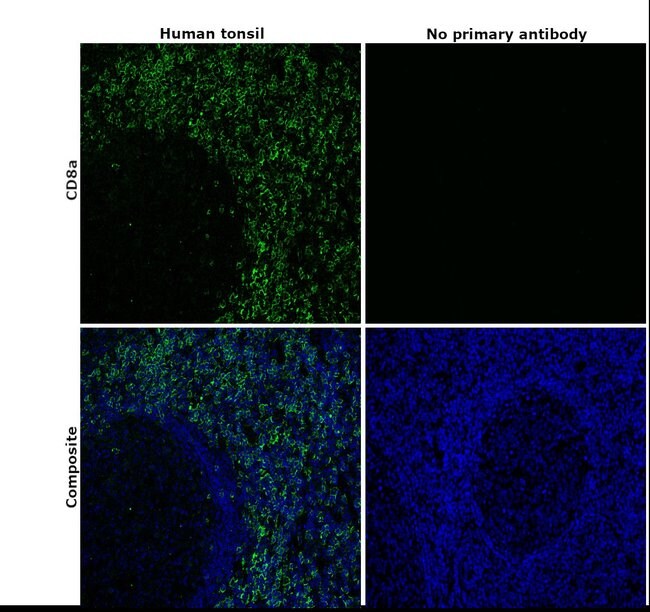
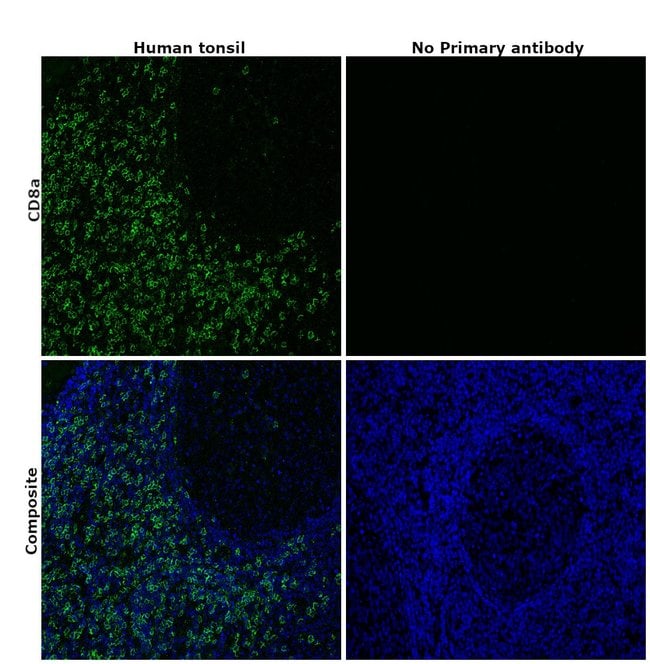
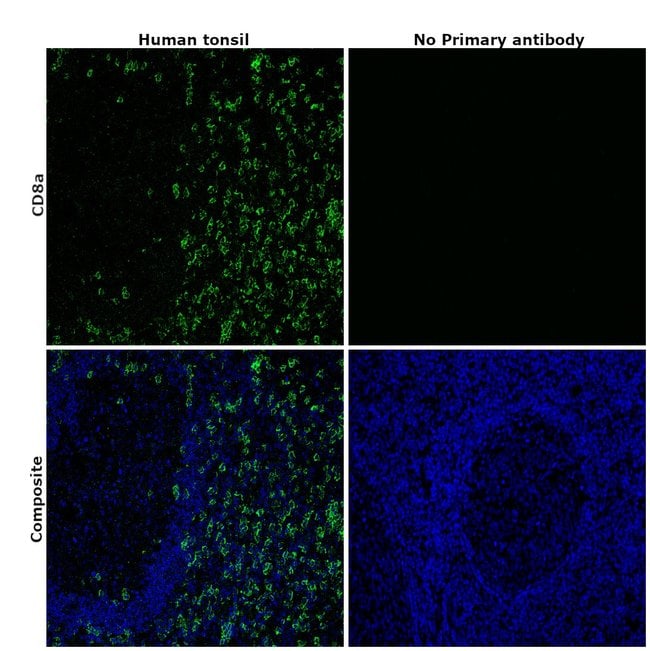
Description: This AMC908 monoclonal antibody reacts with the human CD8a molecule, an approximately 32-34 kDa cell surface receptor expressed either as a heterodimer with the CD8 beta chain (CD8 alpha beta) or as a homodimer (CD8 alphaalpha). A majority of thymocytes and a subpopulation of mature T cells and NK cells express CD8a. CD8 binds to MHC class I and through its association with protein tyrosine kinase p56lck plays a role in T-cell development and activation of mature T cells. Applications Reported: This AMC908 antibody has been reported for use in western blotting, and immunohistochemical staining of formalin-fixed paraffin embedded tissue sections. Applications Tested: This AMC908 antibody has been tested by immunohistochemistry of formalin-fixed paraffin embedded human tissue using high pH antigen retrieval. This can be used at less than or equal to 0.5 μg/mL. This AMC908 antibody has been tested by western blot of reduced peripheral blood mononuclear cells and can be used at less than or equal to 5 μg/mL. It is recommended that the antibody be carefully titrated for optimal performance in the assay of interest. Purity: Greater than 90%, as determined by SDS-PAGE. Aggregation: Less than 10%, as determined by HPLC. Filtration: 0.2 μm post-manufacturing filtered.
Spécifications
Spécifications
| Antigène | CD8a |
| Applications | Immunohistochemistry (Paraffin), Western Blot |
| Classification | Monoclonal |
| Clone | AMC908 |
| Concentration | 0.5 mg/mL |
| Conjugué | Unconjugated |
| Formule | PBS with 0.09% sodium azide; pH 7.2 |
| Gène | CD8B |
| Numéro d’acquisition du gène | P01732, P10966 |
| Alias du gène | BB154331; CD8; CD8 alpha; CD8 alpha chain; CD8 alpha chain precursor; CD8 antigen; CD8 antigen 32 kDa chain; CD8 antigen 37 kDa chain; CD8 antigen alpha polypeptide; CD8 antigen alpha protein; CD8 antigen alpha protein precursor; CD8 antigen alpha-chain; CD8 antigen beta polypeptide; CD8 antigen beta polypeptide precursor; CD8 antigen beta-chain; CD8 antigen, alpha chain; CD8 antigen, alpha polypeptide; CD8 antigen, alpha polypeptide (p32); CD8 antigen, alpha-chain; CD8 antigen, beta chain; CD8 antigen, beta chain 1; CD8 antigen, beta polypeptide; CD8 antigen, beta polypeptide 1 (p37); CD8 antigen, beta-chain; CD8 beta; CD8 beta chain; CD8 beta-2; CD8a; CD8A antigen alpha; CD8a molecule; CD8A; T-cell surface glycoprotein; CD8alpha; CD8B; CD8b antigen; CD8b molecule; CD8b molecule pseudogene; Cd8b1; CD8beta; CD8BP; fCD8; LEU2; Leu-2; Leu2 T-lymphocyte antigen; leu-2a; Ly-2; LY3; Ly-3; Ly-35; Ly-B; Ly-C; Lymphocyte antigen 3; Lyt2; Lyt-2; Lyt-2.1 lymphocyte differentiation antigen (AA at 100); Lyt3; Lyt-3; MAL; membrane glycoprotein; membrane protein; OKT8 T-cell antigen; OX-8 membrane antigen; p32; P37; RHACD8-4; T cell co-receptor; T lymphocyte surface glycoprotein beta chain; T8 T-cell antigen; T-cell antigen Leu2; T-cell membrane glycoprotein Ly-3; T-cell surface glycoprotein; T-cell surface glycoprotein CD8 alpha chain; T-cell surface glycoprotein CD8 beta chain; T-cell surface glycoprotein Lyt-2; T-cell surface glycoprotein Lyt-3; T-cell surface molecule; T-lymphocyte differentiation antigen T8/Leu-2; type I transmembrane glycoprotein |
| Afficher plus de résultats |