Learn More


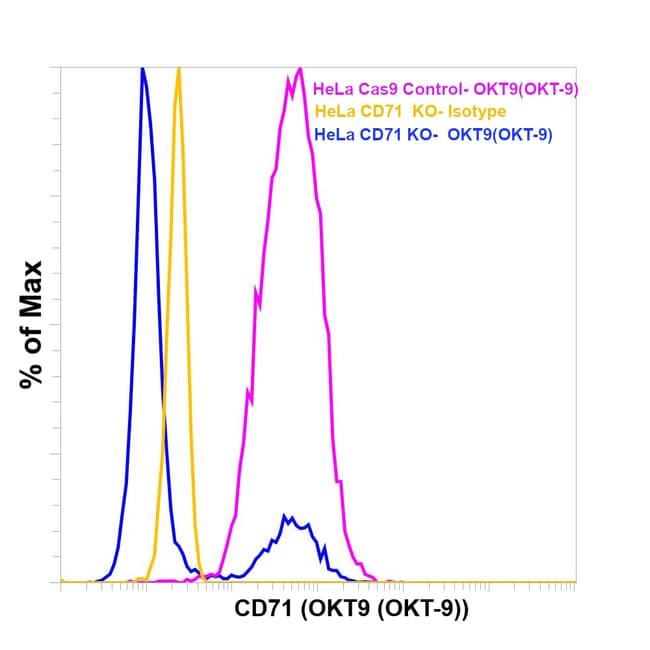
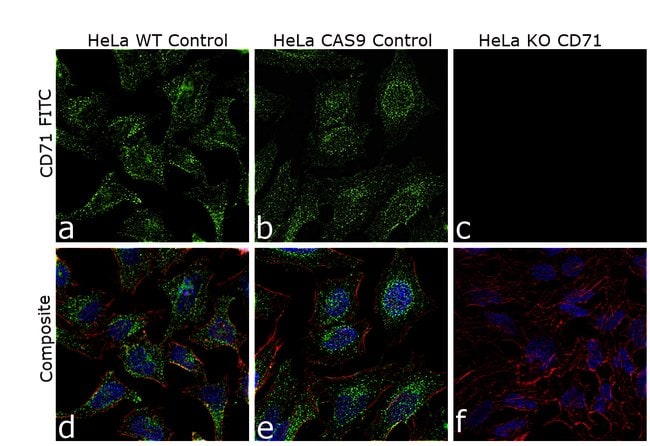
Invitrogen™ CD71 (Transferrin Receptor) Monoclonal Antibody (OKT9 (OKT-9)), eBioscience™, Invitrogen™
Description
Description: The OKT9 monoclonal antibody reacts with human CD71, a 170-180 kDa type II transmembrane protein. CD71, the transferrin receptor, exists as a homodimer on the cell surface and is essential for cellular growth. CD71 is expressed by immature proliferating cells and at low levels on resting mature lymphocytes. Antigen or mitogen stimulation of T and B cells upregulates the expression of CD71. Applications Reported: The OKT9 (OKT-9) antibody has been reported for use in flow cytometric analysis. Applications Tested: This OKT9 (OKT-9) antibody has been tested by flow cytometric analysis of unstimulated and CD3/CD28-stimulated (3 days) human blood cells. This can be used at less than or equal to 0.5 μg per test. A test is defined as the amount (μg) of antibody that will stain a cell sample in a final volume of 100 μL. Cell number should be determined empirically but can range from 10^5 to 10^8 cells/test. It is recommended that the antibody be carefully titrated for optimal performance in the assay of interest. Purity: Greater than 90%, as determined by SDS-PAGE. Aggregation: Less than 10%, as determined by HPLC. Filtration: 0.2 μm post-manufacturing filtered.
Spécifications
Spécifications
| Antigène | CD71 (Transferrin Receptor) |
| Applications | Flow Cytometry, Western Blot, Immunocytochemistry |
| Classification | Monoclonal |
| Clone | OKT9 (OKT-9) |
| Concentration | 0.5 mg/mL |
| Conjugué | Unconjugated |
| Formule | PBS with 0.09% sodium azide; pH 7.2 |
| Gène | TFRC |
| Numéro d’acquisition du gène | P02786 |
| Alias du gène | 2610028K12Rik; AI195355; AI426448; AU015758; CD antigen CD71; CD71; chicken transferrin receptor; E430033M20Rik; I79_000642; IMD46; mammary tumor virus receptor 1; Mtvr1; Mtvr-1; p90; sTfR; T9; TfR; tfR1; TFR2; TFRC; TR; transferrin receptor; transferrin receptor (p90, CD71); transferrin receptor 2; transferrin receptor protein 1; Transferrin receptor protein 1, serum form; Trfr |
| Afficher plus de résultats |
For Research Use Only.