missing translation for 'onlineSavingsMsg'
Learn More

Invitrogen™ CD36 Monoclonal Antibody (HM36), Alexa Fluor™ 700, eBioscience™
GREENER_CHOICE

Numéro de catalogue. 56036282
Encompass
Modifier l'affichage
Click to view available options
Quantité:
100 μg
1 product options available for selection
Product selection table with 1 available options. Use arrow keys to navigate and Enter or Space to select.
Numéro de catalogue. Quantité
56036282 100 μg
Use arrow keys to navigate between rows. Press Enter or Space to select a product option. 1 options available.
1 options
Numéro de catalogue. 56036282 Fournisseur Invitrogen™ Code fournisseur 56036282
Saison des économies
Afficher toutes les promotions

Pour de l'aide SVP utiliser la function de clavardage; nous envoyer un couriel à help@thermofisher.com ou appelez le service à la clientèle au 1-800-234-7437.

Armenian Hamster Monoclonal Antibody

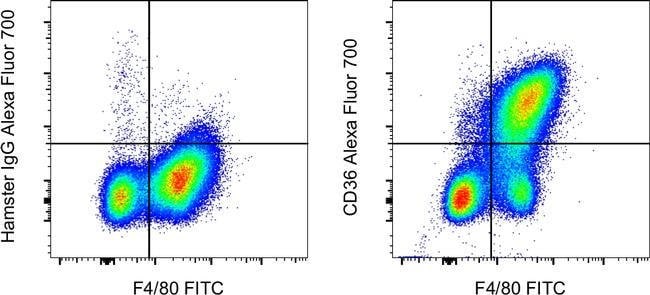
Description: This HM36 antibody recognizes mouse CD36, also known as scavenger receptor BIII. Applications Reported: This HM36 antibody has been reported for use in flow cytometric analysis. Applications Tested: This HM36 antibody has been tested by flow cytometric analysis of thioglycolate-elicited peritoneal macrophages. This may be used at less than or equal to 0.25 μg per test. A test is defined as the amount (μg) of antibody that will stain a cell sample in a final volume of 100 μL. Cell number should be determined empirically but can range from 10^5 to 10^8 cells/test. It is recommended that the antibody be carefully titrated for optimal performance in the assay of interest. Alexa Fluor 700 emits at 723 nm and can be excited with the red laser (633-647 nm). Most instruments will require a 685 LP mirror and 710/20 band pass filter. Please make sure that your instrument is capable of detecting this fluorochrome. Excitation: 633-647 nm; Emission: 723 nm; Laser: Red Laser.

CD36, also known as scavenger receptor class B member 3, is a protein that is expressed on the surface of various cell types, including macrophages, platelets, and adipocytes. It plays a role in lipid metabolism, inflammation, and atherosclerosis, and is involved in the recognition and uptake of various ligands such as oxidized low-density lipoproteins, long-chain fatty acids, and apoptotic cells. CD36 is also implicated in the pathogenesis of malaria. The protein encoded by this gene serves as a receptor for thrombospondin in platelets and various cell lines, and is the fourth major glycoprotein of the platelet surface. It binds to collagen, thrombospondin, anionic phospholipids, and oxidized LDL, and directly mediates cytoadherence of Plasmodium falciparum parasitized erythrocytes. Mutations in this gene cause platelet glycoprotein deficiency. Multiple alternatively spliced transcript variants have been found for this gene. Diseases associated with CD36 include Platelet Glycoprotein IV Deficiency and Coronary Heart Disease 7.

Spécifications

Antigène CD36
Applications Flow Cytometry
Classification Monoclonal
Clone HM36
Concentration 0.2 mg/mL
Conjugué Alexa Fluor 700
Formule PBS with 0.09% sodium azide; pH 7.2
Gène CD36
Numéro d’acquisition du gène Q08857
Alias du gène adipocyte membrane protein; BDPLT10; Cd36; CD36 antigen; CD36 antigen (collagen type I receptor, thrombospondin receptor); CD36 molecule; CD36 molecule (thrombospondin receptor); CD36 protein; CHDS7; cluster determinant 36; collagen type I receptor thrombospondin receptor; collagen type I receptor, thrombospondin receptor; FAT; FAT/CD36; fatty acid translocase; fatty acid translocase/CD36; fatty acid transport protein; glycoprotein IIIb; GP3B; GP4; GPIIIB; GPIV; I79_011940; Leukocyte differentiation antigen CD36; PAS IV; PAS4; PAS-4; PAS-4 protein; PASIV; Platelet collagen receptor; Platelet glycoprotein 4; platelet glycoprotein IV; Scarb3; scavenger receptor class B, member 3; SR-B3; Thrombospondin receptor
Symboles de gène CD36
Espèces hôtes Armenian Hamster
Immunogène CHO cells transfected with full-length mouse CD36.
Méthode de purification Affinity chromatography
Quantité 100 μg
Statut réglementaire RUO
Primaire ou secondaire Primary
ID du gène (Entrez) 12491
Espèces cibles Mouse
Contenu et stockage 4°C, store in dark, DO NOT FREEZE!
Type de produit Antibody
Forme Liquid
Isotype IgG
Afficher plus de résultats Afficher moins de résultats