Learn More
Invitrogen™ CD337 (NKp30) Monoclonal Antibody (AF29-4D12), eFluor™ 450, eBioscience™


Description
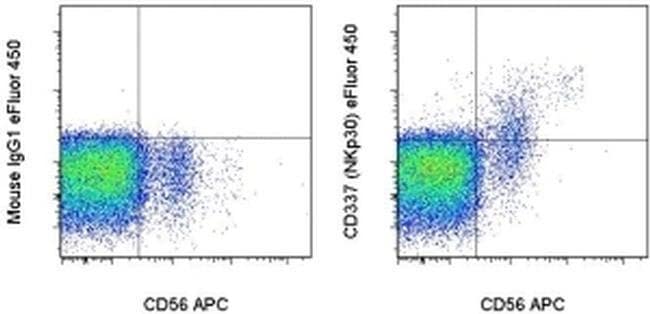
Description: This AF29-4D12 monoclonal antibody reacts with human CD337, which is also known as NKp30. Expressed on NK cells, CD337 is the predominant member of the natural cytotoxicity receptor family that also includes NKp46 and NKp44. CD337 is involved in activating and expanding resting NK cells following interaction with dendritic cells to eliminate tumor, virus-infected, and immature dendritic cells. Several ligands for this receptor have been reported, including B7-H6. The AF29-4D12 antibody has been reported to crossreact to rhesus macaque. Applications Reported: This AF29-4D12 antibody has been reported for use in flow cytometric analysis. Applications Tested: This AF29-4D12 antibody has been pre-titrated and tested by flow cytometric analysis of normal human peripheral blood cells. This can be used at 5 μL (0.125 μg) per test. A test is defined as the amount (μg) of antibody that will stain a cell sample in a final volume of 100 μL. Cell number should be determined empirically but can range from 10^5 to 10^8 cells/test. eFluor® 450 is an alternative to Pacific Blue®. eFluor® 450 emits at 445 nm and is excited with the Violet laser (405 nm). Please make sure that your instrument is capable of detecting this fluorochome. Excitation: 405 nm; Emission: 445 nm; Laser: Violet Laser. Filtration: 0.2 μm post-manufacturing filtered.
Spécifications
Spécifications
| Antigène | CD337 (NKp30) |
| Applications | Flow Cytometry |
| Classification | Monoclonal |
| Clone | AF29-4D12 |
| Concentration | 5 μL/Test |
| Conjugué | eFluor 450 |
| Formule | PBS with BSA and 0.09% sodium azide; pH 7.2 |
| Gène | Ncr3 |
| Numéro d’acquisition du gène | O14931, Q8MJ02 |
| Alias du gène | 1C7; Activating natural killer receptor p30; activating NK-A1 receptor; CD337; LY117; lymphocyte antigen 117; MALS; Natural cytotoxicity triggering receptor 3; natural killer cell p30-related protein; natural killer cell receptor; Ncr3; NK receptor 1c7; Nkp30; NK-p30; NKp30S; NKp30v1; NKp30v1ED |
| Afficher plus de résultats |