missing translation for 'onlineSavingsMsg'
Learn More
Learn More
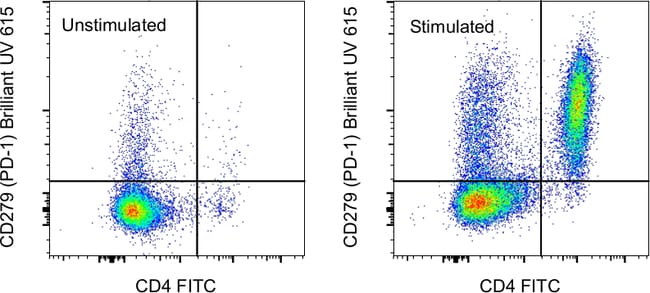
Invitrogen™ CD279 (PD-1) Monoclonal Antibody (J43), Brilliant Ultra Violet™ 615, eBioscience™, Invitrogen™

Description
Cell-mediated immune responses are initiated by T lymphocytes that are themselves stimulated by cognate peptides bound to MHC molecules on antig en-presenting cells (APC). T-cell activation is generally self-limited as activated T cells express receptors such as PD-1 (also known as PDCD-1) that mediate inhibitory signals from the APC. PD-1 can bind two different but related ligands, PDL-1 and PDL-2. Upon binding to either of these ligands, signals generated by PD-1 inhibit the activation of the immune response in the absence of 'danger signals' such as LPS or other molecules associated with bacteria or other pathogens. Evidence for this is seen in PD1-null mice who exhibit hyperactivated immune systems and autoimmune diseases. Despite its predicted molecular weight, PD-1 often migrates at higher molecular weight in SDS-PAGE.
Spécifications
Spécifications
| Antigène | CD279 (PD-1) |
| Applications | Flow Cytometry |
| Classification | Monoclonal |
| Clone | J43 |
| Concentration | 0.2 mg/mL |
| Conjugué | Brilliant Ultraviolet 615 |
| Formule | PBS with BSA and 0.09% sodium azide; pH 7.2 |
| Gène | Pdcd1 |
| Numéro d’acquisition du gène | Q02242 |
| Alias du gène | CD279; EGK_05005; hPD1; hPD-1; hPD-l; hSLE1; Ly101; mPD-1; PD1; PD-1; Pdc1; Pdcd1; programmed cell death 1; programmed cell death 1 protein; programmed cell death protein 1; programmed cell death protein 1-like; programmed death 1; Protein PD1; protein PD-1; sCD279; SLEB2; soluble CD279; systemic lupus erythematosus susceptibility 2 |
| Afficher plus de résultats |