missing translation for 'onlineSavingsMsg'
Learn More

Invitrogen™ CD27 Monoclonal Antibody (LG.7F9), PerCP-eFluor™ 710, eBioscience™, Invitrogen™
GREENER_CHOICE

Numéro de catalogue. 5015942
Modifier l'affichage
Click to view available options
Quantité:
100 μg
25 μg
2 product options available for selection
Product selection table with 2 available options. Use arrow keys to navigate and Enter or Space to select.
Numéro de catalogue. Quantité
5015942 100 μg
5015941 25 μg
Use arrow keys to navigate between rows. Press Enter or Space to select a product option. 2 options available.
2 options
Numéro de catalogue. 5015942 Fournisseur Invitrogen™ Code fournisseur 46027182

Pour de l'aide SVP utiliser la function de clavardage; nous envoyer un couriel à help@thermofisher.com ou appelez le service à la clientèle au 1-800-234-7437.

Armenian Hamster Monoclonal Antibody

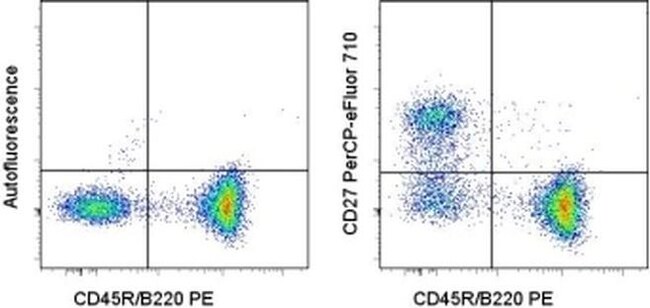
Description: The LG.7F9 monoclonal antibody reacts with mouse CD27, a lymphocyte-specific member of the TNFR superfamily. CD27 is expressed by virtually all mature T cells and by a subpopulation of B cells, mainly memory B cells. In mouse, CD27 has been found on nearly all thymocytes excluding a population of CD46-CD8- precursors. CD27 binds to CD70 and, through this interaction, plays an important role in T cell-B cell interaction. It has been reported that triggering CD27 plays an important role in the maturation of CD4+ and CD8+ effector cells. LG.7F9 cross-reacts with human and rat CD27. Applications Reported: This LG.7F9 antibody has been reported for use in flow cytometric analysis. Applications Tested: This LG.7F9 antibody has been tested by flow cytometric analysis of mouse spleen cells. This can be used at less than or equal to 0.06 μg per test. A test is defined as the amount (μg) of antibody that will stain a cell sample in a final volume of 100 μL. Cell number should be determined empirically but can range from 10^5 to 10^8 cells/test. It is recommended that the antibody be carefully titrated for optimal performance in the assay of interest. PerCP-eFluor™ 710 emits at 710 nm and is excited with the blue laser (488 nm); it can be used in place of PerCP-Cyanine5.5. We recommend using a 710/50 bandpass filter, however, the 695/40 bandpass filter is an acceptable alternative.

CD27 is a 50 kDa member of the tumor necrosis factor (TNF) receptor superfamily that includes CD40 and CD30. The TNF superfamily members are known for the regulation of cell proliferation and death. In contrast to the expression of other TNFR/TNF family members, expression of CD27 and its ligand CD70 is predominantly confined to lymphocytes. High expression levels of CD27 appear to be dependent on proper ligation of antigen receptors. CD70 expression requires additional co-stimulatory and/or pro-inflammatory signals. CD27 is expressed as a disulfide-linked homodimer on mature thymocytes, peripheral blood T cells and a subpopulation of B cells. Activation of T cells via TCR-CD3 complex results in upregulation of CD27 expression on the plasma membrane as well as in the release of its soluble 28-32 kDa form, sCD27, detected in the plasma, urine or spinal fluid. Soluble CD27 is an important prognostic marker of acute and chronic B cell malignancies. RgpA, a cystein proteinase, although activating T cells through the protease-activated receptors (PARs), degradates CD27 and counteracts T cell activation mediated by CD27 and its ligand CD70. CD27-binding protein (SIVA), a proapoptotic protein, can bind to this receptor and is thought to play an important role in the apoptosis induced by this receptor. Diseases associated with CD27 dysfunction include Lymphoproliferative Syndrome 2 and Autosomal Recessive Lymphoproliferative Syndrome.

Spécifications

Antigène CD27
Applications Flow Cytometry
Classification Monoclonal
Clone LG.7F9
Concentration 0.2 mg/mL
Conjugué PerCP-eFluor 710
Formule PBS with 0.09% sodium azide; pH 7.2
Gène CD27
Numéro d’acquisition du gène P26842, P41272
Alias du gène CD antigen 27; CD27; CD27 antigen; CD27 molecule; CD27L receptor; LPFS2; S152; S152. LPFS2; sCD27; soluble CD27; T cell activation antigen S152; T14; T-cell activation antigen CD27; TNFRSF7; TNFSF7; Tp55; Tumor necrosis factor receptor superfamily member 7; tumor necrosis factor receptor superfamily, member 7
Symboles de gène CD27
Espèces hôtes Armenian Hamster
Méthode de purification Affinity chromatography
Quantité 100 μg
Statut réglementaire RUO
Primaire ou secondaire Primary
ID du gène (Entrez) 21940, 500318, 939
Espèces cibles Human, Mouse, Rat
Contenu et stockage 4°C, store in dark, DO NOT FREEZE!
Type de produit Antibody
Forme Liquid
Isotype IgG
Afficher plus de résultats Afficher moins de résultats

For Research Use Only.