Learn More
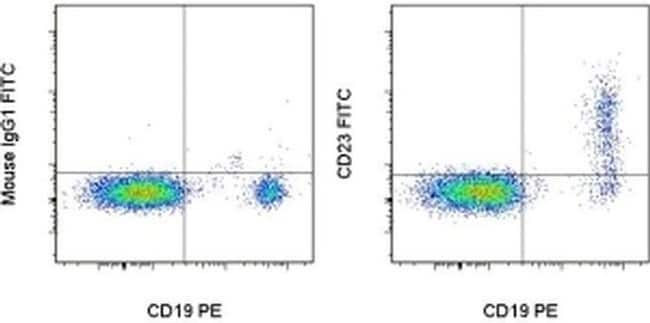
Invitrogen™ CD23 Monoclonal Antibody (EBVCS2), FITC, eBioscience™


Description
Description: The EBVCS2 monoclonal antibody reacts with human CD23, a 45 kDa type II transmembrane glycoprotein. CD23 is expressed on mature B cells, mantle zone B cells, follicular dendritic cells and at low levels on T, NK, langerhans cells and platelets. Expression of CD23 is upregulated upon B cell activation, and soluble forms of the antigen have been reported to be biologically active. CD23 is a low affinity receptor for IgE and is thought to play a role in the regulation of IgE response and B cell activation. CD21 and the alpha subunit of CD11b and CD11c bind to CD23. Applications Reported: The EBVCS2 antibody has been reported for use in flow cytometric analysis, and immunohistochemical staining of frozen tissue sections. Applications Tested: The EBVCS2 antibody has been pre-titrated and tested by flow cytometric analysis of normal human peripheral blood cells. This can be used at 5 μL (0.25 μg) per test. A test is defined as the amount (μg) of antibody that will stain a cell sample in a final volume of 100 μL. Cell number should be determined empirically but can range from 10^5 to 10^8 cells/test. Excitation: 488 nm; Emission: 520 nm; Laser: Blue Laser. Filtration: 0.2 μm post-manufacturing filtered.
Spécifications
Spécifications
| Antigène | CD23 |
| Applications | Flow Cytometry, Immunohistochemistry (Frozen) |
| Classification | Monoclonal |
| Clone | EBVCS2 |
| Concentration | 5 μL/Test |
| Conjugué | FITC |
| Formule | PBS with BSA and 0.09% sodium azide; pH 7.2 |
| Gène | FCER2 |
| Numéro d’acquisition du gène | P06734 |
| Alias du gène | BLAST-2; CD23; CD23 antigen; CD23A; CLEC4J; C-type lectin domain family 4 member J; C-type lectin domain family 4, member J; Fc epsilon receptor II; FC epsilon RII; Fc fragment of IgE receptor II; Fc fragment of IgE, low affinity II, receptor for (CD23); Fc receptor alpha multiple ligand receptor; Fc receptor, IgE, low affinity II, alpha polypeptide; Fcalpha muR; Fcalpha RII; Fce2; fc-epsilon-RII; FCER2; Fcer2a; FceRII; IGEBF; Immunoglobulin E-binding factor; immunoglobulin epsilon-chain; low affinity immunoglobulin epsilon Fc receptor; Low affinity immunoglobulin epsilon Fc receptor membrane-bound form; Low affinity immunoglobulin epsilon Fc receptor soluble form; low-affinity IgE receptor; Ly-42; lymphocyte IgE receptor |
| Afficher plus de résultats |