missing translation for 'onlineSavingsMsg'
Learn More

Invitrogen™ CD22 Monoclonal Antibody (eBio4KB128 (4KB128)), PerCP-eFluor™ 710, eBioscience™
GREENER_CHOICE

Numéro de catalogue. 5015936
Modifier l'affichage
Click to view available options
Quantité:
100 Tests
1 product options available for selection
Product selection table with 1 available options. Use arrow keys to navigate and Enter or Space to select.
Numéro de catalogue. Quantité
5015936 100 Tests
Use arrow keys to navigate between rows. Press Enter or Space to select a product option. 1 options available.
1 options
Numéro de catalogue. 5015936 Fournisseur Invitrogen™ Code fournisseur 46022942
Saison des économies
Afficher toutes les promotions

Pour de l'aide SVP utiliser la function de clavardage; nous envoyer un couriel à help@thermofisher.com ou appelez le service à la clientèle au 1-800-234-7437.

Mouse Monoclonal Antibody

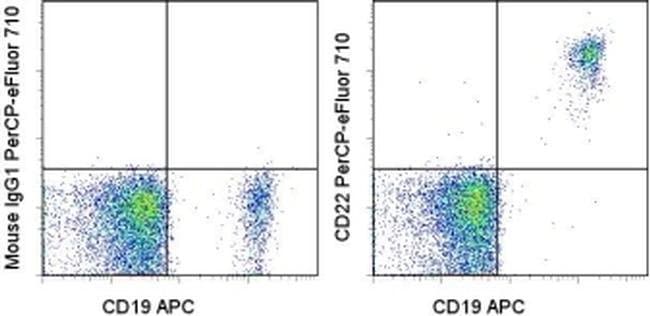
Description: The eBio4KB128 monoclonal antibody recognizes human CD22 (Siglec-2), which is a member of the siglec subgroup of the Ig superfamily. CD22 is a type I transmembrane glycoprotein composed of two polypeptide chains, CD22 alpha and CD22 beta, of 130 and 140 kDa respectively, produced by alternative splicing of the CD22 gene. CD22 is expressed at high levels on mature B cells and B cell lymphomas. The extracellular portion of CD22 contains seven Ig-like domains, some of which are capable of binding ligands with sialic acid moieties expressed on epithelial, endothelial, B and T cells. The intracellular portion of CD22 contains 6 tyrosine residues contained within immunotyrosine-based inhibitory motifs (ITIM) and immunotyrosine-based activation-like motifs, which are phosphorylated upon B-cell receptor engagement, which enables CD22 to participate in the positive and negative regulation of B-cell receptor signaling. Applications Reported: This eBio4KB128 (4KB128) antibody has been reported for use in flow cytometric analysis. Applications Tested: This eBio4KB128 (4KB128) antibody has been pre-titrated and tested by flow cytometric analysis of normal human peripheral blood cells. This can be used at 5 μL (0.06 μg) per test. A test is defined as the amount (μg) of antibody that will stain a cell sample in a final volume of 100 μL. Cell number should be determined empirically but can range from 10^5 to 10^8 cells/test. PerCP-eFluor® 710 emits at 710 nm a...

CD22, also known as BL-CAM, is a type I transmembrane glycoprotein composed of two polypeptide chains, CD22alpha and CD22beta, with molecular weights of 130 and 140 kDa, respectively. These chains are produced by alternative splicing of the CD22 gene. CD22 is prominently expressed on mature B cells and B cell lymphomas, including hairy cell leukemia, diffuse large B-cell lymphoma, and nodular lymphocyte predominance Hodgkin's lymphoma, but is negative in classical Hodgkin's lymphoma. The extracellular portion of CD22 contains seven Ig-like domains that preferentially bind alpha2,6-linked sialic acid moieties found on epithelial, endothelial, B, and T cells. This binding can be masked by cis interactions with sialic acids on the same cell surface. CD22 expression is limited to late stages of B-cell differentiation, making it useful for phenotyping mature leukemias. Intracellularly, CD22 features six tyrosine residues within immunotyrosine-based inhibitory motifs (ITIM) and activation-like motifs. These residues are phosphorylated upon B-cell receptor engagement, allowing CD22 to regulate B-cell receptor signaling. CD22 participates in positive regulation through interactions with Src family tyrosine kinases and acts as an inhibitory receptor by recruiting cytoplasmic phosphatases via SH2 domains, which block signal transduction through dephosphorylation of signaling molecules. CD22's role in both positive and negative regulation of B-cell signaling, along with its specific expression pattern, makes it a valuable marker for antibody customers interested in B-cell-related research and diagnostics.

Spécifications

Antigène CD22
Applications Flow Cytometry
Classification Monoclonal
Clone eBio4KB128 (4KB128)
Concentration 5 μL/Test
Conjugué PerCP-eFluor 710
Formule PBS with BSA and 0.09% sodium azide; pH 7.2
Gène CD22
Numéro d’acquisition du gène P20273
Alias du gène A530093D23; B-cell receptor CD22; BL-CAM; B-lymphocyte cell adhesion molecule; B-lymphocyte cell adhesion molecule (BL-CAM); Cd22; CD22 antigen; CD22 molecule; FLJ22814; Lectin 2; Leu-14; Lyb8; Lyb-8; MGC130020; sialic acid binding Ig-like lectin 2; sialic acid-binding Ig-like lectin 2; Sialic acid-binding Ig-like lectin 2 (Siglec-2); Siglec2; Siglec-2; T-cell surface antigen Leu-14
Symboles de gène CD22
Espèces hôtes Mouse
Méthode de purification Affinity chromatography
Quantité 100 Tests
Statut réglementaire RUO
Primaire ou secondaire Primary
ID du gène (Entrez) 933
Espèces cibles Human
Contenu et stockage 4°C, store in dark, DO NOT FREEZE!
Type de produit Antibody
Forme Liquid
Isotype IgG1 κ
Afficher plus de résultats Afficher moins de résultats