missing translation for 'onlineSavingsMsg'
Learn More
Learn More
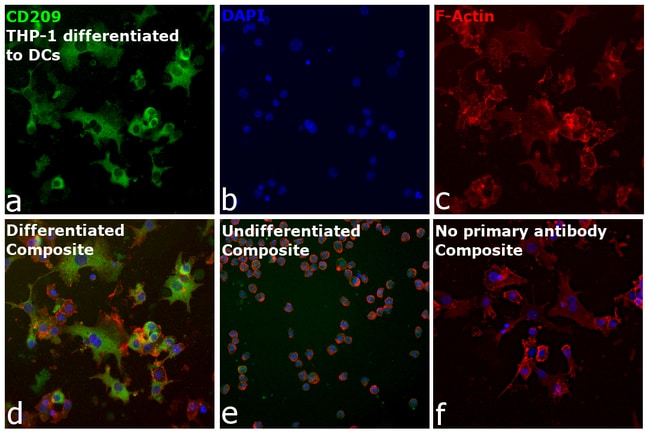
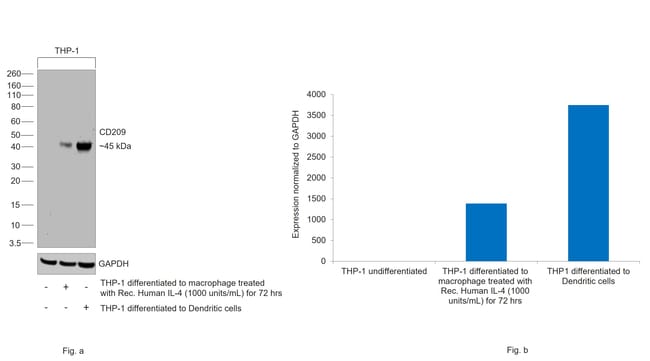
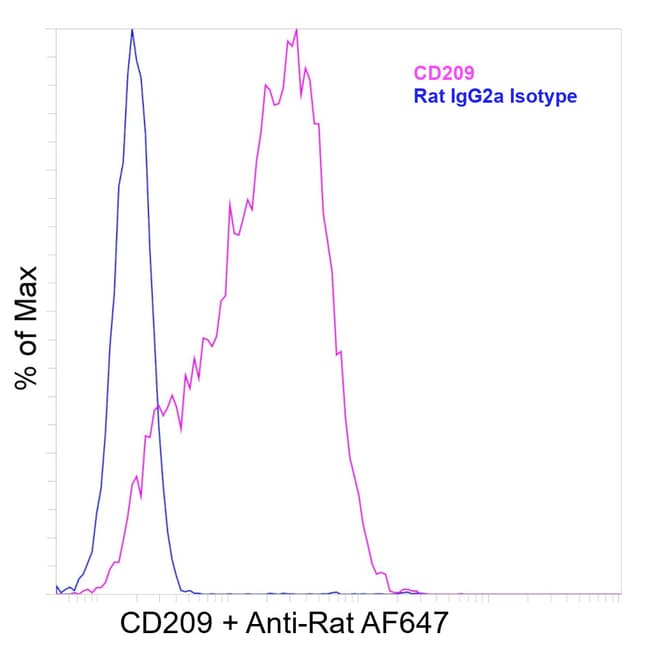
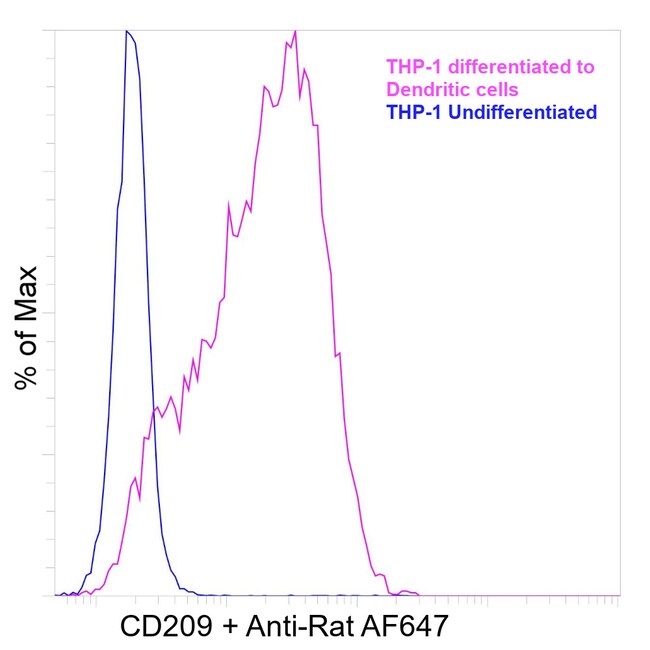
Invitrogen™ CD209 (DC-SIGN) Recombinant Rat Monoclonal Antibody (eB-h209)
Description
Recombinant rat monoclonal antibodies are produced using in vitro expression systems. Recombinant antibodies are produced using specific genes that code for the desired antibodies. These genes are cloned into an expression vector and expressed in vitro. The advantages of recombinant antibodies include better specificity and lot-to-lot consistency. It is recommended that the antibody be carefully titrated for optimal performance in the assay of interest.
This gene encodes a transmembrane receptor and is often referred to as DC-SIGN because of its expression on the surface of dendritic cells and macrophages. The encoded protein is involved in the innate immune system and recognizes numerous evolutionarily divergent pathogens ranging from parasites to viruses with a large impact on public health. The protein is organized into three distinct domains: an N-terminal transmembrane domain, a tandem-repeat neck domain and C-type lectin carbohydrate recognition domain. The extracellular region consisting of the C-type lectin and neck domains has a dual function as a pathogen recognition receptor and a cell adhesion receptor by binding carbohydrate ligands on the surface of microbes and endogenous cells. The neck region is important for homo-oligomerization which allows the receptor to bind multivalent ligands with high avidity. Variations in the number of 23 amino acid repeats in the neck domain of this protein are rare but have a significant impact on ligand binding ability. This gene is closely related in terms of both sequence and function to a neighboring gene (GeneID 10332; often referred to as L-SIGN). DC-SIGN and L-SIGN differ in their ligand-binding properties and distribution. Alternative splicing results in multiple variants.
Spécifications
Spécifications
| Antigène | CD209 (DC-SIGN) |
| Applications | Flow Cytometry, Western Blot, Immunocytochemistry |
| Classification | Recombinant Monoclonal |
| Clone | eB-h209 |
| Concentration | 1 mg/mL |
| Conjugué | Unconjugated |
| Formule | PBS with 0.09% sodium azide; pH 7.2-7.4 |
| Gène | CD209 |
| Numéro d’acquisition du gène | Q9NNX6 |
| Alias du gène | CD209; CD209 antigen; CD209 antigen-like protein A; CD209 molecule; Cd209a; CD209a antigen; CD209a molecule; Cd209d; CD209d antigen; CDSIGN; Cire; CLEC4L; Clec4m; C-type lectin domain family 4 member L; C-type lectin domain family 4, member L; C-type lectin domain family 4, member M; Dcsign; DC-SIGN; DC-SIGN1; Dc-signr; DC-SIGN-related protein; Dendritic cell-specific ICAM-3-grabbing non-integrin; dendritic cell-specific ICAM-3-grabbing non-integrin 1; dendritic cell-specific intercellular adhesion molecule-3-grabbing non-integrin; dendritic cell-specific intracellular adhesion molecules (ICAM)-3 grabbing non-integrin; HIV gpl20-binding protein; MGC129965; MGC130443; RGD1561104; SIGN-R1; SIGNR5 |
| Afficher plus de résultats |