Learn More
Invitrogen™ CD19 Monoclonal Antibody (HIB19), Brilliant Violet™ 650, eBioscience™, Invitrogen™

Description
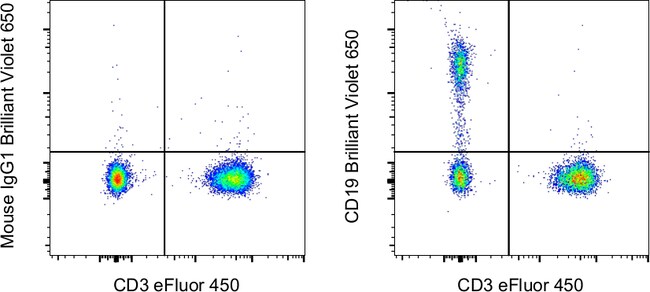
The HIB19 mAb reacts with human CD19, a 95 kDa transmembrane glycoprotein. CD19 is expressed by B cells during all stages of development excluding the terminally differentiated plasma cells. Follicular dendritic cells also express CD19. Together CD21, CD81, Leu13, MHC class II, and CD19 form a multimolecular complex that associates with BCR. Signaling through CD19 induces tyrosine phosphorylation, calcium flux and proliferation of B cells. The SJ25C1 antibody and the HIB19 mAb recognize overlapping epitopes. Applications Reported: This HIB19 antibody has been reported for use in flow cytometric analysis. Applications Tested: This HIB19 antibody has been pre-diluted and tested by flow cytometric analysis of normal human peripheral blood cells. This may be used at 5uL (0.5ug) per test BV 650 is a tandem dye that emits at 649nm and is intended for use on cytometers equipped with a violet (405nm) laser. Please make sure that your instrument is capable of detecting this fluorochrome. When using two or more Super Bright, BV, BUV, or other polymer dye-conjugated antibodies in a staining panel, it is recommended to use Super Bright Complete Staining Buffer (SB-4401-42) or Brilliant Stain Buffer (00-4409-75) to minimize any non-specific polymer interactions. Excitation: 407nm; Emission: 649nm; Laser: Violet Laser. BV is a trademark or registered trademark of Becton, Dickinson and Company or its affiliates, and is used under license. Powered by Sirigen.
Spécifications
Spécifications
| Antigène | CD19 |
| Applications | Flow Cytometry |
| Classification | Monoclonal |
| Clone | HIB19 |
| Concentration | 5 μL/Test |
| Conjugué | Brilliant Violet 650 |
| Formule | PBS with BSA and 0.09% sodium azide; pH 7.2 |
| Gène | Cd19 |
| Numéro d’acquisition du gène | P15391 |
| Alias du gène | AW495831; B4; B-lymphocyte antigen CD19; B-lymphocyte surface antigen B4; Cd19; CD19 antigen; CD19 molecule; CVID3; differentiation antigen CD19; Leu-12; T-cell surface antigen Leu-12 |
| Afficher plus de résultats |