Learn More
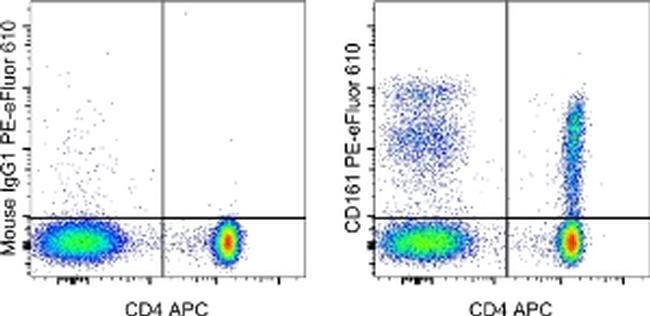
Invitrogen™ CD161 Monoclonal Antibody (HP-3G10), PE-eFluor™ 610, eBioscience™


Description
This HP-3G10 monoclonal antibody reacts with CD161 (also known as NKR-P1A), a member of the C-type lectin superfamily. The human homologue of NK1.1 in C57BL/6 mice, CD161 is expressed on natural killer cells and is upregulated in response to IL-12. CD161 can also be detected on various T cell subsets, including memory/effector CD4+ T cells, CD8+ T cells, gamma delta TCR T cells, and a subset of CD3+ thymocytes. Finally, CD161 expression has been demonstrated on human Th17 CD4+ T cells. The function of this receptor is unclear although studies suggest a possible stimulatory role. Nevertheless, Lectin-like transcript-1 (LLT1), which is also known as osteoclast inhibitory lectin, has been identified as the ligand for CD161. Applications Reported: This HP-3G10 antibody has been reported for use in flow cytometric analysis. Applications Tested: This HP-3G10 antibody has been pre-titrated and tested by flow cytometric analysis of normal human peripheral blood cells. This can be used at 5 μL (0.5 μg) per test. A test is defined as the amount (μg) of antibody that will stain a cell sample in a final volume of 100 μL. Cell number should be determined empirically but can range from 10^5 to 10^8 cells/test. PE-eFluor 610 can be excited with laser lines from 488-561 nm and emits at 607 nm. We recommend using a 610/20 band pass filter (equivalent to PE-Texas Red). Please make sure that your instrument is capable of detecting this fluorochome. Light se...
Spécifications
Spécifications
| Antigène | CD161 |
| Applications | Flow Cytometry |
| Classification | Monoclonal |
| Clone | HP-3G10 |
| Concentration | 5 μL/Test |
| Conjugué | PE-eFluor 610 |
| Formule | PBS with BSA and 0.09% sodium azide; pH 7.2 |
| Gène | Klrb1 |
| Numéro d’acquisition du gène | Q12918 |
| Alias du gène | 4930431A04Rik; Antigen 3.2.3; CD161; CD161 antigen-like family member A; CD161 antigen-like family member B; CD161a; CD161b; CLEC5B; C-type lectin domain family 5 member B; EMBL:AAQ11375.1}; Gm4696; HNKR-P1a; Immunoreceptor NKR-P1E; immunoreceptor NKR-P1G; inhibitory receptor NKR-P1B; killer cell lectin like receptor B1; killer cell lectin-like receptor subfamily A member 1 complex; killer cell lectin-like receptor subfamily B member 1; killer cell lectin-like receptor subfamily B member 1 complex; killer cell lectin-like receptor subfamily B member 1A; killer cell lectin-like receptor subfamily B member 1B; killer cell lectin-like receptor subfamily B member 1B allele A; Killer cell lectin-like receptor subfamily B member 1B allele B; killer cell lectin-like receptor subfamily B member 1B allele C; killer cell lectin-like receptor subfamily B member 1D; killer cell lectin-like receptor subfamily B member 1F; killer cell lectin-like receptor subfamily B member 1G; killer cell lectin-like receptor subfamily B, member 1; killer cell lectin-like receptor subfamily B, member 1A; Klrb1; Klrb1a; Klrb1b; klrb1b {ECO:0000312; Klrb1d; Klrb1f; Klrb1g; Klrb6; lectin-like transmembrane protein Nkrp1g; Ly55; Ly-55; Ly55a; ly-55A; Ly55b; ly-55b; Ly55d; ly-55d; lymphocyte antigen 55; lymphocyte antigen 55 complex, locus A; lymphocyte antigen 55 complex, locus B; lymphocyte antigen 55 complex, locus D; lymphocyte antigen 55A; lymphocyte antigen 55b; lymphocyte antigen 55d; MGC138614; natural killer cell receptor; natural killer cell receptor protein NKR-P1A; natural killer cell receptor protein NKR-P1B; natural killer cell receptor-P1; natural killer cell surface protein NKR-P1B allele B6; Natural killer cell surface protein NKR-P1B allele RNK/SD/BN/F344; natural killer cell surface protein NKR-P1B allele SJL/BALB; natural killer cell surface protein NKR-P1B allele TO; natural killer cell surface protein NKR-P1G; Natural killer cell surface protein P1-2; natural killer cell surface protein P1-3.2.3; Natural killer cell surface protein P1A; natural killer lectin-like receptor 1E; natural killer lectin-like receptor protein 1 e; NKR; NKR-P1; NKR-P1 2; NKR-P1 3.2.3; NKR-P1 34; NKR-P1.7; NKRP12; NKRP1A; NKR-P1A; Nkrp1-a; Nkrp1b; Nkr-p1b; Nkrp1-b; Nkrp1d; NKR-P1D; Nkrp1e; Nkr-p1e; Nkrp-1e; Nkrp1g; NKR-P1G; RGD:2975} |
| Afficher plus de résultats |