missing translation for 'onlineSavingsMsg'
Learn More
Learn More


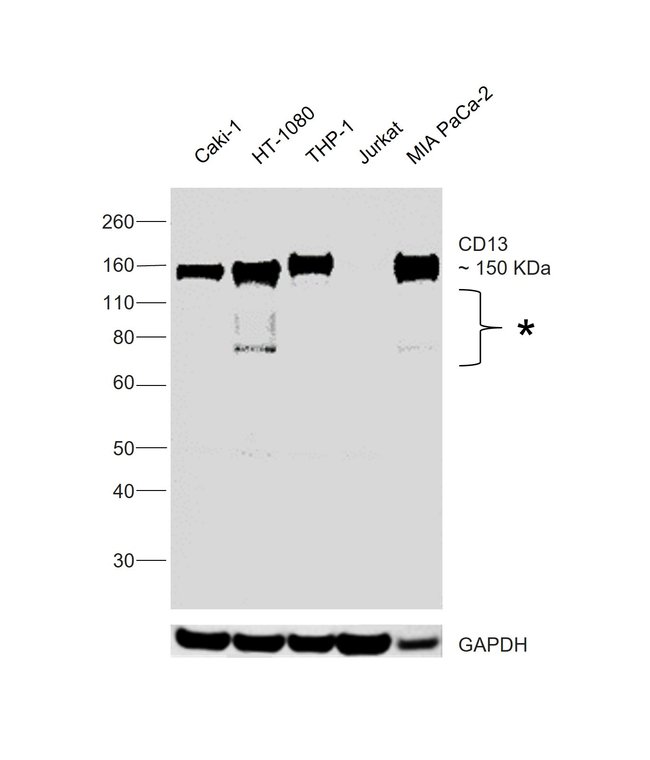

Invitrogen™ CD13 Recombinant Rabbit Monoclonal Antibody (SN71-04)

Description
Recombinant rabbit monoclonal antibodies are produced using in vitro expression systems. The expression systems are developed by cloning in the specific antibody DNA sequences from immunoreactive rabbits. Then, individual clones are screened to select the best candidates for production. The advantages of using recombinant rabbit monoclonal antibodies include: better specificity and sensitivity, lot-to-lot consistency, animal origin-free formulations, and broader immunoreactivity to diverse targets due to larger rabbit immune repertoire.
CD13, also known as ANPEP, is a 150-170 kDa type II transmembrane zinc-binding ectopeptidase expressed on a wide variety of cell types and tissues. It is prominently found on monocytes and granulocytes in the blood, but not on lymphocytes. Additionally, CD13 is expressed on endothelial cells, epithelial cells, fibroblasts, kidney proximal tubules, intestine, placenta, and myeloid leukemia cells. As a metalloprotease, CD13 preferentially catalyzes the removal of neutral amino acids from small peptides, thereby activating or inactivating bioactive peptides. It plays a crucial role in various biological processes, including the degradation of enkephalins and endorphins, terminal degradation of peptides, amino acid scavenging, antigen processing, and the adhesion and migration of cells. CD13 is also involved in extracellular matrix degradation, signal transduction, inflammatory responses, regulation of intercellular contact, cell motility, and vascularization. In the context of disease, CD13 is associated with the protection of leukemic cells against apoptosis and is linked to a poor prognosis in carcinomas. Furthermore, CD13 functions as an aminopeptidase enzyme and serves as an alpha receptor for coronavirus.
Spécifications
Spécifications
| Antigène | CD13 |
| Applications | Immunohistochemistry (Paraffin), Western Blot, Western Blot, Western Blot |
| Classification | Recombinant Monoclonal |
| Clone | SN71-04 |
| Concentration | 1 mg/mL |
| Conjugué | Unconjugated |
| Formule | TBS with 0.05% BSA, 40% Glycerol and 0.05% sodium azide; pH 7.4 |
| Gène | ANPEP |
| Numéro d’acquisition du gène | P15144, P15684, P97449 |
| Alias du gène | alanyl (membrane) aminopeptidase; alanyl (membrane) aminopeptidase (aminopeptidase N, aminopeptidase M, microsomal aminopeptidase, CD13, p150); alanyl aminopeptidase; alanyl aminopeptidase, membrane; aminopeptidase; aminopeptidase Ey; Aminopeptidase M; aminopeptidase N; aminopeptidase N.; aminopeptidase N/CD13; Anpep; APDE; Apm; AP-M; APN; AP-N; bAPN; cAPN; Cd13; cluster of differentiation antigen 13 (CD13); fAPN; gp130; gp150; h AP-N; hAPN; kidney aminopeptidase M; kidney Zn peptidase; KZP; Lap1; Lap-1; leucine arylaminopeptidase 1; LOW QUALITY PROTEIN: aminopeptidase N; membrane alanine aminiopeptidase; membrane alanine aminopeptidase; membrane alanyl aminopeptidase; membrane protein p161; Microsomal aminopeptidase; myeloid plasma membrane glycoprotein CD13; p150; pAPN; PEPN; porcine aminopeptidase N; rAPN; rbAPN; Unknown (protein for MGC:126949) |
| Afficher plus de résultats |