missing translation for 'onlineSavingsMsg'
Learn More
Learn More
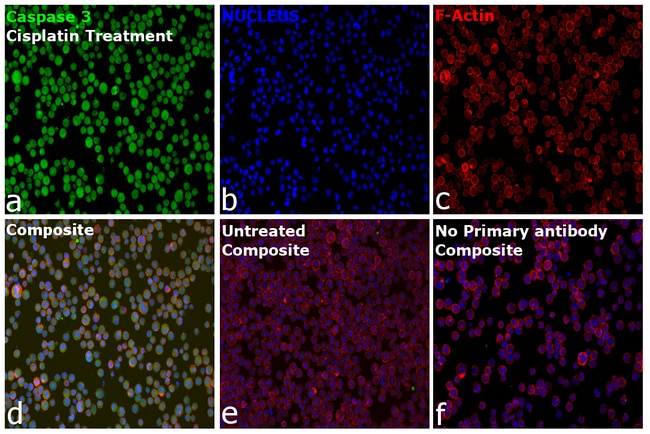
Invitrogen™ Caspase 3 Recombinant Rabbit Monoclonal Antibody (CASP3-TD9)
Description
Recombinant Rabbit monoclonal antibodies are produced using in vitro expression systems. Recombinant antibodies are produced using specific genes that code for the desired antibodies. These genes are cloned into an expression vector and expressed in vitro. The advantages of recombinant antibodies include better specificity and lot-to-lot consistency. It is recommended that the antibody be carefully titrated for optimal performance in the assay of interest.
This gene encodes a protein which is a member of the cysteine-aspartic acid protease (caspase) family. Sequential activation of caspases plays a central role in the execution-phase of cell apoptosis. Caspases exist as inactive proenzymes which undergo proteolytic processing at conserved aspartic residues to produce two subunits, large and small, that dimerize to form the active enzyme. This protein cleaves and activates caspases 6, 7 and 9, and the protein itself is processed by caspases 8, 9 and 10. It is the predominant caspase involved in the cleavage of amyloid-beta 4A precursor protein, which is associated with neuronal death in Alzheimer's disease. Alternative splicing of this gene results in two transcript variants that encode the same protein.
Spécifications
Spécifications
| Antigène | Caspase 3 |
| Applications | Immunocytochemistry |
| Classification | Recombinant Monoclonal |
| Clone | CASP3-TD9 |
| Concentration | 1 mg/mL |
| Conjugué | Unconjugated |
| Formule | PBS with 0.09% sodium azide; pH 7.2-7.4 |
| Gène | CASP3 |
| Numéro d’acquisition du gène | P42574 |
| Alias du gène | A830040C14Rik; AC-3; Apopain; Apopain precursor; Casp3; CASP-3; caspase 3; Caspase 3 apoptosis related cysteine protease (ICE-like cysteine protease); caspase 3, apoptosis related cysteine protease; Caspase 3, apoptosis related cysteine protease (ICE-like cysteine protease); caspase 3, apoptosis-related cysteine peptidase; caspase 3, apoptosis-related cysteine protease; Caspase3; caspase-3; Caspase-3 subunit p12; Caspase-3 subunit p17; Caspase-3-like protein; CC3; Cpp32; CPP-32; CPP32B; CPP32beta; cysteine protease CPP32; cysteine protease; CPP32; apopain; ICE3; IRP; LICE; mldy; PARP cleavage protease; procaspase3; protein Yama; SCA-1; SREBP cleavage activity 1; Yama; yama protein |
| Afficher plus de résultats |