missing translation for 'onlineSavingsMsg'
Learn More

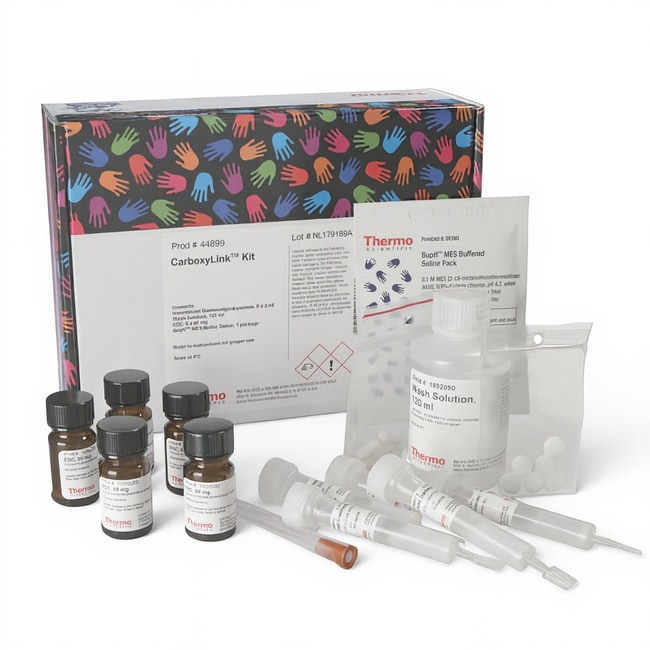
Thermo Scientific™ CarboxyLink™ Immobilization Kit, 2 mL

Catalog No. PI44899
Change view
Click to view available options
Quantity:
5 Column Kit
1 product options available for selection
Product selection table with 1 available options. Use arrow keys to navigate and Enter or Space to select.
Catalog No. Quantity
PI44899 5 Column Kit
Use arrow keys to navigate between rows. Press Enter or Space to select a product option. 1 options available.
1 options
Catalog No. PI44899 Supplier Thermo Scientific™ Supplier No. 44899
Only null left

Covalently immobilize peptide antigens and other carboxylate ligands for affinity purification using DADPA-activated agarose beads and EDC crosslinker.

Thermo Scientific™ CarboxyLink Coupling Resins and Kits provide for the covalent immobilization of peptides or other carboxyl-containing (-COOH) molecules to a porous, beaded resin for use in affinity purification procedures.

These activated resins enable immobilization of carboxylate ligands for use in affinity protocols. CarboxyLink Resin is crosslinked beaded agarose (or acrylamide-based Thermo Scientific UltraLink™ Biosupport) that has been activated with diaminodipropylamine (DADPA) to contain long spacer arms, each of which have a primary amine at the end. When incubated with the resin and the carbodiimide crosslinker EDC (included in the CarboxyLink Immobilization Kit), carboxyl-containing molecules become permanently attached to the support by stable amide bonds. Once a molecule is coupled, the prepared affinity column can be used multiple times in typical protein affinity purification procedures. CarboxyLink Coupling Resins also can be used to immobilize other kinds of molecules using alternative amine-reactive crosslinking chemistries.

Highlights:

  • CarboxyLink Coupling Resins – beaded agarose or acrylamide support activated with diaminodipropylamine (DADPA) for amine-to-carboxyl conjugation using EDC crosslinker

  • Efficient peptide immobilization – easily couple 1 to 2mg of peptide per milliliter of settled resin

  • Stable linkage – immobilization results in covalent attachment of carboxyl groups by amide bonds, allowing for multiple rounds of affinity purification with one batch of prepared resin

  • Flexible and gentle coupling conditions – immobilization reaction completed in simple MES or other non-amine and non-carboxyl, near-neutral buffer, with or without organic solvent

  • Ideal for unmodified peptides – immobilizes peptides with high capacity and various orientations without steric hindrance, allowing for effective use in affinity purification of specific antibodies

  • Convenient kits and product sizes – choose 5-column kits with complete sets of buffers, crosslinker and versatile spin/drip columns containing either type of resin (agarose or polyacrylamide) or choose stand-alone resin for other uses

CarboxyLink Coupling Resin (Part No. 20266, 44899):

  • Ligand: diaminodipropylamine (DADPA)
  • Support: crosslinked 4% beaded agarose
  • Spacer arm: 9 atoms
  • Loading: activated with at least 16μmol amine per milliliter of settled resin
  • Format: 50% resin slurry in 0.05% sodium azide

UltraLink DADPA Resin (Part No. 53154):

  • Ligand: diaminodipropylamine (DADPA)
  • Support: Thermo Scientific UltraLink Biosupport
  • Spacer arm: 14 atoms
  • Loading: activated with at least 40μmol amine per milliliter of settled resin
  • Format: 50% resin slurry in 0.02% sodium azide

Includes:

CarboxyLink Resin Columns (DADPA agarose or UltraLink Support), EDC crosslinker, coupling buffer (MES-buffered saline), wash solution, and column accessories

Specifications

Capacity (Metric) 2 mL
Description CarboxyLink Immobilization Kit, 2mL
Content And Storage Sufficient For: Immobilizing 1 to 2 mg of peptide per column
• CarboxyLink Columns, 2 mL, 5 columns
• EDC Crosslinker, 5 x 60 mg
• MES Buffered Saline Pack (makes 500 mL), 1 pack
• Wash Solution, 120 mL
• Column Accessories

Store EDC desiccated at -20°C. Store other components at 4°C.
Product Line CarboxyLink
Quantity 5 Column Kit
Target Antibody
Type Immobilization Kit
Stationary Phase Amine
Sufficient For 5 Columns
Format Spin Column
Column Type Affinity, Agarose Resin
Show More Show Less
What is the difference between the Thermo Scientific CarboLink (now Glycolink) and CarboxyLink Resins?

The CarboxyLink Resin is for immobilizing carboxyl-containing biomolecules after EDC activation. CarboLink Resin is hydrazide-activated and immobilizes glycoproteins. Carbolink has been replaced with glycolink immobilization kits and resins. Glycolink can also be used to immobilize steroids or other molecules containing ketones. Both resins are capable of coupling ligands via carboxylic acids using EDC (Cat. No. 22980). Both immobilization chemistries are available on UltraLink Resin as UltraLink Hydrazide (glycoproteins) and UltraLink DADPA (carboxyl) Resins.

How many purifications can be performed using the same affinity column with CarboxylLink or DADPA UltraLink resin?

The stability of the immobilized protein and the type of elution buffer used determines how many times a column can be reused. Typically, the columns can be reused at least 10 times without significant loss in purification efficiency.

My peptide is not water-soluble; can I use other solvents for conjugation when using the CarboxylLink or DADPA UltraLink resin?

Yes. When coupling water-insoluble peptides or other molecules, use water-miscible solvents such as ethanol, methanol, DMSO or DMF. Dissolve the peptide in 100% of the water-miscible solvent first and then add this solution to the Conjugation Buffer. Organic solvent concentrations up to 50% in the coupling reaction are compatible. When using high concentrations of organic solvent (> 25%), gradually equilibrate the resin into the organic solvent. For example, wash the resin with 2-3 column volumes of each of the following solutions before adding the sample in 50% organic solvent:

- 95% aqueous, 5% organic solvent
- 85% aqueous, 15% organic solvent
- 75% aqueous,25% organic solvent
- 60% aqueous, 40% organic solvent
- 50% aqueous, 50% organic solvent
Reverse the percent organic solvent and re-equilibrate the resin in 100% aqueous if purifying a sample in aqueous buffer.

How do I determine the degree of antibody coupling to the CarboxylLink or DADPA UltraLink resin?

Protein samples can be quantified using Thermo Scientific BCA Protein Assay (Cat. No. 23225) or Coomassie Plus (Bradford) Protein Assay (Cat. No. 23236). Alternatively, coupling can be estimated by measuring the protein concentration in solution before and after coupling. The difference in the two measurements is the amount coupled to the resin. Make sure to factor in any change in sample volume.

Are the CarboxylLink and DADPA UltraLink Resins available as kits?

CarboxyLink Coupling Resin is available as a kit (Cat. No. 44899), which contains sufficient components to prepare five reusable affinity columns. The resin is also available separately (Cat. No. 20266, 25 mL). DADPA UltraLink is available only as a kit (Cat. No. 53154). The kits do not contain buffers for affinity purification.

What is the difference between CarboxyLink and DADPA UltraLink Resins?

The CarboxyLink Resin is composed of 6% crosslinked beaded agarose. The DADPA UltraLink Resin is composed of an azlactone and acrylamide polymer, which is more durable than agarose and can withstand pressures up to 100 psi, making it suitable for medium-pressure, fast-flow techniques involving large sample volumes.

How do CarboxyLink and DADPA UltraLink Resins immobilize molecules?

These resins are derivatized with diaminodipropylamine (DADPA). DADPA has a terminal primary amine that enables covalent immobilization of peptides or other carboxyl-containing (-COOH) molecules. When incubated with the resin and the carbodiimide crosslinker EDC (included in the CarboxyLink Immobilization Kit), carboxyl-containing molecules become permanently attached to the resin by stable amide bonds. The immobilized molecules can then be used in affinity purification procedures. CarboxyLink/DADPA UltraLink Coupling Resins can also be used to immobilize other kinds of molecules using alternative amine-reactive crosslinking chemistries.

How many columns does the CarboxyLink Immobilization Kit (Cat. No. 44899) contain?

The CarboxyLink Immobilization Kit (Cat. No. 44899) contains 5 columns of 2 mL each.


For Research Use Only. Not for use in diagnostic procedures.