missing translation for 'onlineSavingsMsg'
Learn More
Learn More
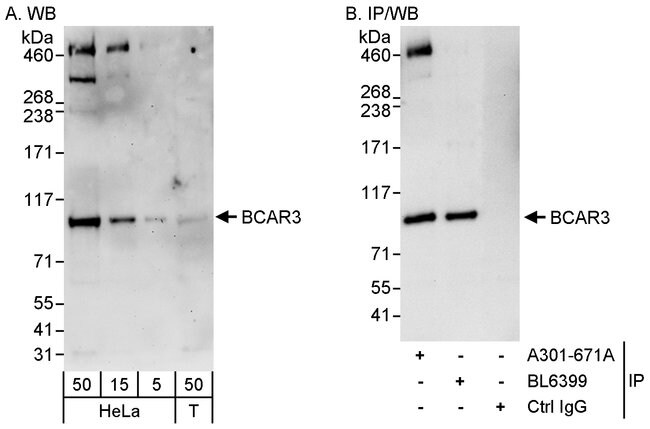
BCAR3 Rabbit anti-Human, Polyclonal, Bethyl Laboratories

Description
The recommended shelf life for this product is 1 year from date of receipt.
Breast tumors are initially dependent on estrogens for growth and progression and can be inhibited by anti-estrogens such as tamoxifen. However, breast cancers progress to become anti-estrogen resistant. Breast cancer anti-estrogen resistance gene 3 was identified in the search for genes involved in the development of estrogen resistance. The gene encodes a component of intracellular signal transduction that causes estrogen-independent proliferation in human breast cancer cells. The protein contains a putative src homology 2 (SH2) domain, a hall mark of cellular tyrosine kinase signaling molecules, and is partly homologous to the cell division cycle protein CDC48.
Spécifications
Spécifications
| Antigène | BCAR3 |
| Applications | Immunoprecipitation, Western Blot |
| Classification | Polyclonal |
| Concentration | 0.2 mg/ml |
| Conjugué | Unconjugated |
| Formule | TBS with 0.1% BSA and 0.09% sodium azide |
| Gène | BCAR3 |
| Numéro d’acquisition du gène | O75815 |
| Alias du gène | BCAR3; NSP2; SH2D3B; breast cancer anti-estrogen resistance 3; KIAA0554; OTTHUMP00000011961; breast cancer antiestrogen resistance 3; dJ1033H22.2 (breast cancer anti-estrogen resistance 3) |
| Symboles de gène | BCAR3 |
| Afficher plus de résultats |