missing translation for 'onlineSavingsMsg'
Learn More
Learn More
Invitrogen™ ADORA1 Polyclonal Antibody

Description
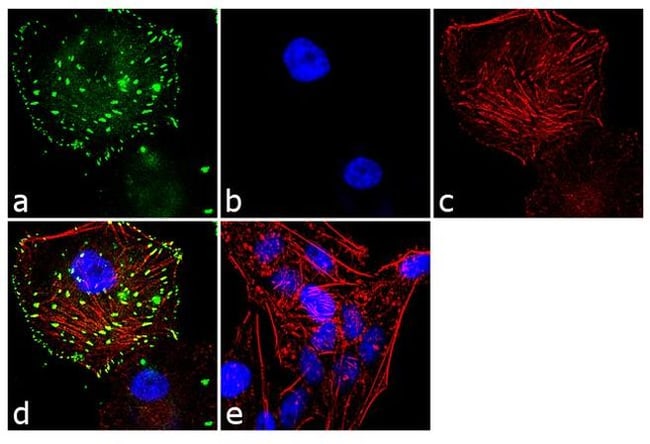
PA3-041 detects Adenosine Receptor A1 from human and mouse samples. Reactivity is stronger in mouse, and is only recommended for use in overexpressed or recombinant human samples. PA3-041 has been successfully used in Western blot applications. By Western blot PA3-041 detects a ~34-37 kDa band representing Adenosine Receptor A1 from mouse brain. The PA3-041 immunogen is a mix of synthetic peptides corresponding to the C-terminal portion of human and mouse Adenosine Receptor A1 residues. The immunizing sequences are: C(309) Q P A P P I D E D L P E E R P D D(326) for human, and C(309) Q P K P P I E E D I P E E K A D D(326) for mouse.
Adenosine receptors (ARs) are members of the 7-transmembrane domain G-protein-coupled receptor superfamily. Structural, biochemical and pharmacological analyses of the AR genes and protein has led to the discovery of four distinct AR subtypes (A1, A2a, A2b, A3). Activation of ARs mediates several receptor subtype-specific physiological processes that include cardiac rate, smooth muscle tone, platelet aggregation, inflammation, cell growth and death, and neurotransmission. The A1AR is a glycoprotein that can activate Gi and Go proteins in vitro. In intact cells, agonist occupation of the A1AR has been shown to cause pertussis toxin-sensitive inhibition of adenylyl cyclase activity and, in some systems, a stimulation of phospholipase C resulting in mobilization of intracellular calcium stores. Activation of potassium channels by A1AR has been intensively studied in relation to its dramatic effects on the cardiovascular system. A1AR protein is highly expressed in brain (especially cerebellum, hippocampus, thalamus, and cortex) and spinal cord and in part, modulates neurotransmitter release. In white adipocytes A1AR inhibits lipolysis and stimulates glucose uptake. Other tissues also express A1AR including kidney and testis.
Spécifications
Spécifications
| Antigène | ADORA1 |
| Applications | Western Blot, Immunocytochemistry |
| Classification | Polyclonal |
| Concentration | Conc. Not Determined |
| Conjugué | Unconjugated |
| Formule | Whole serum with 0.05% sodium azide |
| Gène | ADORA1 |
| Numéro d’acquisition du gène | P30542, Q60612 |
| Alias du gène | A1AR; A1-AR; A1R; AA1R; adenosine A1 receptor; adenosine A1 receptor variant 1; adenosine A1 receptor variant 2; adenosine receptor A1; ADO-A1 receptor; ADORA1; AI848715; AR; BB176431; RDC7; Ri |
| Symboles de gène | ADORA1 |
| Afficher plus de résultats |