Learn More
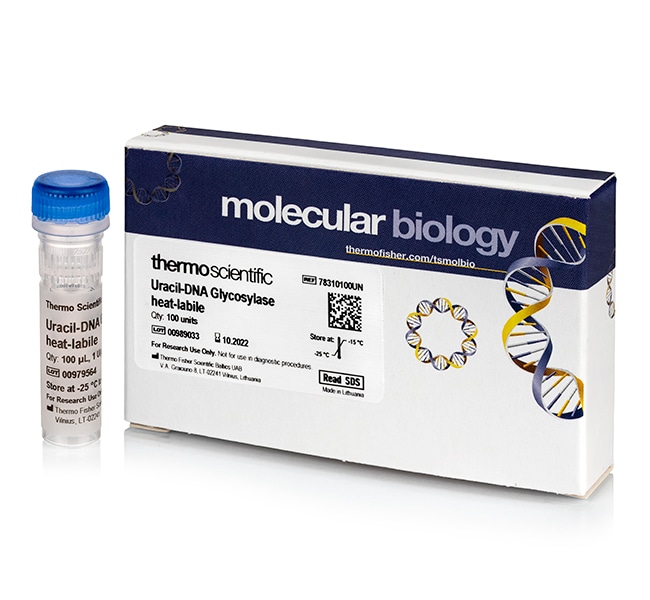
Thermo Scientific™ Uracil-DNA Glycosylase, heat-labile
Description
Uracil-DNA Glycosylase excises uracil from dU-containing DNA by cleaving the N-glycosidic bond between the uracil base and the sugar backbone. This cleavage generates alkali sensitive apyrimidinic sites that are blocked from replication by DNA polymerase or prevented from becoming a hybridization site.
Double and single-stranded dU-containing DNA are substrates for Uracil-DNA Glycosylase whereas RNA and normal dT-containing DNA are not.
Uracil-DNA Glycosylase can also be used to increase the cloning efficiency of PCR products having dU-containing primers incorporated into them as well as increasing the efficiency of site-directed mutagenesis.
The Uracil-DNA Glycosylase derived from Gadus morhua has all the attributes of the enzyme derived from E. coli with the added benefit of being heat-labile. It is completely and irreversibly inactivated after 10 minute incubation at 50°C.
Purity:
The enzyme is chromatographically purified and tested for contaminating endonucleases and exonucleases.
Storage Buffer:
20 mM Tris-HCl pH 7.5 (25°C), 50 mM NaCl, 0.4% non-ionic surfactant, 7 mM DTT, 0.1 mM EDTA, 50% Glycerol.
Assay Conditions:
The reaction mixture contains 70 mM Tris-HCl, pH 8.0, 10 mM NaCl, 1 mM EDTA, 100 μg/mL BSA, 3H-dUTP labeled DNA, and Uracil-DNA Glycosylase. Incubation is at 37°C for 1 hour.
Unit Definition:
One unit is the amount of enzyme required to liberate 1 nmol uracil from dU-containing DNA in one hour at 37°C.
Concentration:
1 unit/μL
Applications:
- Study of DNA repair and mutation detection.
- Increase cloning efficiency of PCR products.
- Increase the efficiency of site-directed mutagenesis.
- Study of protein-DNA interactions.
Source:
Recombinant from Gadus morhua (cod liver)
Specifications
Specifications
| Content And Storage | Shipped on dry ice. Store at -20°C. |
| Enzyme | Glycosylase |
| Compatible Buffer | Storage Buffer |
| Quantity | 100 U |
| Product Type | Uracil DNA Glycosylase |
Frequently Asked Questions (FAQs)
UDG (uracil-DNA-glycosylase) refers to a superfamily of enzymes comprising six sub-families. Family I UDG enzymes are called UNG, after the uracil-N-glycosylase gene. The terms UDG and UNG are commonly used interchangeably because they perform the same function in qPCR, namely, to remove Uracil from dU-containing DNA to prevent carryover contamination from previous PCRs. See the following link: https://www.thermofisher.com/uk/en/home/life-science/pcr/real-time-pcr/real-time-pcr-learning-center/real-time-pcr-basics/what-is-ung-udg.html
We recommend sequencing up to 5 DNA or RNA samples (4 samples and a non-template control (NTC)) on a single Ion 550 Chip.
The Oncomine Comprehensive Assay Plus, manual library preparation (Cat. No. A46721) is designed to prepare barcoded sample libraries from DNA and RNA. The kit consists of Oncomine Comprehensive Assay Plus DNA (2-pool) (Part No. A45615), RNA Oncomine Comprehensive Assay v3M (2-pool) (Part No. A33637), and two kits of Ion AmpliSeq Library Kit Plus (Cat. No. 4488990). Sufficient reagents are provided to prepare libraries from 24 samples.
10 ng of nucleic acid input per pool (20 ng of DNA and 20 ng of RNA) isolated from FFPE samples, including fine needle biopsies, is needed for the Oncomine Comprehensive Assay Plus, manual library preparation.
The assay is optimized for use with formalin-fixed paraffin embedded (FFPE) samples.
For Research Use Only. Not for use in diagnostic procedures.