Learn More
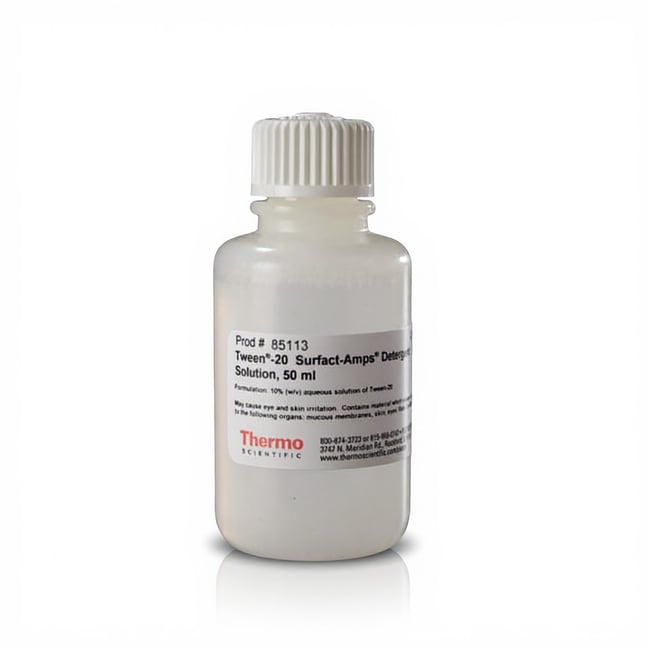


Thermo Scientific™ Tween™ 20 Surfact-Amps™ Detergent Solution
Description
Thermo Scientific™ Surfact-Amps 20 Detergent Solution is highly-purified Tween-20 detergent stabilized and supplied as a 10% solution in 10mL glass ampules.
Thermo Scientific™ Tween-20 Detergent Surfact-Amps Solution is highly-purified Tween-20 detergent stabilized and supplied as a 10% solution in 10mL glass ampules.
This is an easy-to-use 10% (w/v) solution of purified Tween-20 detergent for use in routine and high-demand protein research methods and molecular biology techniques. Tween-20 is a nonionic polyoxyethylene surfactant that is most frequently added to PBS or TBS wash buffers for ELISA, Western blotting and other immunoassay methods.
Surfact-Amps™ Detergent Solutions (10% w/v) provide unsurpassed purity, quality and stability. Unlike neat detergents, which are extremely viscous, Surfact-Amps 10% Solutions are easy to pipette and accurately dispense. The surfactant solutions are carefully prepared and packaged under nitrogen in glass ampules, ensuring their stability and eliminating the accumulation of peroxides and degradation products.
Highlights:
Tween 20 – a popular nonionic detergent for use in immunoassay wash buffers
Accurate – precise 10% detergent solution in ultrapure water
Easy-to-use – solution is simple to dispense and dilute for use
Exceptionally pure – less than 1.0μeq/ml peroxides and carbonyls
Stable – packed in glass ampules under inert nitrogen gas
Detergent Properties:
- Molecular Weight: 1228
- Detergent Class: Nonionic
- Aggregation Number: Unknown
- Micelle Molecular Weight: Unknown
- Critical Micelle Concentration (CMC): 0.06mM (0.0074%, w/v)
- Cloud Point: 95°C
- Dialyzable: No
Specifications
Specifications
| Product Type | Detergent |
| Content And Storage | Store in a cool, dry, and well-ventilated area |
| Form | Liquid |
| Product Line | Surfact-Amps, Tween |
| Reagent Type | Detergent Solution |
| Quantity | 50 mL |
Frequently Asked Questions (FAQs)
Tween-20 Surfact-Amps Detergent Solution is a highly-purified Tween 20 detergent stabilized as a 10% solution and packaged under nitrogen in glass ampules or non-leaching HDPE bottles, ensuring its stability and eliminating the accumulation of peroxides and degradation products.
The detergent is screened for:
- Visualization: clear, light yellow liquid, free of particulates
- Concentration: 10.0 +/- 1.0%
- Oxidant concentration: less than or equal to 1.0 µeq/mL
- Carbonyl concentration: less than or equal to 1.0 µeq/mL
- suspended solids: residue present must not exceed Residue Reference
See the COA for further details.
Thermo Scientific Pierce Surfact-Amps detergents are highly purified, precisely diluted (10%) formulations that are ideal for applications or assays that are sensitive to contaminants that are present in unpurified detergents. We test every batch to insure that our detergents contain less than 1.0 µeq/mL peroxides and carbonyls and package them under nitrogen, to prevent oxidization during storage.
Superior quality - lower measurable contaminant levels than other leading vendors
Accurate -precise 10% detergent solution in ultrapure water
Easy-to-use - solution is simple to dispense and dilute for use
Exceptionally pure - less than 1.0 µeq/mL peroxides and carbonyls
Ionic detergents, or those that carry a charge, are the most likely to be denaturing to proteins. Denaturing detergents can be anionic such as sodium dodecyl sulfate (SDS) or cationic such as ethyl trimethyl ammonium bromide. These detergents totally disrupt membranes and denature proteins by breaking protein-protein interactions through changes in the three-dimensional structure of the proteins. Nondenaturing detergents can be divided into nonionic detergents (i.e., Triton X-100), bile salts (i.e., cholate), and zwitterionic detergents (i.e., CHAPS).
Detergents are amphipathic molecules containing both a nonpolar “tail” having aliphatic or aromatic character, and a polar “head”. The ionic character of the polar head group forms the basis for broad classification of detergents as ionic, nonionic, or zwitterionic.
For Research Use Only. Not for use in diagnostic procedures.