missing translation for 'onlineSavingsMsg'
Learn More

Thermo Scientific™ SulfoLink™ Immobilization Kit for Peptides, 2 mL

Catalog No. PI44999
Change view
Click to view available options
Quantity:
5 Column Kit
1 product options available for selection
Product selection table with 1 available options. Use arrow keys to navigate and Enter or Space to select.
Catalog No. Quantity
PI44999 5 Column Kit
Use arrow keys to navigate between rows. Press Enter or Space to select a product option. 1 options available.
1 options
Catalog No. PI44999 Supplier Thermo Scientific™ Supplier No. LSG44999
Only null left

Covalently immobilize cysteine-peptides or proteins (sulfhydryl-ligands) for affinity purification using iodoacetyl-activated agarose beads and columns.

Thermo Scientific™ SulfoLink Coupling Resin is iodoacetyl-activated for the covalent immobilization of sulfhydryl-containing peptides or proteins for affinity purification.

SulfoLink Coupling Resin is porous, crosslinked 6% beaded agarose that has been activated with iodoacetyl groups. When incubated with a solution of peptide or protein that contains reduced cysteine residues, the iodoacetyl groups react specifically and efficiently with the exposed sulfhydryls (-SH) to form covalent and irreversible thioether bonds that permanently attach the peptide or protein to the resin. The result is a custom-made affinity resin for purification of antibodies, antigens and other molecules of interest.

Complete SulfoLink Immobilization Kits are available for peptides and proteins. Each kit contains all the reagents for preparing the respective peptide or protein sample and five columns containing 2mL of SulfoLink Resin that can be used in either gravity-flow or centrifuge format for efficient coupling reactions and multiple cycles of affinity purification. A single-column Trial Kit for use with either peptides or proteins is also available, or the SulfoLink Coupling Resin can be purchased separately.

Highlights:

  • Specific conjugation through sulfhydryl (-SH) groups – the iodoacetyl groups react specifically with sulhydryls to form irreversible thioether bonds

  • Separate kits optimized for peptides or proteins – kits include optimized reagents for preparing peptide or protein samples for efficient immobilization

  • Fast – spin columns increase protocol speed; prepare and couple samples in 2 hours (peptides) to 3.5 hours (proteins)

  • Flexible coupling conditions – use pH 7.5 to 9.0 aqueous buffers, organic solvent (e.g., 20% DMSO) or denaturant (guanidine·HCl), as needed for protein or peptide solubility during coupling reaction

  • Easy-to-follow instructions – streamlined protocols for sample preparation, immobilization and affinity purification

  • High capacity – immobilize 1 to 2mg peptide or 2 to 20mg protein per 2mL column of SulfoLink Coupling Resin

Includes:

Kits contain SulfoLink Resin Columns (2mL), protein or peptide preparation reagents (e.g., reducing agent), coupling buffer, wash solution, L-cysteine solution (for quenching) and desalting columns (protein kit only)

Recommended for:

Immobilize peptides having terminal cysteine residues to purify antibodies that were generated against peptide immunogens prepared by maleimide conjugation; Immobilize antibodies in oriented manner through hinge-region sulfhydryls to ensure that antigen binding sites are not sterically hindered for antigen affinity purification

Specifications

Capacity (Metric) 2 mL
Content And Storage Sufficient For: Immobilizing 0.1 to 1 mg of sulfhydryl-peptide per column
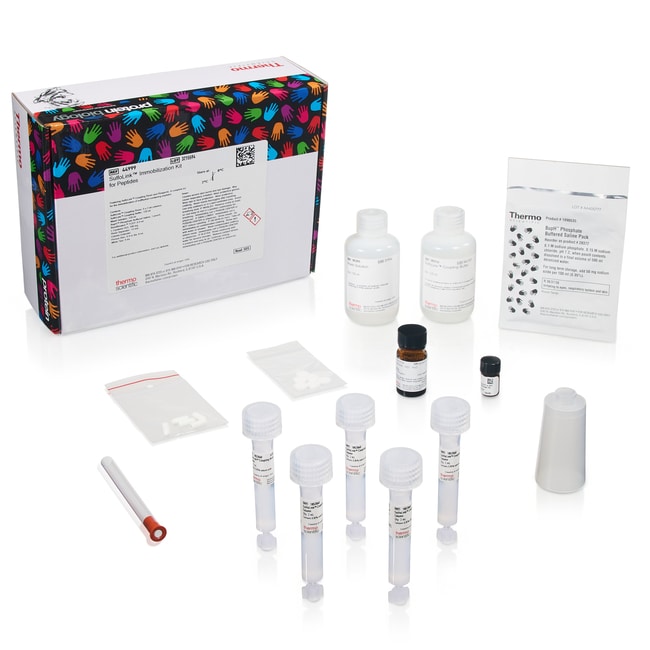
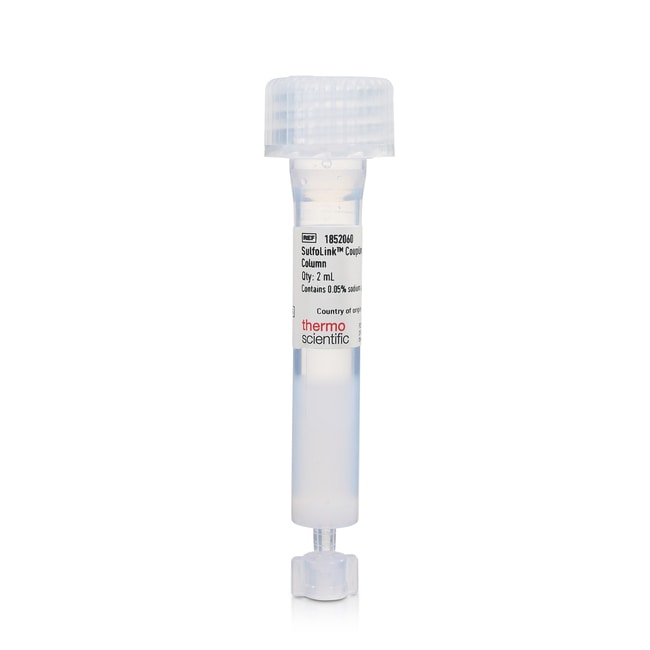
• SulfoLink Columns, 2 mL, 5 columns
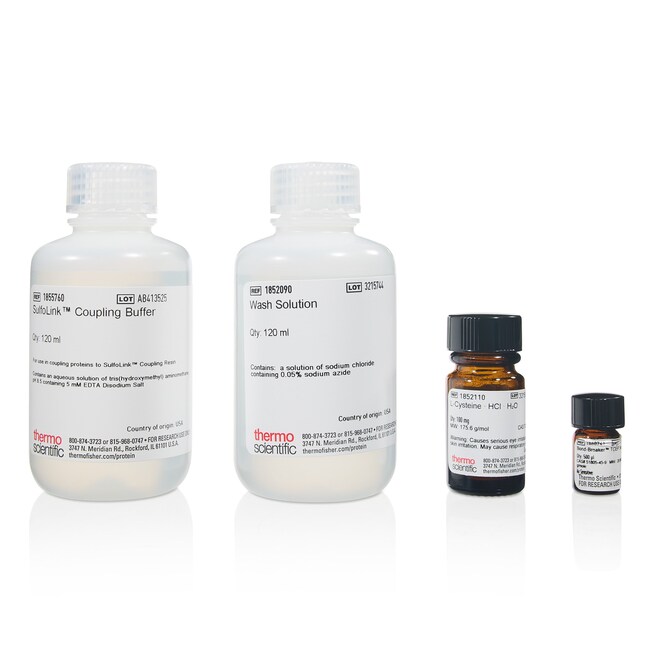
• SulfoLink Coupling Buffer, 120 mL
• Wash Solution, 120 mL
• PBS Pack (makes 500 mL), 1 pack
• Bond-Breaker TCEP Solution, Neutral pH, 0.5 mL
• L-Cysteine·HCl, 100 mg
• Column Accessories

Store at 4°C protected from light.
Product Line SulfoLink
Quantity 5 Column Kit
Type Immobilization Kit
Stationary Phase Haloacetyl
Sufficient For 1 to 2 mg of Sulfhydryl-Peptide per Column
Format Spin Column
Column Type Affinity, Agarose Resin
What is the binding capacity of SulfoLink Resin?

SulfoLink Resin can bind approximately 5 mg of reduced IgG per mL of support. For peptides, the capacity is approximately 1 mg of peptide per mL of gel. Capacity for other compounds will vary.

When using the SulfoLink Coupling Resins and Kits, my peptide is not soluble in the coupling buffer. What can I do?

SulfoLink Immobilization is compatible with 3-4 M fresh urea or guanidine. Alternatively, dissolve the peptide in 100% DMSO. Add the peptide in DMSO to the coupling buffer so that the DMSO does not exceed 20% of the final solution.

Must I block the resin before each use when using the SulfoLink Coupling Resins and Kits?

No. The resin will no longer react with subsequent sulfhydryls after the ligand is attached and the remaining active sites are blocked.

How many purifications can I perform using the same SulfoLink Column?

The columns can be reused at least 10 times without loss of activity.

How does SulfoLink Immobilization work?

SulfoLink Resin is crosslinked 6% beaded agarose that has been derivatized with a 12-atom spacer arm that ends in an iodoacetyl group. This spacer arm is helpful for peptides or large proteins that might otherwise be sterically hindered in binding their ligand. The iodoacetyl group reacts with free sulfhydryls at pH 7.5-8.5 to form covalent thioether bonds. The sulfhydryl must be present in the reduced form because disulfides will not react with the iodoacetyl group.

How do I reduce my sample and confirm the reduction when using the SulfoLink Coupling Resins and Kits?

The kit includes the reductant beta-Mercaptoethylamine (beta-MEA, Cat. No. 20408); however, the following reductants can also be used: dithiothreitol (DTT), Cat. No. 20290; ß-MEA Cat. No. 35600 and 35601; and TCEP-HCl Cat. No. 20490. You can also use Ellman's Reagent (Cat. No. 22582) to confirm the presence of sulfhydryls. Ellman's Reagent reacts with reduced sulfhydryls to produce a distinctive yellow color that is readable at 412 nm. After it is reduced, desalt the sample directly into an appropriate buffer and allow it to react with the column. This will prevent disulfide formation from reforming.

How do I perform affinity purifications with conjugated SulfoLink Affinity Columns?

Equilibrate the column with 3-5 bed-volumes of an appropriate binding buffer. Add 1 mL of sample for each 2 mL column (serum should be diluted at least 1:1 with binding buffer). Add an additional 200 µl of binding buffer to ensure that the entire sample has entered the gel bed. Cap the column bottom and top. Incubate the column for 1 hour. Wash away non-bound proteins with 5-7 bed-volumes of binding buffer or 1 M NaCl. Elute the bound sample by adding small fractions (0.5-1.0 ml) of elution buffer such as Thermo Scientific IgG Elution Buffer (Cat. No. 21004).

In the Peptide Immobilization manual, it states "If peptide is oxidized, perform the TCEP reduction" when using the SulfoLink immobilization kit for peptides. What is the TCEP reduction step? Can I apply the peptide solution containing TCEP to the column?

The cysteine sulfhydryl is very labile when exposed to air or in solution, and it can easily oxidize with another sulfhydryl. This typically happens between sulfhydryls from two molecules, but it can sometimes occur if there are at least two cysteines present on the same peptide or protein. This oxidation forms a disulfide bond and changes the two cysteines into cystine.

TCEP is one of three commonly used reducing agents that can break a disulfide bond. The other common reducing agents are beta-mercaptoethanol (β-ME or 2-ME) and dithiothreitol (DTT).

In step A-3 of the manual, one would carry out the TCEP reduction by adding 0.1 mL TCEP to the solution prepared in step A-1 and let incubate for 30 minutes. After the SulfoLink Resin is prepared in steps B-1 to B-3, one would add the sulfhydryl-containing molecule (result of step A-3) to the SulfoLink Resin.


For Research Use Only. Not for use in diagnostic procedures.