Learn More
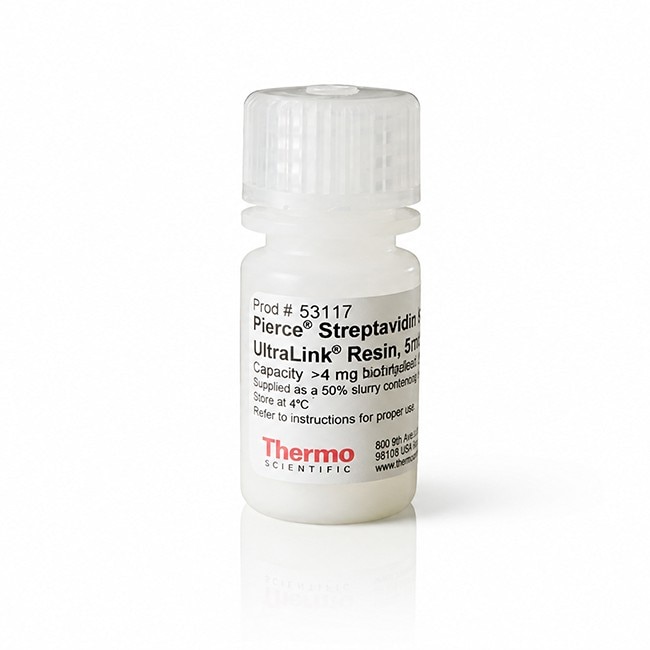


Thermo Scientific™ Pierce™ Streptavidin Plus UltraLink™ Resin
Description
Thermo Scientific™ Pierce Streptavidin Resins comprise a wide selection of high-quality affinity beads and columns for nearly any kind of biotin-based purification procedure.
Additional Information and Online Ordering
Highlights:
Proven coupling chemistries – the methods used to prepare these resins are superior to typical cyanogen bromide (CNBr) immobilization, providing high functionality, low nonspecific binding and excellent leach-resistance
Versatile resins – Agarose (polysaccharide-based) and UltraLink™ Biosupport (acrylamide-based) resins provide two different options for particular experimental conditions and are compatible with gravity-flow, spin and FPLC methods
Available in multiple formats – choose from two resin types, regular or high capacity preparations, and small or large-scale package sizes (bulk sizes are also available)
Superior performance – High Capacity Resin has 2 to 3 times higher binding capacity than alternative supplier products, allowing use of small amounts of resin for experiments
Item-Specific Features:
- Agarose Resins are crosslinked 6% beaded agarose
- UltraLink Resins beaded acrylamide support (UltraLink Biosupport)
- Plus and High Capacity Resins have higher loading (i.e. density) of immobilized streptavidin protein than the regular forms
Recommended for:
Purification of membrane antigens in conjunction with biotinylated monoclonal antibodies; Cell-surface labeling with biotinylation reagents, followed by precipitation with immobilized streptavidin; Purification of cell-surface glycoproteins using biotinylated Concanavalin A; Recovery of single-stranded DNA for dideoxy sequencing
Specifications
Specifications
| Capacity (Metric) | 10 mg Biotinylated BSA Binding per mL Resin |
| Content And Storage | Upon receipt store at 4°C. Product is shipped at ambient temperature. |
| Particle Size | 45 to 165 μm |
| Product Line | Pierce, UltraLink |
| Quantity | 5 mL |
| Protein Form | Recombinant |
| Target | Biotin-Tagged Molecule |
| Type | Resin |
| Stationary Phase | Streptavidin |
| Sufficient For | Binding ≥/= 48 μg Biotin/mL Resin (≥/= 4 mg Biotinylated BSA/mL Resin) |
| Show More |
Frequently Asked Questions (FAQs)
UltraLink Immobilized Streptavidin Plus Support should be used when you are planning to perform anything other than gravity filtration with a column. Streptavidin Plus UltraLink Resin is often preferred for immunoprecipitation because the white appearance of the support allows the pellet to be visualized more easily than the translucent pellet of agarose supports.
The biotin-binding capacity is >3 mg biotinylated BSA/ml of resin, or >120 nMoles biotin/mL of resin which is equilvalent to approximately 30 µg of biotin or 30 units of biotin/ml.
The binding affinity of streptavidin is similar to that of avidin, which is Ka = 10^15/M.
UltraLink Biosupport Medium is stronger than agarose, being capable of withstanding 100 p.s.i. The support starts with an azlactone ring that opens upon immobilization of a ligand to form a five-molecule spacer arm.
Steric hindrance can interfere with the binding. As with avidin, the double ring structure of biotin must fit 9 angstroms into the streptavidin molecule for binding to occur. Competitive inhibition by endogenous biotin may also interfere with binding of your biotinylated ligand.
For Research Use Only. Not for use in diagnostic procedures.