Learn More
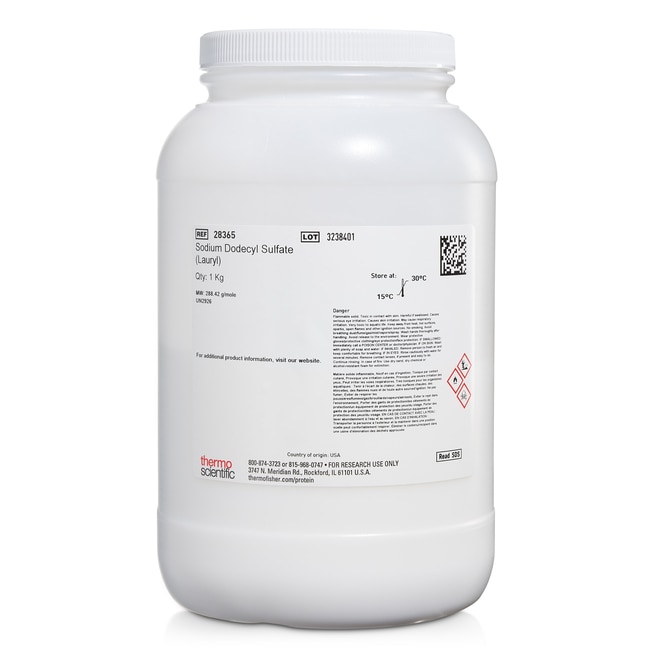
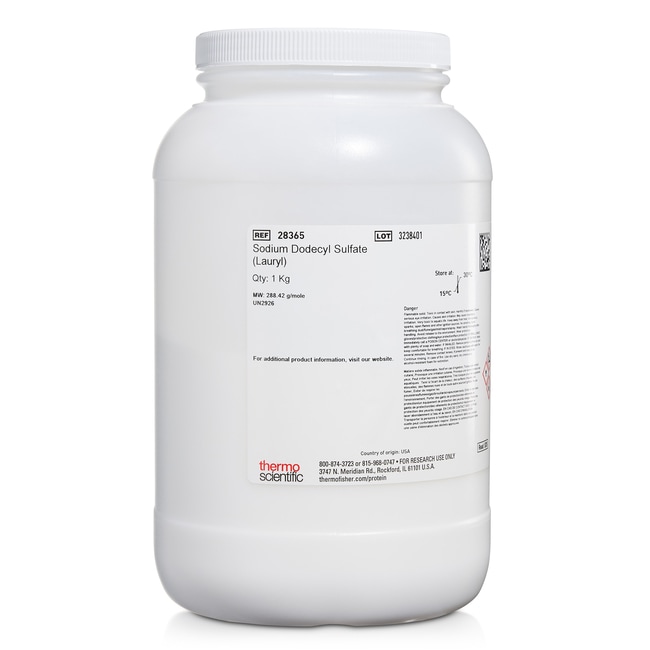

Thermo Scientific™ Sodium Dodecyl Sulfate (SDS), Lauryl
Description
Thermo Scientific Sodium Dodecyl Sulfate (Lauryl) is standard-grade SDS detergent for use in protein polyacrylamide gel electrophoresis (PAGE).
Features of Sodium Dodecyl Sulfate (Lauryl):
- Popular anionic detergent for a variety of protein methods
- Especially useful for denaturing polyacrylamide gel electrophoresis (SDS-PAGE)
- Common component of cell lysis buffers
This lauryl-grade sodium dodecyl sulfate (SDS) is a popular anionic detergent for routine protein electrophoresis and cell lysis methods. The formulation is a mixture of several different alkyl sulfate chain lengths (C10 to C18).
Properties of SDS (values for pure C12):
- Molecular Weight: 288.5 g
- Detergent Class: Ionic (anionic)
- Aggregation Number: 62
- Micelle Molecular Weight: 18,000 g
- Critical Micelle Concentration (CMC): 6 to 8 mM (0.1728 to 0.2304%, w/v)
- Cloud Point: >100°C
- Dialyzable: No
Specifications for Sodium Dodecyl Sulfate:
- Visual: White powder, free of foreign material.
- Solubility: 10% (aq, w/v) solution must be clear, colorless to slightly yellow.
- Chain length: C12 >60%; C14 = 20 to 35%; C16 <10%; C10 and C18 <1% each
Related Products
- Sodium Dodecyl Sulfate (SDS), C12 (Cat. No. 28312)
- Sodium Dodecyl Sulfate (SDS), 20% Solution (Cat. No. 62202)
Specifications
Specifications
| Color | White |
| Product Type | Detergent |
| Solubility | 10% (aq, w/v) solution must be clear, colorless to slightly yellow |
| Content And Storage | Store in original container protected from direct sunlight in a dry, cool and well-ventilated area, between the following temperatures: 20°C to 25°C. |
| Form | Powder |
| Reagent Type | Detergent (Pure) |
| Quantity | 1 kg |
Frequently Asked Questions (FAQs)
SDS in a 4X sample buffer concentrate tends to precipitate from solution and to make the solution viscous and difficult to pipette. The LDS is much more soluble.
Ionic detergents, or those that carry a charge, are the most likely to be denaturing to proteins. Denaturing detergents can be anionic such as sodium dodecyl sulfate (SDS) or cationic such as ethyl trimethyl ammonium bromide. These detergents totally disrupt membranes and denature proteins by breaking protein-protein interactions through changes in the three-dimensional structure of the proteins. Nondenaturing detergents can be divided into nonionic detergents (i.e., Triton X-100), bile salts (i.e., cholate), and zwitterionic detergents (i.e., CHAPS).
Detergents are amphipathic molecules containing both a nonpolar “tail” having aliphatic or aromatic character, and a polar “head”. The ionic character of the polar head group forms the basis for broad classification of detergents as ionic, nonionic, or zwitterionic.
Detergents are amphipathic molecules, meaning they contain both a nonpolar “tail” having aliphatic or aromatic character and a polar “head”. Like the components of biological membranes, detergents have hydrophobic-associating properties as a result of their nonpolar tail groups. Nevertheless, detergents are themselves water soluble.
Consequently, detergent molecules allow the dispersion (miscibility) of water-insoluble, hydrophobic compounds into aqueous media, including the extraction and solubilization of membrane proteins. Detergent monomers solubilize membrane proteins by partitioning into the membrane bilayer. With increasing amounts of detergents, membranes undergo various stages of solubilization.
Detergents can be denaturing or non-denaturing with respect to protein structure. Denaturing detergents can be anionic such as sodium dodecyl sulfate (SDS) or cationic such as ethyl trimethyl ammonium bromide. These detergents totally disrupt membranes and denature proteins by breaking proteinprotein interaction. These detergents are considered harsh. Non-denaturing detergents can be divided into nonionic detergents (i.e., Triton X-100), bile salts (i.e., cholate), and zwitterionic detergents (i.e., CHAPS). These detergents do not denature proteins and do not break protein-protein interactions. These detergents are considered mild.
For Research Use Only. Not for use in diagnostic procedures.